
This article was written exclusively for The Film Magazine by Scott Z. Walkinshaw.
Coming 2 America (2021)
Director: Craig Brewer
Screenwriters: Kenya Barris, Barry W. Blaustein, David Sheffield
Starring: Eddie Murphy, Arsenio Hall, Wesley Snipes, Jermaine Fowler, Shari Headley, KiKi Layne, Leslie Jones, Tracy Morgan, James Earl Jones
Coming to America (1988) arrived as a fresh, joyful comedy directed by John Landis, driven by the electric chemistry between Eddie Murphy and Arsenio Hall. It was a box-office hit and notable for its predominantly Black cast at a time when that representation was less common in mainstream Hollywood. More than three decades later, Coming 2 America aims to revisit that same charm and nostalgia, but the sequel struggles to capture the original’s spark.
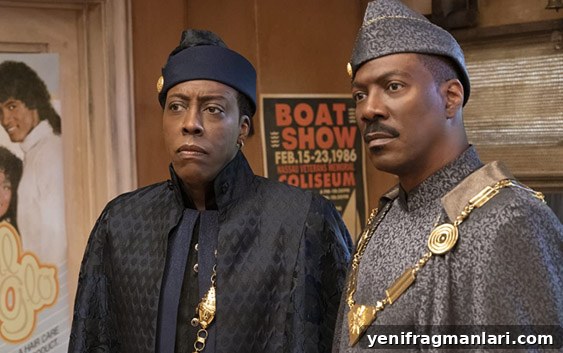
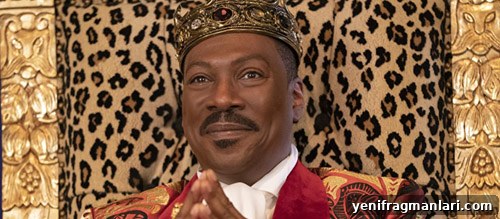
The film returns to Prince Akeem (Eddie Murphy) and his loyal friend-turned-aide Semmi (Arsenio Hall). Since Akeem’s first visit to the United States, Zamunda has modernized: ceremony and tradition have been updated with pop culture touches, grand pageantry is intercut with musical cameos, and the practical backdrops of the original have given way to glossy digital production design. Akeem and Queen Lisa (Shari Headley) now have three daughters. Their eldest, Meeka (KiKi Layne), is introduced as an intelligent, capable heir who expects to inherit the throne — except Zamundan law still allows only a man to rule. When King Jaffe (James Earl Jones) reveals on his deathbed that Akeem fathered an unknown son in New York, Akeem returns to retrieve the heir and forestall a potential conflict with General Izzi (Wesley Snipes) and Nextdoria.
One of the film’s most glaring issues is its tonal and narrative contradictions. The original movie established Akeem’s motives as a sincere search for love, not a careless pursuit of affairs, so the sudden introduction of a son from a past encounter feels inconsistent. That backstory is presented as a comedic flashback in which Leslie Jones’s character, Mary, drugs and sexually assaults Akeem. The sequel treats that sequence casually and attempts to play it for laughs, then moves on as if it were little more than a plot device. In a 2021 cultural context that pays closer attention to consent and gender politics, this plot point lands awkwardly and undermines the film’s attempts at progressive messaging, especially given how Meeka’s suitability to rule is acknowledged only to be sidelined.
Meeka is repeatedly shown and described as prepared to lead, yet the film sidelines her and her mother to make way for Lavelle (Jermaine Fowler), the surprise son whose culture clash and “fish out of water” moments are meant to provide the comic engine. Unfortunately, Fowler’s performance lacks the magnetic comedic force Eddie Murphy delivered in the original; his Lavelle never quite becomes an anchor for the story. The sequel flips the original’s dynamic — instead of a prince navigating New York, it’s a New Yorker navigating Zamunda — but this reversal feels stretched and overly reliant on recognizable set-pieces rather than fresh comic invention.
Craig Brewer, who directed Murphy’s warm 2019 comeback Dolemite Is My Name, and writers Barry W. Blaustein and David Sheffield (joined here by Kenya Barris) mine the sequel for callbacks and fan service. Returning bits — the My-T-Sharp barbershop crew, Randy Watson and his band Sexual Chocolate — reappear alongside numerous references to the first movie. Some of these moments work because Murphy and Hall still generate undeniable comic chemistry, though the film’s PG-13 constraints keep much of their edge somewhat muted. The sequel’s leave-no-stone-unturned approach means it frequently pauses to celebrate earlier jokes and characters; the result is affectionate but cluttered. At times, archival footage from the original is used to orient new viewers, which raises the question of who the film is primarily aimed at: newcomers or longtime fans.
The movie also leans heavily on spectacle and broad, contemporary pop-culture signifiers to define Zamunda, shifting much of the world-building away from the more grounded, location-driven humor of the 1988 original. Where Coming to America froze a particular essence of late-80s New York, the sequel trades in exaggerated set pieces and an almost theme-park interpretation of royal life. That approach dilutes the sharpness that made the first film feel both lived-in and surprising.
There are, however, moments of genuine charm. A quiet scene in a Zamundan branch of McDowell’s, where Akeem shares an honest conversation with his father-in-law Cleo (Paul Amos), provides the film’s most sincere emotional beat. Murphy still has flashes of the comic brilliance that defined his earlier work, and Hall’s versatility remains a highlight. But these instances are isolated within a plot crowded with detours and callbacks that prevent many characters from getting the screen time they deserve.
Ultimately, Coming 2 America is a nostalgic exercise that struggles to reconcile its reverence for the original with contemporary expectations. It attempts to celebrate legacy characters and introduce new ones while engaging in topical conversations about gender and leadership, but the execution is uneven. For viewers hoping for a sequel that matches the vitality and invention of the 1988 classic, this follow-up will likely feel underwhelming. For fans who want to revisit beloved characters and enjoy a few spirited performances, there is still some enjoyment to be found.
10/24
Written by Scott Z. Walkinshaw
You can support Scott Walkinshaw in the following places:
Twitter – @scottfuzz
Letterboxd – /scottfuzz