
This article was originally published to SSP Thinks Film by Sam Sewell-Peterson.
Godzilla (2014)
Director: Gareth Edwards
Screenwriters: Max Borenstein, Dave Callaham
Starring: Aaron Taylor-Johnson, Elizabeth Olsen, Bryan Cranston, Ken Watanabe, Sally Hawkins, Juliette Binoche, David Strathairn, Carson Bolde, CJ Adams
Sixty-seven years after Toho introduced Godzilla as a haunting allegory for the nuclear trauma of Hiroshima and Nagasaki, Gareth Edwards reimagined the monster for a 21st-century audience. His 2014 film blends large-scale destruction with quieter human moments, yet it struggles to fully commit to a clear thematic voice.
The film opens in 1999 with scientists (Ken Watanabe and Sally Hawkins) investigating a massive, prehistoric carcass recently unearthed in the Philippines. Among the remains are two strange eggs; something hatches and begins moving toward Japan. On the outskirts of Tokyo, nuclear plant engineer Joe Brody (Bryan Cranston) notices unusual seismic activity and urges an evacuation of the facility he oversees. His warnings come too late to prevent tragedy. Years later, driven by survivor’s guilt, Joe continues searching for answers while his estranged son Ford (Aaron Taylor-Johnson), now a naval officer, becomes entangled in the escalating crisis as monstrous threats emerge.
Edwards’ film explicitly nods to Ishiro Honda’s original Godzilla at moments—the monorail disaster and certain character names evoke the 1954 classic—but its spirit owes much to Steven Spielberg-style blockbuster storytelling. The structure, tone, and even some visual beats recall Jurassic Park: creatures contained in electrified enclosures, tense vehicle sequences peering through fogged windshields, and triumphant post-battle poses that emphasize spectacle. Edwards also references his own earlier work, marrying indie creature-feature sensibilities to big-studio scale.
Where Honda’s Godzilla was a precise, uncompromising commentary on nuclear weapons and wartime trauma, this newer film is comparatively ambivalent. It touches on multiple possible causes—nuclear activity, environmental imbalance, humanity’s destructive tendencies—but avoids making a decisive statement. That indecision weakens the movie’s moral clarity; rather than confronting a single issue, it scatters blame and softens its critique, leaving the narrative with less emotional impact than it might have had.
The film’s antagonists, the MUTOs (Massive Unidentified Terrestrial Organisms), are conceptually serviceable but unremarkable. Their design and behavior feel derivative at times, echoing elements from modern creature cinema without delivering the distinctive character of Toho’s diverse kaiju or the imaginative designs seen in other recent monster films. As a result, the MUTOs rarely resonate as memorable threats on their own.
Aaron Taylor-Johnson portrays Ford as a dutiful, action-driven hero, motivated by family protection and duty. The performance fits the role but often reads as formulaic: Ford alternates between careful father and impulsive soldier without the script fully exploring the emotional tension such a split could produce. Bryan Cranston’s Joe Brody provides the film’s emotional core in concept, but his screen time and development are limited. Several strong actors—Ken Watanabe, Sally Hawkins, Juliette Binoche—appear in smaller, serviceable roles that support the plot without elevating it.
One of the film’s undeniable assets is Alexandre Desplat’s score. Lush, cinematic, and attuned to both Western and Eastern musical sensibilities, the soundtrack provides moments of genuine beauty and gravitas. Desplat’s compositions echo the original Godzilla motifs without copying them, helping to establish an emotional throughline throughout the film’s spectacle-heavy sequences.
Visually, the movie offers striking set-pieces. The HALO jump sequence, heavily featured in marketing, stands out as a meticulously crafted action piece that balances tension and scale—an image that could easily populate a poster. Unfortunately, many other action moments do not reach the same level of sustained excitement, leaving the film uneven in its pacing of spectacle.
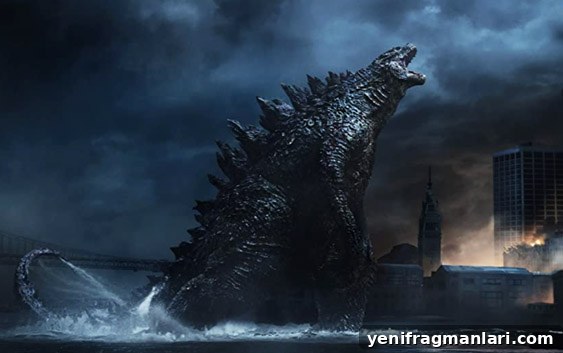
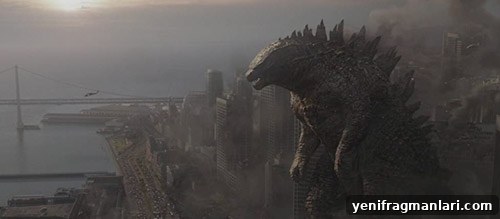
The film’s central conceit—Godzilla as a force of nature, a kind of ecological reset—works well in theory. When Godzilla appears on screen, he is powerfully realized: imposing against ruined skylines, moving through open water with prehistoric grace, and unleashing his atomic breath in climactic set-pieces. Yet the title monster’s actual screen time is limited. For a movie named Godzilla, audiences expecting prolonged confrontations and a deeper connection to the creature may feel shortchanged. The film captures Godzilla’s might, but it rarely allows viewers to know him beyond the role he fills in the narrative.
Gareth Edwards brought fresh visual ideas and a keen eye for atmosphere to a legendary franchise, and the movie benefits from strong production values and a compelling score. Still, the screenplay’s reluctance to commit to a sharper thematic stance, combined with underused characters and inconsistent action pacing, prevents the film from reaching its full potential. The result is an impressive-looking blockbuster that often flirts with emotional resonance without fully delivering it.
10/24
Recommended for you: Showa Era Godzilla Movies Ranked (1954–1975)