
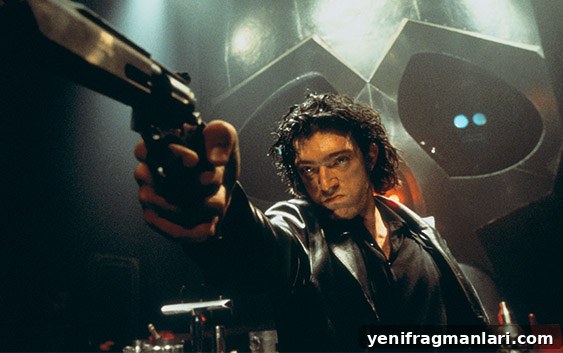

Dobermann (1997)
Director: Jan Kounen
Screenwriters: Frederique Dumas, Eric Neve
Starring: Vincent Cassel, Monica Bellucci, Tcheky Karyo, Antoine Basler
The late 1980s and 1990s ushered in a new era of extremes in on-screen sex and violence, driven by home video, premium cable channels, and a loosening of industry self-censorship. Filmmakers such as Brian De Palma, Quentin Tarantino, and Takashi Miike blended entertainment, stylized visuals, and shock, producing works that could be both technically impressive and deliberately profane. Balancing artful provocation and base vulgarity is a difficult line: some films use transgression to serve craft and themes, while others veer into empty sensationalism. Where does Jan Kounen’s Dobermann land?
Released in 1997 and adapted from novels by Joël Houssin, Dobermann is Kounen’s tenth feature film. It follows a violent criminal gang led by the character Dobermann, pursued by a sadistic police officer. Critics at the time framed the film as part of a “new new wave” in French cinema, a movement presented as rebellious against the established critical tastes and institutions. Kounen and contemporaries like Mathieu Kassovitz openly positioned the film as an attack on conservative critical gatekeepers, using irreverent imagery to underline that stance. One of the movie’s provocative moments—intentionally crude and emblematic of that stance—shows a protagonist relieving himself and using a film magazine as toilet paper, a deliberate act of cinematic sacrilege.
That antagonistic posture gives the film an interesting cultural footprint: it’s an explicit artistic statement about authorship and cinematic freedom. The irreverence can feel purposeful, an attempt to shock the critical establishment and assert a new tone for crime movies. Yet the film’s appetite for provocation sometimes outweighs its attention to character and narrative depth. Moments intended as commentary can come off as gratuitous, and the style occasionally interferes with the emotional and narrative clarity the source material might have provided.
What audiences most often praise is the film’s kinetic action. Dobermann delivers exaggerated, cartoonish violence—groin shots, explosive head wounds, and broadly staged bloodletting are deployed in service of a hyper-stylized, transgressive tone. The action carries a performative, almost celebratory quality; even infants are put in jeopardy amid the film’s mayhem. For viewers seeking audacious spectacle and relentless energy, the movie achieves its aims. Its final sequences go further into excess, offering the kind of extreme finale many viewers expect from this kind of cinema.

The cast anchors the film’s chaos with committed performances. Vincent Cassel and Monica Bellucci share strong on-screen chemistry; Bellucci’s largely nonverbal contribution adds intensity and an enigmatic quality to their scenes together. Their provocative intimacy amid criminal action—most famously their embrace during a bank robbery—captures the film’s collision of sex, danger, and showmanship. The supporting players are memorable for their eccentricities: there’s a shotgun-wielding priest, a gang member with a pet puppy, and a corrupt, coarse detective who contrasts with the crew’s own brand of amorality. Even the film’s cross-dressing character is performed with conviction, though that portrayal also points to missed opportunities for deeper nuance.
Where Dobermann falters is in its underdevelopment of motivation and interiority. The protagonist’s backstory is reduced to a symbolic moment—receiving a gun as a child—without much exploration of why he lives by violence or what drives him beyond immediate survival and loyalty to his gang. A richer emotional or psychological through-line would have given the action greater stakes and made viewers invest more fully in the characters’ fates. The antagonist’s relentless pursuit provides a powerful external force, but Dobermann himself remains thinly sketched, making it harder to root for him beyond his cool demeanor and ferocity.
Despite those shortcomings, Dobermann accomplishes most of what it sets out to do: it is a defiantly stylized crime picture that prioritizes shock, speed, and spectacle. Its commitment to excess—drug-fueled parties, outré visual choices, and deliberate trashiness aimed at provocation—marks it as a cult artifact of late-1990s transgressive cinema. The film’s ambition and craft are evident, even when its taste for provocation overshadows deeper storytelling.
In retrospect, Dobermann deserves consideration as a provocative work that helped define a strand of postmodern European crime filmmaking. Fans of extreme action and bold visual risk will find much to admire, while viewers seeking layered character study may be left wanting. After more than two decades, the film remains a memorable, watchable piece of transgressive genre cinema that continues to invite debate about the balance between style and substance.
Score: 16/24
Blue Finch Film Releasing presents Dobermann in cinemas and on digital download 13 May.