
Kingdom of the Planet of the Apes (2024)
Director: Wes Ball
Screenwriter: Josh Friedman
Starring: Owen Teague, Freya Allan, Kevin Durand, Peter Macon, William H. Macy, Lydia Peckham, Travis Jeffery, Sara Wiseman, Neil Sandilands, Eka Darville
More than half a century after the original film launched an enduring sci-fi franchise, Kingdom of the Planet of the Apes arrives as the tenth main installment. The series has continually reinvented itself across eras—from the Cold War allegories of the 1970s to the more recent trilogy that explored humanity’s fraught relationship with nature and used cutting-edge performance-capture VFX. This new film moves the timeline centuries beyond Caesar’s revolution and asks whether the franchise can continue to evolve while staying true to its thematic roots.
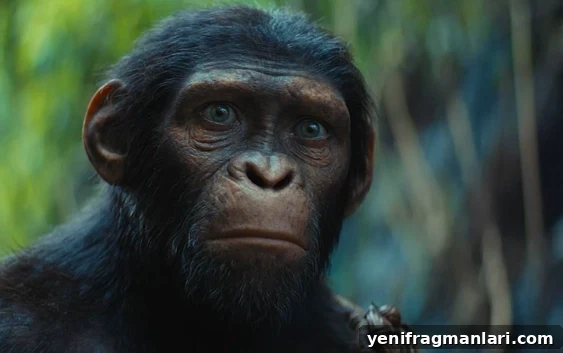
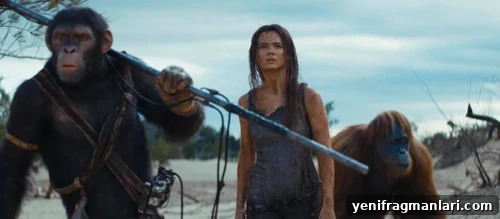
Set generations after Caesar, the story follows Noa (Owen Teague), a young chimpanzee whose coming-of-age rites are interrupted when a rival clan attacks his village. Separated from his people, Noa forms an uneasy alliance with a remarkably alert human woman (Freya Allan, introduced simply as Nova) and encounters a warm-hearted orangutan priest, Rakka (Peter Macon). Their journey takes them into the territory of Proximus Caesar (Kevin Durand), a charismatic and tech-obsessed bonobo who rules with theatrical menace.
Director Wes Ball and writer Josh Friedman present the plot in a deliberately winding manner. On paper the film reads like a compact quest: rescue the captured, face the tyrant. On screen, however, the narrative often takes detours. The film’s early sequences do a strong job of world-building, immersing viewers in a planet reclaimed by nature where tree-covered skyscrapers and dense forests form the backdrop for evolving ape societies. Performance-capture work lends remarkable subtlety to the apes’ expressions, and the visual detail throughout is frequently dazzling.
The movie opens memorably with a sequence in which Noa and two peers climb to retrieve eagle eggs to train as hunting birds—an evocative image that establishes the culture of the Eagle Clan and Noa’s familial expectations. These scenes showcase both the film’s eye for texture and its creative choices about how different ape groups have adapted to their environments. The eagles themselves, however, don’t always achieve the same level of believability as the apes, and at times become a plot convenience more than a fully integrated element of world-building.
Much of the film’s middle act feels exploratory rather than focused. As Noa travels with Nova and meets Rakka, the movie slows to allow for character beats and scenic immersion, but these passages sometimes read like side quests that delay the narrative momentum. Still, moments of warmth and humor, particularly those involving Rakka’s storytelling about Caesar, help maintain emotional interest even when the story sidelines its central threat.
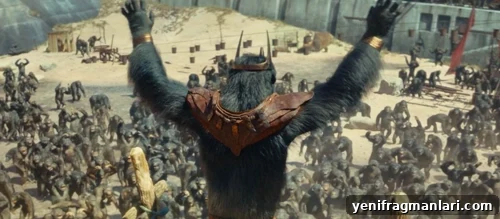
The film regains urgency around its midpoint with the arrival of Proximus Caesar, played with grandstanding relish by Kevin Durand. Proximus is an entertainingly unhinged antagonist whose theatrical presence and technological appetite make him one of the movie’s most compelling figures. Unfortunately, his screen time is relatively limited; the film often returns to more conventional hero beats rather than expanding on the intriguing power dynamics he introduces.
One of the film’s most interesting shifts is the reduced role of human civilization. Humans appear largely feral and marginal compared with the learned apes, and this installment is notable for its scarcity of prominent human characters. William H. Macy’s Trevathan serves as a human intermediary to Proximus, supplying weapons and historical tales, but his sudden competence compared with other humans is never fully explained. Freya Allan’s Nova, meanwhile, provides a bridge between the species, though her backstory is hinted at rather than thoroughly explored.
Themes that could have driven sharper commentary—religion, the manipulation of history, and authoritarian mythmaking—surface periodically but never fully develop. Rakka’s role as a keeper of stories suggests a critique of how leaders appropriate legends, and Proximus’ self-mythologizing hints at dangerous revisionism. Yet the screenplay ultimately favors spectacle, including an effects-heavy climax that emphasizes watery CG set pieces over deeper exploration of the film’s thematic potential.
Despite narrative unevenness, the film succeeds on a visual and technical level. The VFX and performance-capture craft remain state-of-the-art, and several scenes achieve genuine emotional resonance. Where the movie is less successful is in producing a central character as instantly memorable as Andy Serkis’ Caesar or Charlton Heston’s Taylor. Owen Teague shows promise and brings energy to Noa, and the supporting cast helps populate this expanded world with distinctive voices.
Ultimately, Kingdom of the Planet of the Apes is a handsome, ambitious chapter in a long-running saga. It pushes the timeline forward appreciably and opens several narrative and thematic doors for future entries. With tighter editing and a clearer throughline, this installment could have delivered a more concentrated emotional punch. As it stands, it’s an evocative, at times uneven continuation that demonstrates the franchise’s ability to evolve visually while still searching for the next great dramatic breakthrough.
Score: 15/24
Rating: 3 out of 5.
Recommended for you: Planet of the Apes Movies Ranked