
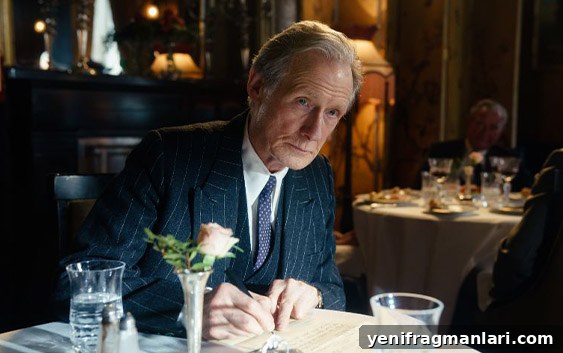

Living (2022)
Director: Oliver Hermanus
Screenwriters: Kazuo Ishiguro
Starring: Bill Nighy, Alex Sharp, Aimee Lou Wood, Tom Burke
Adapting a film as revered as Akira Kurosawa’s 1952 classic Ikiru is a delicate task. Oliver Hermanus’s Living relocates that moral and emotional core from post-war Japan to post-war Britain, retaining the original’s essential story while reshaping it for a different cultural and historical setting. At its heart, Living follows Mr. Williams, a long-serving civil servant whose life of routine and quiet anonymity is abruptly ruptured by a devastating diagnosis. The film charts his gradual awakening, as he seeks meaning and purpose in the limited time that remains.
Hermanus’s approach is faithful rather than revisionist. Many of the film’s compositions and sequences echo Kurosawa’s original: moments of bureaucracy depicted through rigid office groupings, the slow-moving montage of petitioners shuffled between departments, and the image of a solitary figure occupying a child’s swing. Those directorial choices underline the universality of the story’s themes—mortality, regret, and the quest for dignity—and demonstrate how a narrative can transcend place while preserving its emotional truth.
Stylistically, Living opts for restraint. The decision to present the film in a slightly narrower aspect ratio (around 1.48:1) helps maintain a contained, domestic feel appropriate to the period. The filmmakers also experiment with texture and tone, punctuating color sequences with episodes of black-and-white photography, which serves both as an aesthetic nod to the era and as a tonal device that underscores the protagonist’s shifting inner life. The measured editing trims the original’s runtime, condensing certain scenes without sacrificing the core arc.
Central to the film’s success is Bill Nighy’s performance. He brings a quiet precision to Mr. Williams, conveying a wealth of emotion through minimal gesture and carefully modulated speech. Nighy’s portrayal is at once understated and profoundly moving: he captures the small indignities of bureaucratic life and, crucially, the human vulnerability that surfaces when a man is suddenly confronted with his own mortality. The supporting cast—Aimee Lou Wood, Tom Burke, Alex Sharp, and others—provide empathetic and measured performances that complement Nighy’s lead work without overwhelming it.
Emilie Levienaise-Farrouch’s score contributes significantly to the film’s atmosphere. Her music is evocative without being intrusive, framing scenes of introspection and quiet revelation with a sensitivity that enhances the emotional resonance. Production design and costume work successfully recreate post-war Britain on what appears to be a modest budget; the film’s attention to period detail helps anchor the story in a convincing social and historical reality.
Despite its many strengths, Living is not without flaws. One notable misstep is a late sequence on a train in which dialogue becomes overly explicit about the film’s themes. Rather than allowing emotion and subtext to convey meaning, this exchange spells out the lesson in heavy-handed terms, briefly undermining the subtlety that precedes it. If the scene had been trimmed or reworked to rely on implication rather than literal exposition, the film’s tonal unity would be stronger. Still, this lapse does not erase the film’s overall achievements.
What Living offers is a respectful, skillfully crafted reimagining that demonstrates how an enduring story can be translated across cultures and decades without losing its power. It is a film that rewards patient viewing: its quiet moments accumulate into a moving statement about the importance of human connection, compassion, and making the most of the time we are given. For viewers familiar with Kurosawa’s Ikiru, Living provides a thoughtful homage; for those encountering the story for the first time, it stands on its own as a mature and affecting drama.
Score: 19/24
Living was released digitally on 3 March and on Blu-ray & DVD on 13 March 2023. The film remains a poignant, well-acted meditation on life and purpose, anchored by an exceptional central performance from Bill Nighy and a steady directorial hand from Oliver Hermanus.