
Renfield (2023)
Director: Chris McKay
Screenwriter: Ryan Ridley
Starring: Nicholas Hoult, Nicolas Cage, Awkwafina, Ben Schwartz, Adrian Martinez, Shohreh Aghdashloo, Brandon Scott Jones, Jenna Kanell, Bess Rous, James Moses Black
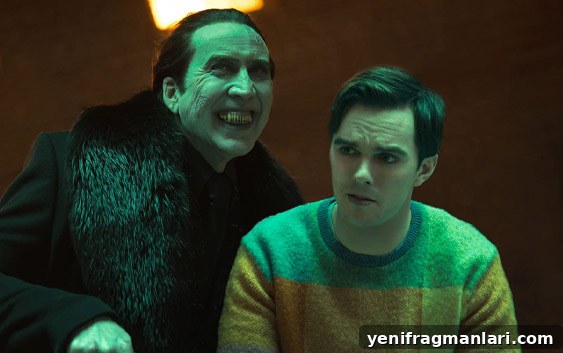
Nicolas Cage, an actor known for his unpredictability and intense screen presence, has finally taken on a role many horror fans have long imagined: Dracula. In Renfield, Cage embraces the iconic vampire with a baleful and flamboyant energy that anchors a film that blends horror, comedy and action. This contemporary reimagining nods directly to Bram Stoker’s novel and the 1931 Tod Browning adaptation while carving its own irreverent path through modern New Orleans.
At the center of the story is Robert Montague Renfield (Nicholas Hoult), a devoted and broken familiar who has served Count Dracula for decades. Renfield performs menial, often degrading tasks by day and brings victims to his master by night, slowly becoming a hollowed-out figure of dependence and self-loathing. When a vampire-hunter attack leaves Dracula severely weakened, the two relocate to a new city and are forced to rebuild their lives. Relocated to contemporary New Orleans, Renfield begins to question the nature of his co-dependent relationship with Dracula and to consider whether he might reclaim his agency.
Renfield’s arc is at once tragic and darkly comic. The film cleverly reframes Renfield’s historical depiction as a merely mentally unstable servant by introducing a supernatural element: Dracula bestows temporary physical enhancements on his thrall when Renfield consumes insects such as flies, spiders and cockroaches. This device transforms the formerly passive Renfield into a surprisingly formidable physical force, capable of gruesome and inventive violence. The movie leans into splattery, over-the-top action sequences—often punctuated by sharp music choices—that escalate from brutal to gleefully absurd.
Nicholas Hoult delivers a textured performance, balancing vulnerability and unpredictable ferocity as a man shaped by a century of abuse. Hoult’s Renfield recalls Dwight Frye’s classic portrayal but is updated with contemporary sensitivity and a clear emotional throughline: Renfield seeks connection and a life beyond servitude. Awkwafina plays Rebecca, a grieving police officer who becomes a rare source of empathy and stability in Renfield’s life. Their relationship provides the emotional core of the film and gives Renfield a believable path toward self-discovery, highlighted in a small but telling makeover scene that symbolizes his slow reemergence.
Cage’s Dracula is theatrical and unapologetically sinister. He imbues the character with a monstrous charisma and a disturbing calmness that makes his manipulations chilling. The film frames their relationship as an abusive romance—one sided, controlling, and deeply toxic—allowing both actors to explore the dynamics of power, control and emotional exploitation in ways that are occasionally funny and often unsettling.

Renfield is strongest when it pays homage to classic Universal monster cinema. Meticulous visual references and affectionate pastiches will satisfy fans of the old-school, campy horror tradition. Director Chris McKay demonstrates a clear appreciation for genre history, blending it with a contemporary, self-aware sensibility that recalls recent blockbuster antihero comedies. The film’s production design, costume work and carefully staged moments evoke the past while functioning within a modern action-comedy framework.
However, the movie is uneven when it shifts toward a more conventional crime-thriller subplot. A revenge angle involving Rebecca’s quest to find her father’s killer and various organized-crime elements feel familiar and undercooked, never fully meshing with the supernatural core. Performances in the crime subplot—while competent—lack the impact of the film’s vampire-centered scenes. Ben Schwartz and Shohreh Aghdashloo, for example, occupy roles that are serviceable but not especially memorable compared with the magnetic central trio.
The group therapy scenes offer an intriguing counterpoint to the gore and satire, yet their tone sometimes flirts with broadness that undermines potential emotional weight. The film sporadically undercuts genuine dramatic beats with humor, likely to preserve a buoyant tone, but this approach occasionally prevents deeper, more affecting moments from landing fully.
Ultimately, Renfield is an entertaining genre hybrid that won’t revolutionize horror-comedy but succeeds on the strength of its lead performances, inventive action, and affectionate references to classic monster films. Fans will come for Cage’s outrageous, scene-stealing Dracula and stay for Nicholas Hoult’s surprising physicality and emotional growth. If you enjoy darkly comic takes on classic mythology, splatter-heavy action and a modern twist on co-dependent relationships, Renfield is a lively, frequently hilarious ride.
Score: 17/24
Recommended for you: Top 10 times Nicolas Cage went full Cage (listicle)