
The World’s End (2013)
Director: Edgar Wright
Screenwriters: Simon Pegg, Edgar Wright
Starring: Simon Pegg, Nick Frost, Martin Freeman, Paddy Considine, Eddie Marsan, Rosamund Pike, David Bradley
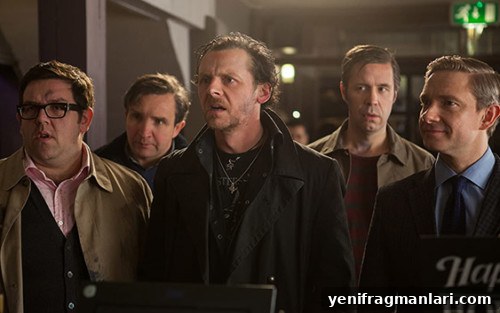
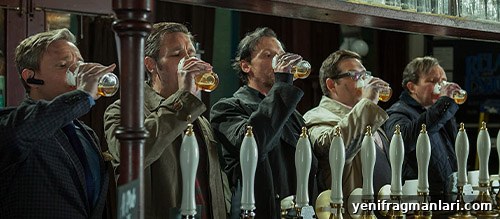
The World’s End (2013) completes Edgar Wright, Simon Pegg and Nick Frost’s Cornetto Trilogy with a film that is both darker in tone and richer in theme than its predecessors. While some fans initially found it more divisive compared to Shaun of the Dead and Hot Fuzz, critics largely welcomed it and many viewers have since re-evaluated its emotional and thematic depth. The film follows Gary King (Simon Pegg) and four old school friends as they reunite to finish a long-abandoned pub crawl—the Golden Mile—in their hometown of Newton Haven, only to discover that something deeply wrong is lurking beneath the town’s familiar façade.
One of the film’s most effective choices is how it subverts the established roles from the earlier films. Nick Frost, usually cast as the affable heavy, plays a restrained, responsible professional who acts as the pragmatic counterpoint to Pegg’s stubborn, nostalgic man-child. That reversal highlights the duo’s chemistry rather than diminishing it: years of collaboration allow their timing and rapport to feel effortless. Martin Freeman is similarly cast against type as the deadpan Oliver, a far cry from his more well-known comic and heroic characters. Paddy Considine and Eddie Marsan round out the central quintet, bringing varied energy and grounded performances that keep the group dynamics believable and compelling.
The supporting cast is strong, with memorable turns from Rosamund Pike and David Bradley among others. Familiar faces from the Wright-Pegg circle appear across the dozen pubs visited during the crawl, adding layers of in-joke recognition and continuity for long-time fans without detracting from the main narrative for newcomers.
Expectations around The World’s End were unusually high when it arrived, partly because Pegg and Wright had spent the intervening years working on major studio projects. Those raised expectations may have influenced early audience reactions and box-office performance—the film ultimately earned roughly half of what Hot Fuzz made—but such figures don’t fully capture how the film functions as a thematic and tonal capstone to the trilogy.
Action sequences in the film remain inventive and well-staged, but they serve the story more than they dominate it. The pub fights, a hallmark of the series, are present and frequently inspired: the cramped, chaotic brawl in a pub toilet stands out as a sequence that blends choreography, humor and suspense. Compared to the broad action of Hot Fuzz, the violence here often feels more intimate and eerier, matching the film’s creeping sense that the world the characters remember has been disturbingly altered.
Thematically, The World’s End is the trilogy’s most reflective and melancholic entry. It examines nostalgia and the difficulty of letting go: Gary’s quest to relive a single night from his youth becomes a lens for exploring regret, arrested development and the fragile myth of “the one perfect night.” The film also comments on the homogenization of British towns—the “Starbucking” of local pubs and the loss of distinctive community spaces—and asks whether the characters’ sense of loss stems from their own failures or real cultural change. Threaded through this domestic unease is an unexpected science fiction element that reframes the town’s transformation and gives the narrative a fresh, unsettling edge.
Music plays a crucial role in the film’s atmosphere. A soundtrack heavy on 1990s Britpop evokes the era when the protagonists came of age; songs from The Stone Roses, Pulp and The Happy Mondays help anchor the film’s emotional beats and underline the characters’ attempts to reconnect with their past. Other song choices—such as The Doors’ “Alabama Song (Whiskey Bar)” and The Housemartins’ “Happy Hour”—cleverly echo the film’s pub-centric plot while enhancing tone and mood.
As a finale to the Cornetto Trilogy, The World’s End does not simply recycle the comedic formulas of its predecessors. It is more of a slow burner, favoring suspense and simmering tension over relentless gag density. That pacing won’t suit every viewer, but it allows the film to explore darker emotional territory and to present the leads in more nuanced ways. Simon Pegg and Nick Frost demonstrate range, supported by a strong ensemble, and Edgar Wright ties visual inventiveness to a story that balances nostalgia with critique.
For audiences willing to follow its quieter, more reflective arc, The World’s End rewards with a bittersweet, thought-provoking conclusion to a beloved trilogy. It may remain underrated compared to the more openly comic entries, but its thematic ambition and tonal risks give it a distinct place in Wright’s filmography and in contemporary British genre cinema.
Score: 17/24