
A Clockwork Orange — A Film Review
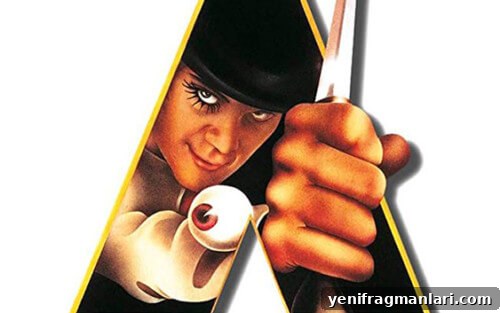
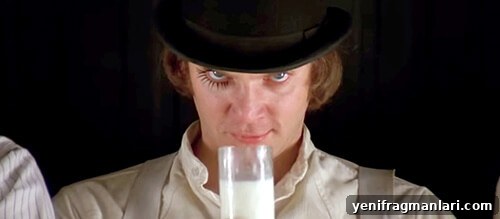
Four droogs load up on Moloko Plus, primed for a bout of ultraviolence. A Clockwork Orange opens on Alex DeLarge’s insolent smirk, a challenge aimed squarely at the viewer. Stanley Kubrick’s signature visual precision is everywhere: arresting symmetry, meticulous camera moves and a protagonist who dares us to look away first. The film thematically revolves around choice, yet the spectator is rarely offered one. Malcolm McDowell’s magnetic performance dominates the frame, compelling us to bear witness to this disturbing narrative.
Discussing Kubrick’s A Clockwork Orange necessarily involves acknowledging its long history of controversy. Contrary to the popular myth that it was universally reviled in 1972, many critics praised the film on release, although it also attracted vehement detractors. The film’s perceived connection to contemporary criminal incidents in the UK prompted intense debate about whether violent media can influence violent behavior in real life — an argument that continues to resurface in public discourse.
Notable critic Pauline Kael criticized the film for what she saw as gratuitous pornography, particularly objecting to scenes of sexual assault that she felt were presented in a way meant to titillate. As conversations about depictions of sexual violence have evolved, Kael’s concerns remain difficult to dismiss. Although the film condemns Alex’s actions, Kubrick’s camera often lingers on the perpetrators, framing the narrative through a predominantly masculine viewpoint. Similar to films like Taxi Driver or Scarface, A Clockwork Orange tracks a single man’s descent into brutality, with female characters frequently reduced to tools that advance the protagonist’s story rather than fully realized individuals.
As part of a season celebrating Kubrick, the British Film Institute recently reintroduced A Clockwork Orange to UK cinemas after nearly two decades. I had the chance to view The Shining on the big screen previously, and this screening made clear that Kubrick remains a master of cinematic spectacle. From the opening overture and narration to the synthetic musical cues and precise pacing, the film asserts total control over the theatrical experience.
Presented in a 2K restoration, each unsettling frame gains renewed intensity. Seeing A Clockwork Orange in a cinema — framed by two blood-red curtains — reinforces the film’s operatic qualities. Its retro-futuristic production design revels in clinical corridors and desolate urban spaces, settings that underscore Alex’s theatrical presence and the tragic hubris of a character whose fate resembles that of an operatic antihero.
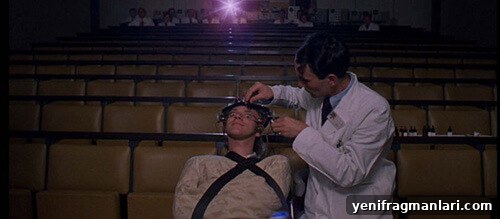
Alex is egotistical and violent, yet his capacity for free will remains, even after the brutal psychological experiments he endures. McDowell’s early performance — raw, brutish, and often gleefully menacing — is tempered by a knowing smirk and a pronounced admiration for “Ludwig Van.” Physically battered and mocked, Alex eventually recognizes that psychological control can be both simpler and more destructive than physical punishment.
When Alex collapses at the doorway of a former victim, he immediately recognises the writer Patrick Magee portrays. The film then subjects that character to another chilling performance of “Singin’ in the Rain” and later floods his senses with Beethoven’s Ninth Symphony. This sonic assault drives the writer to desperate actions, and yet, after treatment and recovery, Alex is practically rewarded with social reintegration and a government position — a disturbing commentary on institutions that claim to cure violence while co-opting it.
Kubrick builds a dystopia where the state is neglectful and self-serving. Alex and his gang operate beyond the law, but the film ominously suggests that violence is a transferable skill valued by the authorities. The transformation of Dim and Georgie from street thugs into abusive officers anticipates the modern concerns around police brutality and institutional corruption, making the film’s social critique as relevant now as it was on release.
In interviews, McDowell has urged audiences to move past the shock of the film’s provocation, noting how its bleak climaxes are punctured by moments of unexpected, almost grotesque, comic relief. One such moment occurs during a scene where the Minister of the Interior, played with stiff conservatism by Anthony Sharp, offers Alex apologies and employment. Alex’s impulsive, childlike gestures while eating — reportedly improvised — highlight how absurd and transactional the system can be. That mixture of menace and comedy crystallizes the film’s themes of individuality, coercion and moral ambiguity.
A Clockwork Orange is Kubrick’s most distinctly English picture, and its portrait of an apathetic, bureaucratic state seems informed by personal observation. The film proposes a chilling paradox: an authoritarian machine that nurtures and then attempts to eliminate the very evil it has produced, spoon-feeding a class it despises while plotting its downfall. Alex resents and exploits this reality in equal measure, refusing to relinquish his own agency even as the world around him seeks to reshape him.
You can support Lucas Hill-Paul by following his work on social media: Personal Twitter – @lucashpaul
You can find more of his writing at Film Daily News – @FilmDailyNews