
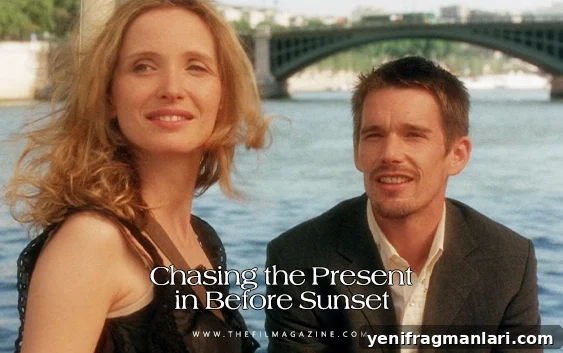
Before Sunset is a race against the clock on a perfect summer afternoon. The light turns everything golden, and for a few hours it seems as if anything might be possible.
Released February 10, 2004, Before Sunset is the second film in Richard Linklater’s acclaimed trilogy, following Before Sunrise (1995) and preceding Before Midnight (2013). In Before Sunrise, Jesse (Ethan Hawke) and Celine (Julie Delpy) meet as strangers on a train and spend a night wandering Vienna, talking and falling for one another. They believe, briefly, that their encounter exists outside of time and part without giving each other names or contact information, agreeing instead to meet again at a train station six months later.
Set nine years later and filmed on location in Paris, Before Sunset was co-written by Linklater, Hawke, and Delpy. The film places character, chemistry, and conversation above conventional plot mechanics. Shot in a city that inspired the French New Wave, it adopts a monologue-heavy, freeform style that feels both intimate and everyday. If Before Sunrise is about imagining the future and Before Midnight is about reflecting on the past, Before Sunset is an exercise in inhabiting the present.
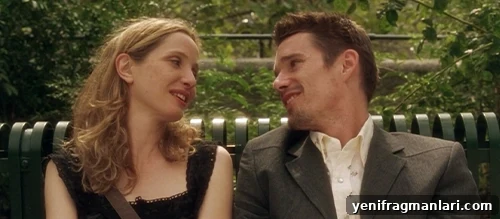
Now in their early thirties, Jesse is in Paris for the last stop of his book tour. His novel recounts in detail the night he spent with a French woman he met on a train. During a conversation about his work, he explains an idea for a new novel—one that captures two moments simultaneously, where the past and present fold into each other. At that moment he sees Celine for the first time since Vienna. His description of a life collapsing into the present—“for a moment, all his life is folding in and it’s obvious to him that time is a lie… it’s all happening all the time and inside every moment is another, all happening simultaneously”—works as a thematic mission statement for the film.
That idea—of trying to live in the present when the past has been relived so many times in memory—drives the film. The writing team captures that sensation with remarkable subtlety: the past stands in front of you, familiar yet strange, and you must decide whether to live in it or move forward.
Before Sunset unfolds in near real-time. With a runtime under 80 minutes, the film follows a leisurely walk through Paris: streets, parks, a café for coffee and a cigarette, and finally an apartment where a song is played. The naturalism feels deliberate rather than improvised. Although the movie gives the impression of spontaneous conversation, the trilogy’s long takes and small gestures were carefully rehearsed and scripted to appear effortless. That preparation allows the actors to inhabit the moment fully, making each glance, breath, and interruption feel immediate.
“Memory is a wonderful thing if you don’t have to deal with the past,” Celine says. Their conversation repeatedly returns to old stories—childhood memories, relationships since their one-night encounter—yet they keep trying to re-anchor themselves in the present. The film’s time constraint—Jesse must catch a plane—keeps pulling them back into the moment. Neither wants this second encounter to become another memory to be analyzed later while lying beside someone new.
Before Sunset balances restraint with emotional exposure. The two do not consummate their reunion with a kiss, but the movie is charged with desire throughout. Jesse skirts the subjects of his wife and child at first; Celine forgets the man she claims to love. Surface-level banter gives way to deeper confessions as familiarity breaks down defensive walls. Celine, more outspoken at thirty-two than at twenty-three, teases Jesse playfully—small gestures that feel like tests of whether this encounter is real or a trick of time. Despite their maturity, the setting sun serves as a reminder that a deadline still looms.
Their reunion confirms that their earlier nostalgia was meaningful rather than merely sentimental. Jesse reveals he wrote his book to preserve that night and, more quietly, to reach Celine. She admits she read the book twice and discovered his tour stop at her favorite bookstore. They never fully articulate all of their feelings, but longing and recognition fill their words and posture.
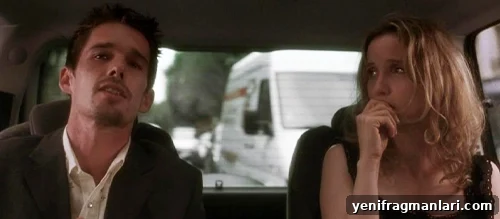
Both crave a life filled with passion and meaning. Early on they agree that “desire is the fuel of life.” The film’s emotional climax unfolds during a long car ride back to Celine’s apartment, when they lay bare long-held dissatisfactions. Jesse describes himself as someone perpetually restless, wanting intimacy without the compromises of commitment. He worries about his ability to create a stable life for his son amid a strained marriage. Celine, who channels her ideals through environmental work, has built walls to protect herself from further hurt and carries a certain cynicism rooted in experience.
They acknowledge the toll of avoiding pain by withdrawing from engagement. Jesse exposes his vulnerability while admitting his inability to settle. Celine reveals how their shared history reshaped her. When they finally admit their mutual regrets—over what could have been in Vienna, over unsatisfying relationships and missed chances—a barrier between them collapses. The film moves from teasing conversation to a more vulnerable, honest exchange that feels earned.
Early in the film, over coffee and a shared cigarette, Celine asks Jesse what his problems are. As the evening progresses and they grow closer, the light in his eyes brightens. He answers simply and honestly: “Right now, I don’t have any. I’m just damn happy to be here.”
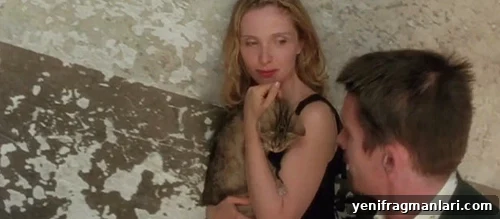
In the film’s longest silence, Celine leads Jesse upstairs to her apartment. On the winding stairway they move slowly, perhaps imagining what will happen behind closed doors after so many years. He asks to hear a song she wrote—a waltz about their first meeting—and she plays it, dancing and humming along to a tune that evokes Nina Simone’s spirit. As she performs, Jesse relaxes onto her couch and lets himself be present.
For all their philosophical monologues about change, responsibility, and whether men and women can fulfill each other in modern life, the film’s final moments achieve a simple, profound presence. They acknowledge time passing and respond with something like joy.
“Baby, you are gonna miss that plane.”
Jesse leans back, the wedding ring catching the light as he fiddles with it, and laughs.
“I know.”
Recommended for you: The Before Trilogy: How to Capture a Moment
Written by Kyra Lieberman
You can support Kyra Lieberman in the following places:
Portfolio: Kyra Lieberman
Blog: & More
X (Twitter): @kyralieberman
Instagram: @kyralieb