
Italian Neorealism: Origins, Key Figures and Characteristics
Italian Neorealism was not so much a formal school as a cinematic trend that emerged from Italy’s social and historical circumstances in the 1930s and 1940s. While Roberto Rossellini is often credited as a founding figure, the movement can be traced to Luchino Visconti’s 1943 film Ossessione (English: “Obsession”). Scholars disagree about the movement’s precise timeframe: some restrict Neorealism to the immediate postwar years (roughly 1945–1948), while others extend its influence into the early 1960s.
Visconti began his effort to reshape Italian cinema in the 1930s through his work with the journal Cinema. Influenced by French realist directors such as Jean Renoir and Marcel Carné, he developed techniques that helped define the new trend in Italy. Both Visconti and Rossellini are now regarded as foundational figures of Neorealism, yet their cinematic approaches were markedly different: Rossellini favored immediacy and improvisation, while Visconti pursued a more carefully composed, deliberate mise-en-scène.
Where Rossellini often prioritized content over form, Visconti paid intense attention to visual arrangement and stagecraft. In Ossessione, for example, Visconti’s mise-en-scène immediately signals the film’s emotional tension. The story of Gino, a wandering drifter, and Giovanna, the neglected wife of a restaurant owner, is set against an environment that visually mirrors Giovanna’s constrained life. Visconti uses subjective shots to present Gino as Giovanna sees him, establishing the lovers’ drama from the opening sequences.

Visconti also constructs the restaurant’s bleak surroundings as a physical reflection of Giovanna’s life, a choice that both frames and propels the story toward adultery. Other notable Visconti films include The Earth Trembles (1948) and Bellissima (1951). His approach tended to be more codified and carefully planned than Rossellini’s, emphasizing detail and structured plots over improvisation.
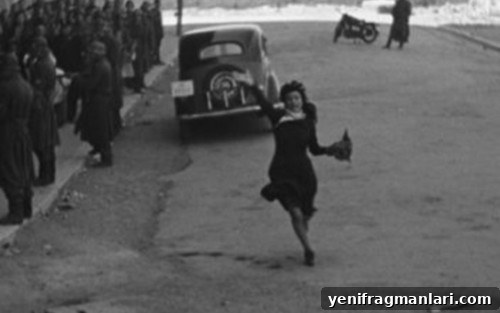
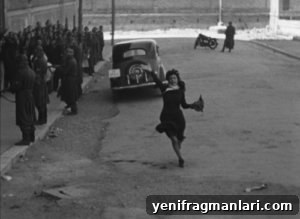
Rossellini began his career during the fascist era and made three films that critics later referred to as his “Fascist Trilogy”: The White Ship (1941), A Pilot Returns (1942) and The Man with a Cross (1943). Yet by 1945 he shifted direction with Rome, Open City, filmed amid real wartime ruins. The film captures chaos and poverty while focusing on the Italian resistance; one unforgettable sequence features Anna Magnani’s character Pina running and shouting after the car that carries her husband away, ending with her being shot.
Rossellini often cast non-professional actors, preferred shooting on location, and used narrative ellipses that deliberately withheld causal explanation. Rather than building a conventional Hollywood-style climax, he often focused on the aftermath—the emotions and consequences—leaving causes implicit. This strategy appears strongly in Paisà and in the Neorealist trilogy that includes Rome, Open City (1945), Paisà (1946) and Germany Year Zero (1948).
Although many viewers point to Rome, Open City as the moment Neorealism entered the public eye, credit for the movement’s origins can reasonably be shared between Visconti and Rossellini. Their contrasting styles underline that Neorealism was not a rigid, codified school but a broad, evolving trend that directors interpreted in different ways while remaining united by common aims.
Neorealism is typically defined by several distinguishing features: location shooting in real, often impoverished settings; the frequent use of non-professional actors; a documentary-like depiction of contemporary social realities; and an emphasis on stories about the poor and working classes rather than the middle or upper strata. The movement sought to convey a sense of unmediated reality, enabling viewers to feel present in the world on screen rather than watching symbolic or allegorical spaces. In this respect, Visconti’s more deliberate, symbolic mise-en-scène stands as a partial departure from the movement’s more raw impulses, demonstrating the diversity within Neorealism.
Other important figures in the movement include Pietro Germi, Giuseppe De Santis and Vittorio De Sica. De Sica directed several internationally acclaimed films such as Bicycle Thieves (1948), Miracle in Milan (1951) and Umberto D. (1952). Pietro Germi also made enduring contributions with films like Path of Hope (1950) and The Railroad Man (1956), each of which holds a significant place in Italian film history.
Recommended for you: Our “Where to Start with…” Series
Bibliography and further reading
Bazin, André. “Le réalisme cinématographique et l’école italienne de la libération.” Esprit, XVI, n.1 Janvier 1948.
Farassino, Alberto. “Neorealismo, storia e geografia”. Neorealismo. Cinema italiano 1945-1949, edited by Farassino Alberto, EDT, 1989.
Miccichè, Lino. Visconti e il neorealismo. Marsilio, 1990.
Parigi, Stefania. Neorealismo. Il nuovo cinema del dopoguerra. Marsilio, 2014.