
Host (2020)
Director: Rob Savage
Screenwriters: Gemma Hurley, Jed Shepherd, Rob Savage
Starring: Haley Bishop, Jemma Moore, Emma Louise Webb, Radina Drandova, Caroline Ward, Edward Linard, Seylan Baxter
2020 transformed how we communicate, perhaps permanently. Video conferencing tools such as Zoom and Skype moved from convenience to necessity, keeping colleagues, friends and families connected while everyone adjusted to life and work from home. Filmmakers have had to adapt as well, and few films capture that improvisation more effectively than Host, a compact, high-tension horror piece that unfolds entirely through a Zoom call.
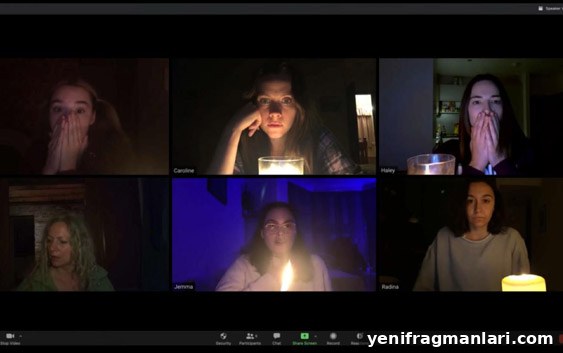
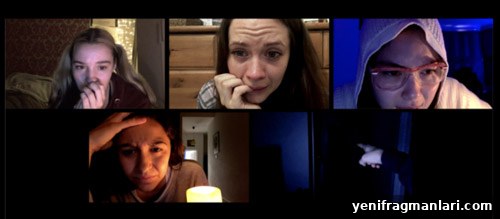
Using the constraints of a single computer screen, a time limit on the call, and the narrow frame of webcam footage, Host turns limitations into strengths. The film follows six friends—Haley, Jemma, Emma, Radina, Caroline and Teddy—who meet up for their usual video catch-up and decide to enliven the evening with a socially distanced séance. They hire an online medium to guide the ritual, but when the guide’s connection drops and the group begins to mock the setup, something malevolent crosses over and begins to torment them.
The premise is simple, but the execution is clever. The screenplay introduces inventive rules for how the séance operates within a modern, digitally mediated setting: do not invent a dead friend to liven the show, and be cautious with masks and personal props—apparently demonic entities have no sense of humor and can occupy anything created or offered with intent. Such small details give the film its distinct mythology and will make viewers wary the next time the word “mask” comes up.
Beyond the concept, the film benefits enormously from the chemistry of its cast. The actors feel like a real group of friends—frequent collaborators who understand one another’s rhythm—which gives the semi-improvised moments a natural, lived-in quality. That authenticity helps sell the mounting dread. The Zoom interface, with its grid of faces, chat messages and reaction icons, becomes an expressive tool; small gestures, shifting lighting, and the judicious use of filters and virtual backgrounds create an atmosphere that lingers long after the film ends.
Critics of found-footage horror may point out familiar lapses in logic—why keep filming when danger is imminent?—but Host largely avoids stretching credibility, especially early on when everyone remains seated at their laptops and unaware of the full scope of the threat. When things escalate, the film asks for the usual suspension of disbelief typical to the genre. Accepting that lets you experience the film’s concentrated shock and mounting panic without getting bogged down in practicalities.
Technically, the film makes smart, low-fi choices that enhance rather than distract. Instead of relying solely on jump scares, it uses the Zoom aesthetic—frozen frames, delayed audio, distorted video—to create a creeping unease. While the final act does ratchet up the number of sudden scares as characters try to flee a relentless force, what remains most effective are the quieter, eerier moments: a distorted background image, a face that appears in a reflection, or a friend who suddenly behaves in inexplicable ways.
At just under an hour, Host is lean and disciplined. Director Rob Savage and co-writers Gemma Hurley and Jed Shepherd compress the story into a tight runtime that keeps tension high without overstaying its welcome. The film demonstrates how constraints—social distancing, limited sets, remote performances—can inspire creativity. The result is a suspenseful, intimate horror film that leverages contemporary technology to explore timeless fears.
In the end, Host stands out as a resourceful example of pandemic-era filmmaking that both comments on and exploits the realities of remote communication. Its shocks are immediate and effective, but the lasting fright comes from the small, seemingly ordinary images that the film turns into sources of terror. For viewers who have spent hours on video calls, the film offers a new and unsettling perspective on a familiar medium: it makes Zoom itself feel vulnerable.
21/24
Recommended for you: The Art of the Social Media Thriller; Narcissism, Paranoia and Tools for Good or Ill