
Mandibles (2020)
Director: Quentin Dupieux
Screenwriter: Quentin Dupieux
Starring: Grégoire Ludig, David Marsais, Adèle Exarchopoulos
Quentin Dupieux has built a reputation for making films that lean into absurdity and dark whimsy. From Rubber, his unusual tale about a murderous tyre, to Deerskin, which examines obsession through the lens of a man and his jacket, Dupieux consistently favors offbeat premises. Mandibles continues that pattern, centering on a comically improbable situation: two dim-witted friends discover a giant fly in the trunk of a car and hatch a plan to train it and profit from their discovery.
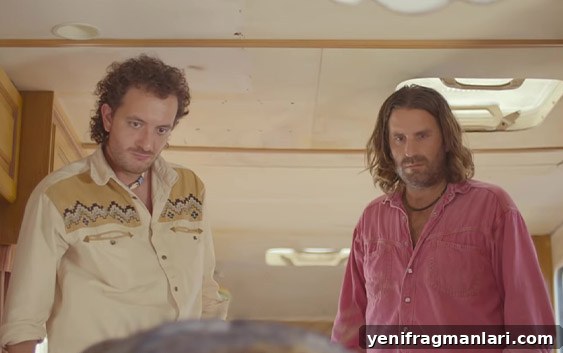
At first glance the concept has the breezy, surreal charm typical of Dupieux. The film introduces Manu (Grégoire Ludig) and Jean-Gab (David Marsais) as earnest, simple characters whose friendship is central to the early scenes. Ludig and Marsais offer committed and likable performances, giving the pair a believable camaraderie that makes their silliness feel human rather than purely cartoonish. Those opening sequences, where Dupieux blends absurd humor with a warm, low-key rapport between the leads, are the movie’s strongest moments.
However, Mandibles struggles to sustain that initial promise. As the runtime progresses, the screenplay increasingly relies on a succession of gags and scenarios that feel underdeveloped or repetitive. The film moves briskly, but speed does not always translate into purpose; each new scene often seems to mark a drop in tone or quality rather than an escalation of stakes. The giant fly, which initially serves as the film’s central hook, gradually recedes from importance, leaving the narrative untethered and the comedic focus scattered.
Technically, Mandibles is competent. The production values are solid and the film looks and sounds like a professional feature. Yet where Dupieux normally infuses his work with a distinct visual and tonal signature, here the direction and design come across as surprisingly restrained. Cinematography and sound design are unobtrusive rather than provocative, which undercuts opportunities to make the absurd material feel more striking. That lack of distinct artistry contributes to a sense that the film could have been bolder in committing to its surreal premise.
The most significant flaws lie in the characterization and comedic choices. The addition of Agnès, played by Adèle Exarchopoulos, is particularly problematic. Written as a character who speaks loudly and constantly due to brain damage from a skiing accident, Agnès is intended as a running gag, but the joke lands poorly. Rather than adding depth or freshness, the portrayal reads as insensitive and tired, and too much screen time is devoted to a single gag that does not develop or evolve. The result is a half of the film that becomes grating rather than funny.
Beyond Agnès, many supporting characters are sketched in broad strokes and rarely reveal surprising dimensions. Manu and Jean-Gab start out as charmingly naive, but over the course of the story they flatten into one-note figures whose antics grow wearisome. The film’s broader problem is an absence of stakes or thematic payoff: with few characters to root for and the central novelty—the massive insect—fading into the background, Mandibles begins to feel purposeless. Viewers may find themselves asking why certain scenes exist and what, if anything, the film intends to communicate.
There are moments of genuine whimsy and a few laughs that demonstrate Dupieux’s ability to mine the absurd for comedy, but those instances are too infrequent to salvage the whole. The film’s pacing and tone suggest an intention to be playful and light, yet the reliance on repetitive gags and an undernourished plot leaves an impression of squandered potential. Instead of a lean, surreal fable with a pointed edge, Mandibles often reads like a series of loosely connected sketches that never coalesce into a satisfying whole.
In sum, Mandibles is a mixed effort from a filmmaker known for memorable oddities. It offers brief, charming exchanges and an intriguing premise, but it is undone by uneven execution, uninspired technical choices, and character work that grows flat or offensive. Fans of Dupieux’s more successful experiments may find a few moments to enjoy, yet the film as a whole struggles to justify its concept across its runtime.
3/24