
This article was written exclusively for The Film Magazine by Libby Briggs.
The Wedding Planner (2001)
Director: Adam Shankman
Screenwriters: Pamela Falk & Michael Ellis
Starring: Jennifer Lopez, Matthew McConaughey, Bridgette Wilson-Sampras, Justin Chambers
The Wedding Planner arrives as a polished example of early‑2000s romantic comedy craft: glossy production design, picture‑perfect weddings, and two charismatic leads meant to ignite a modern fairy tale. On paper, Mary Fiore (Jennifer Lopez) is exactly the kind of heroine rom‑com audiences like—independent, successful and obsessive about making other people’s special days unforgettable. But as Libby Briggs argues in this reassessment, the film’s charm is uneven and the story’s attitudes toward fidelity and gender make the romance feel dated when examined closely.
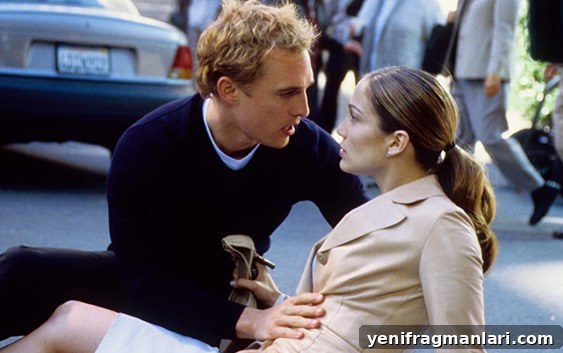
Mary is a top wedding planner whose own love life was derailed by a cheating fiancé. When she literally falls into the life of paediatrician Steve Edison (Matthew McConaughey), the script sets up every rom‑com staple: the heroic rescue, a believable first date, the chemistry that should follow. Steve is handsome, confident and clearly attractive to Mary. Only later we discover he is engaged to be married—and to the very bride whose wedding Mary is hired to plan.
Matthew McConaughey’s performance here divides audiences. His laid‑back charm fits the mold of a rom‑com leading man, but the film asks viewers to accept ethically dubious behavior without substantial on‑screen consequences. Steve’s evasions and infidelities are framed as forgivable transgressions, explained away with charm or male impulsiveness rather than examined. That framing is a weakness when the audience expects the plot to justify why the heroine should forgive and fall in love again. The result is a romantic arc that feels manufactured rather than earned.
There’s a second suitor in the film, Massimo, an earnest and sweet Italian who enters Mary’s life at her father’s urging. He represents an arranged‑marriage trope by proxy: his presence prompts Mary to re‑evaluate what she wants from a partner and whether security and affection can be arranged or must be freely chosen. Massimo’s sincerity is appealing, but the script undercuts him by presenting him as second best—the safe option that Mary settles for only because she’s been led to doubt her own worth. That dynamic leaves a sour note, implying that emotional convenience and public appearances can outweigh honest commitment.
These narrative choices expose a recurring problem in some nineties and early‑noughties rom‑coms: they often forgive selfish or predatory behavior from male characters without fully holding them accountable. Films of this era frequently relied on the notion that persistence equals passion, or that infidelity is a temporary obstacle on the road to true love. The Wedding Planner inherits these conventions, and while the production glitters—lavish receptions, manicured gardens, abundant cake and champagne—the emotional core is less convincing.
Visually, the film is hard to fault. The set design, costumes and wedding scenes were clearly intended to evoke aspiration: glossy magazine pages come to life with floral arches, elaborate centerpieces and charming details that make the viewer linger. These elements help sell the fantasy of the job and of high‑end romance, and for many viewers the visual pleasures will outweigh the narrative flaws. The weddings look like modern Pinterest boards—carefully curated, picture‑perfect and undeniably pretty.
But a rom‑com requires more than sheen. It needs characters we root for, growth that feels honest and a central relationship that earns its happily ever after. The Wedding Planner offers spectacle and a pair of likable stars, but it struggles to reconcile charismatic performances with a script that normalizes questionable conduct. For some viewers, the chemistry between Jennifer Lopez and Matthew McConaughey will be enough to sustain nostalgia; for others, the movie’s ethical blind spots and thin emotional stakes will limit its appeal.
In short, The Wedding Planner is a product of its time: visually engaging and full of rom‑com tropes, yet softened by conventions that modern viewers may find problematic. As a case study in early‑2000s romantic comedy, it’s worth watching—if only to see how glamour and storytelling intersect when genre formulas take precedence over character accountability.
8/24
Written by Libby Briggs
You can support Libby Briggs in the following places:
Twitter – @libbyjxde