

Love in the Abstract: What Film Can Teach Us About Heartbreak
Films speak a language of their own: visual cues, sound, editing rhythms and performance choices that shape how an audience feels and what it expects. A static, composed shot suggests control and calm; loud, insistent music signals disorder or threat. These conventions are comforting. They let viewers settle into stories that feel recognizably coherent, offering an escape from everyday chaos and a sense that events will arrange themselves with narrative logic.
At the same time, great filmmakers often seek to surprise, to carry us through emotional terrain that resists tidy explanation. Lean too heavily on those conventional techniques and a film becomes predictable and safe—everything is spelled out on the surface and emotion is reduced to a checklist. The counterpoint is cinema that embraces ambiguity, that uses form and genre in unexpected ways to reveal the messier truths of love and loss. Is one approach superior to the other? Not necessarily. But exploring how different methods render heartbreak and connection helps illuminate what film can uniquely do.
Consider Richard Linklater’s Before Sunrise (1995). The film follows two strangers, Jesse (Ethan Hawke) and Celine (Julie Delpy), who meet on a train and fall into an intense, intimate conversation over a single evening. From the opening scene the audience is invited into their orbit: we witness the subtle ways they warm to each other, the confessions and missteps that make their connection feel human. The film’s formal clarity—its structure, naturalistic dialogue and temporal simplicity—engenders a powerful emotional response when the evening comes to an end. The heartbreak here is immediate and visceral because the film stays close to lived experience, showing how ordinary gestures and honest talk can produce deep attachment.

Wong Kar-wai’s Chungking Express (1994) takes a different route. The film consists of two loosely connected narratives about people adrift in Hong Kong’s urban sprawl, each searching for connection in its own way. Wong represents longing through objects and behavior rather than expository dialogue: one character associates canned pineapple with the end of a relationship, another finds solace in food and small rituals. In the second story, a man tends to loneliness by talking to the possessions in his apartment; a young woman responds to her feelings by occupying his space, touching the things he touches and inhaling the atmosphere of his life.
What stands out in Chungking Express is how much meaning is carried by actions, by long looks, by the textures of the city. Much of the film’s emotional truth emerges from images and rhythms rather than explicit explanation. This refusal to tidy every feeling into narrative beats allows the viewer to inhabit a state of longing that feels authentic precisely because it is elliptical. The film blends elements of crime, comedy and melodrama, resisting a single genre label; that hybrid quality helps it represent love as something fragmented and unpredictable.

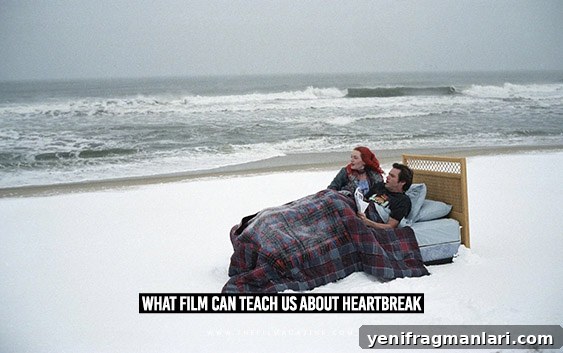
Michel Gondry’s Eternal Sunshine of the Spotless Mind (2004) offers another powerful model. The premise—erasing painful memories of a past relationship—permits the film to take place within the mind, where logic loosens and imagery becomes associative. As Joel (Jim Carrey) watches his memories of Clementine (Kate Winslet) dissolve, the film leans into surreal, sometimes nightmarish visual metaphors that convey the experience of loss more convincingly than simple realism could. Horror-tinged sequences, dream logic and visual disruptions externalize emotional states, making internal pain visible. By borrowing from genres outside straightforward romance, Gondry creates a viewing experience that is both emotionally precise and formally daring.
These directors demonstrate how altering form—blending genres, privileging image over exposition, using objects as emotional shorthand—can reach a different register of feeling. Human emotion is messy and often resists tidy categorization; representing love in all its contradictions sometimes requires cinematic devices that are themselves contradictory. A film that uses surreal imagery or genre play can produce a truer impression of what it feels like to lose someone, to yearn, to remember.
There is a practical reason audiences and filmmakers return to familiar tropes: expectations provide comfort. If you walk into a film labeled “romance,” you usually expect certain resolutions. But certainty can be stifling. Overreliance on tropes dulls surprise and diminishes the emotional potency of moments that might otherwise unsettle us. Films that mix tonal registers—comedy with melancholy, realism with fantasy—can keep viewers alert, letting images and mood linger after the credits roll. A scene in which a house is swallowed by waves as lovers part, or a napkin with a blank plane ticket, can haunt precisely because it refuses immediate, literal interpretation.
Ultimately, both direct, realist storytelling and abstract, genre-bending cinema can succeed when they remain committed to emotional truth. What matters is an honest core: a relation to human experience that resonates and can still surprise. Declaring one method superior to another simplifies a more interesting reality. The richer question is how filmmakers use technique to open the viewer to feelings that are otherwise hard to name.
Connection is central to our lives—an attempt to understand another person, to be understood in return. Love produces contradictions: trust after betrayal, forgiveness after disappointment, choices that seem irrational to outsiders. Those private, idiosyncratic experiences don’t always need justification, and they don’t always translate neatly to plot conventions. When films allow for ambiguity—when they invite viewers to let go of assumptions—they can mirror the absurd, nonsensical aspects of real life and create moments of genuine emotional clarity. By embracing uncertainty, cinema can make us feel something deeper.
Written by Sam Florsheim
You can support Sam Florsheim in the following places:
Instagram – @samflorsh
Website – samflorsheim.com