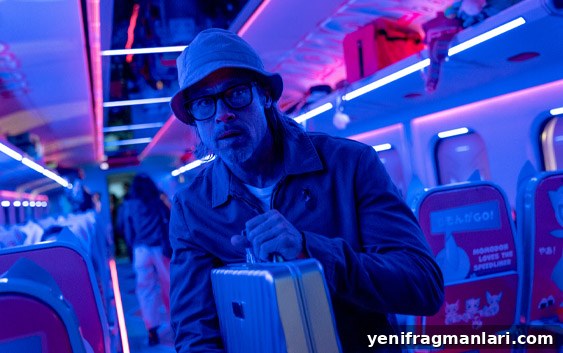

Bullet Train (2022) Review
Director: David Leitch
Screenwriters: Zak Olkewicz, Kôtarô Isaka
Starring: Brad Pitt, Joey King, Aaron Taylor-Johnson, Brian Tyree Henry, Andrew Koji, Hiroyuki Sanada, Michael Shannon
The existence of Bullet Train — a glitzy, neon-drenched action comedy that reportedly cost nearly $86 million — raises more than a few questions about how big budgets are spent. On paper the premise is simple and combustible: Brad Pitt plays Ladybug, a thief reluctantly returning to work who finds himself trapped on a high-speed Tokyo train with a roster of assassins, each with their own agenda and, crucially, all circling the same prize — a briefcase containing ten million dollars. The concept promises a compact, tense thriller with comic potential, but the execution delivers mixed results.
The cast throws themselves into the material with infectious energy. Pitt leads with a loose, weary charm, while Joey King, Aaron Taylor-Johnson, Brian Tyree Henry and the rest bring color and physical commitment to the set-piece moments. Director David Leitch stages numerous stylish sequences — whip-pans, quick cuts, neon lighting and inventive choreography — and the film often looks terrific. The production design and cinematography lean into a hyper-stylized aesthetic that suits the premise: a lethal, claustrophobic chessboard hurtling through Japan.
Where Bullet Train stumbles is in its tonal discipline and pacing. The screenplay keeps jumping between present action and flashbacks in an attempt to weave together character motives and intersecting storylines, but the structure frequently undermines its own momentum. Early scenes set up promises of brisk tension and kinetic mayhem, yet long stretches are devoted to managing how and why the characters remain aboard the train — a sequence of contrivances that dulls the film’s initial zip. Jokes and quips arrive with regularity, but many feel repetitive or overstretched, undercutting the urgency the plot needs to sustain.
Action scenes are often stylish but not always polished. The choreography favors slick moves and rapid edits, which look striking in short bursts but sometimes leave the viewer disoriented rather than exhilarated. At moments the film seems restrained, oddly cautious for a story that would benefit from embracing its own absurdity and letting chaos reign. This restraint results in a film that flirts with delirium but rarely commits to the full-throttle, gleeful carnage the premise could support.
Another consequence of prioritizing style over depth is that several characters remain underwritten. While a handful receive memorable beats or clear motivations, many function more as archetypal set-pieces than fully realized people. There’s humor in the archetypes, and the performers do their best to squeeze personality into limited screentime, but emotional stakes rarely break through in a meaningful way. Films that succeed with similar locked-room ensembles often balance spectacle with empathy; they use quirky, violent setups to reveal something about the characters. Bullet Train, for all its larger-than-life personas, too often keeps its characters at arm’s length.
Comparisons are inevitable. Other films have used confined spaces and multiple combatants to generate both laughs and genuine tension, and those works often meld the ridiculous and the human in ways that feel organic. Bullet Train occasionally reaches those heights — a standout sequence here or a clever line of dialogue there — but such moments are scattered rather than cumulative. The film’s commitment to a uniform tone and flashy visual approach sometimes blinds it to opportunities for either greater emotional payoff or fuller, inventive mayhem.
Still, the movie is far from a failure. The performances, the production values, and certain high-energy sequences provide ample entertainment. Viewers who come for glossy action, sharp production design and irreverent humor will find much to enjoy. But for an action-comedy with such a straightforward, high-concept hook — assassins on a speeding train, a ticking prize and limited space — the film often feels curiously measured and self-aware where it could have been anarchic and liberating.
Score: 11/24