Flux Gourmet (2022)
Director: Peter Strickland
Screenwriter: Peter Strickland
Starring: Asa Butterfield, Gwendoline Christie, Ariane Labed, Fatma Mohamed, Makis Papadimitriou
Peter Strickland, the director celebrated for his distinctive and often divisive cinematic voice, returns with Flux Gourmet, a film that reaffirms his fascination with the strange and the stylized. Following his giallo-inflected dark comedy In Fabric, Strickland offers another formally confident piece that leans into surrealism, satire, and sensory provocation. Flux Gourmet premiered at the Edinburgh International Film Festival and has since provoked strong reactions—praise from those who admire its visual precision and aesthetic daring, and frustration from viewers who find its structure and humor alienating.
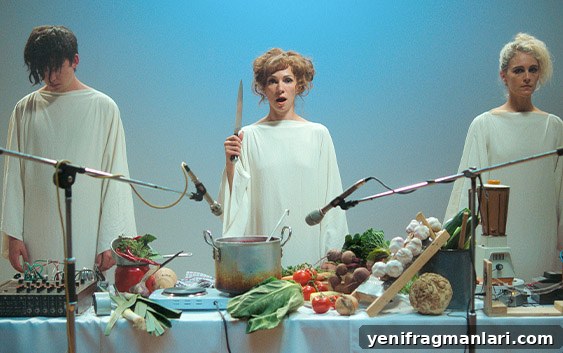
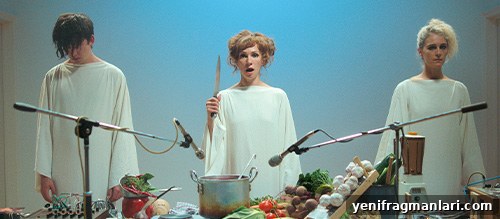
The film centers on a small collective of experimental performance artists whose practice is self-described as “sonic catering.” This eccentric troupe extracts abrasive, unsettling sounds from food and everyday consumption to create performances that test the boundary between music, noise, and performance art. They move into a secluded arts institution for a residency that will be documented by a journalist, Stones (Makis Papadimitriou), whose chronic flatulence becomes an oddly persistent thread throughout the story. The residency is intended as a period of creation and critical exchange; what unfolds is an often uncomfortable satire of contemporary art culture and the personalities that inhabit it.
Visually, Strickland remains in full command. The cinematography bathes scenes in striking primary colors and meticulously composed frames, recalling the director’s love for giallo aesthetics—bold color palettes, precise lighting, and an almost fetishistic attention to mise-en-scène. The production design and camera work are consistently handsome, and Strickland’s ability to make each shot feel purposeful and hallucinatory is one of the film’s most notable achievements.
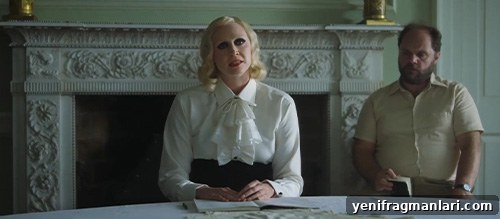
But strong visuals do not fully compensate for narrative weaknesses. The screenplay unfolds across three weeks of the residency—week one, week two, week three—each ostensibly structured to explore a different member of the group and their contribution to the collective. In practice, the film repeats the same sequence of beats: a member interview, a communal meal, directorial critique from Jan Stevens (Gwendoline Christie), a performance, and increasingly bizarre interpersonal episodes. This repetition is deliberate, but it often feels inert rather than incisive, sapping momentum and making much of the film feel like variations on the same scene rather than a progression.
Character focus is uneven. Fatma Mohamed’s Elle di Elle dominates the early sections as a hot-tempered, imperious band leader who refuses criticism; Asa Butterfield’s Billy Rubin and Gwendoline Christie’s Jan Stevens get significant attention in later segments; Ariane Labed’s Lamina Propria, while intriguing, remains under-explored. Moments that promise deeper emotional or narrative payoff—such as a brief, intimate encounter between Lamina and Stones—are teased and then abandoned, leaving narrative threads unresolved. This approach can amplify the film’s unsettling texture, but it also creates a sense of missed opportunity: characters who beg for complexity remain one-note.
Satire is the film’s declared engine, but it frequently tips into caricature. The depiction of noise music and its attendant pretensions is relentless; stage shows grow absurdly over-the-top and the performers’ inability to distinguish meaningful sonic choices from random clamor is played as a pointed joke. While satire requires exaggeration, the film’s barbs sometimes feel blunt, repeating the same targets until the critique loses edge. At the same time, Strickland employs broad, low-brow humor—most notably Stones’ flatulence—as comedic ballast. The juxtaposition of highbrow satire and base bodily comedy is intentional, suggesting that pretension and vulgarity are two sides of the same cultural coin, but the film frequently lands on the least effective elements of both registers rather than synthesizing them into something sharper.
The voiceover narration, delivered by Stones in his native tongue, attempts to bridge the film’s tonal divides and to offer an observational anchor. Instead, it often accentuates the film’s unevenness: it can feel like an inside joke about international cinema that doesn’t always clarify or deepen the satire. The result is a movie that revels in its own strangeness but sometimes confuses eccentricity with substance.
Performances are committed across the board. Gwendoline Christie brings a brittle authority to Jan, Fatma Mohamed’s Elle is combustible in a way that makes her both magnetic and exhausting, and Makis Papadimitriou’s Stones anchors the film with a weary, bemused presence. Ariane Labed’s Lamina hints at a quieter emotional center that the script ultimately underutilizes. Asa Butterfield’s Billy offers restraint amid the group’s chaos, but the ensemble cannot fully overcome the material’s repetitive tendencies.
For viewers drawn to formally daring cinema and elaborate visual design, Flux Gourmet will offer plenty to admire: bold framing, striking color choices, and moments of genuinely inspired mise-en-scène. For others, the film’s satirical blows land unevenly, its humor oscillates between high and low registers, and its structural repetition becomes a hindrance rather than a device for critique. Ultimately, Flux Gourmet is an ambitious, polarizing piece—beautifully made but frustrating in execution. It rewards patience and openness to tonal experimentation, but those seeking a sharper satirical edge or a more coherent narrative may find it wanting.
Score: 5/24