Queer (2024)
Director: Luca Guadagnino
Screenwriter: Justin Kuritzkes
Starring: Daniel Craig, Drew Starkey, Jason Schwartzman, Henrique Zaga, Lesley Manville
William S. Burroughs remains a deeply complicated and controversial figure in twentieth-century literature. His life contained both notable literary influence and deeply troubling personal actions — the most notorious of which was the killing of Joan Vollmer in Mexico, an incident that has long shaped how his life and work are read. Yet Luca Guadagnino’s film adaptation, Queer, does not center on scandal. Instead it channels Burroughs’ prose into a cinematic meditation on desire, identity, addiction, and the fragile intimacy between two men in a world hostile to their truth.
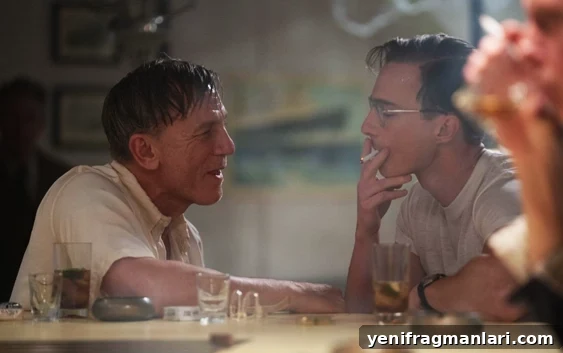
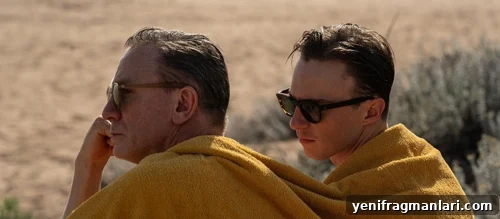
Queer follows William Lee (Daniel Craig), an American expatriate in Mexico City, whose yearning for the younger Eugene Allerton (Drew Starkey) sets the story in motion. Their relationship deepens as they travel into South America in search of the yagé (yage) root, an entheogenic plant that becomes both a literal and symbolic quest. Through moments of affection, dependence, withdrawal, and hallucination, Lee and Allerton confront who they are to themselves and to each other. The film frames this journey as a search for authenticity in a life conditioned to hide desire and mask pain.
Guadagnino’s reputation for lush, sensorial filmmaking raises expectations, and with two releases in one year there is inevitable comparison with his earlier successes. Yet Queer stakes its own claim: it is less pastoral romance and more a compact, often claustrophobic portrait focused almost exclusively on Lee’s interior life. The camera rarely abandons him, and the cinematography reflects his mental and emotional confinement. Sparse wide shots emphasize tight interiors and a feeling of containment, while jungle sequences — nominally free and wild — are shot to feel like another form of enclosure, undermining the notion of escape.
Casting is a strength. Daniel Craig brings an unexpected vulnerability to William Lee, expanding beyond his more publicized roles to inhabit the intellect, fragility, and addiction of the character. He shifts seamlessly among Lee’s many faces: lover, cynic, dreamer, and addict. Drew Starkey matches him with a nuanced period-appropriate presence that reads as both believable and slightly otherworldly — at times representing a real person and at others resembling a projection of Lee’s desires. Their chemistry, alternately tender and tense, anchors the film.
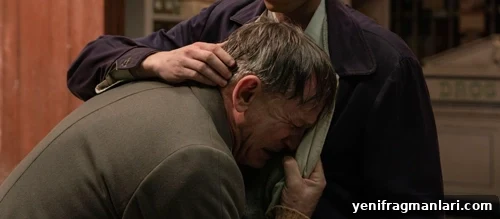
Thematically, the film examines compulsory heterosexuality as a form of social illness. Lee’s discomfort in conventional heterosexual roles becomes a recurring motif: in one striking scene he speaks frankly with a disfigured woman, revealing that his supposed attraction to women is not genuine but performative, a social script he cannot fully inhabit. Guadagnino repeats and reframes this sense of disembodiment throughout the film, most poignantly during the yagé sequences where reality and hallucination blend and identity feels both dissolved and revealed.
Surrealism is deployed sparingly and to great effect. Long takes accompanied by carefully curated music establish mood and interior headspace; intimate, sometimes disorienting sequences of bodies and faces merging create images that are both beautiful and unsettling. These moments evoke Burroughs’ dreamlike prose without attempting literal illustration, giving the film its necessary strangeness and emotional resonance.
Not every element lands perfectly. A few effects-driven sequences — such as an encounter with a bright yellow viper at a jungle home — occasionally read as incongruous, their execution feeling more cinematic novelty than organic surrealism. At times the narrative leans into the awkwardness of new relationships or into performative storytelling delivered by supporting characters like Jason Schwartzman, which can undercut the film’s tonal consistency. Still, these lapses are brief and do not significantly diminish the film’s emotional core.
Musically and stylistically, the film is unmistakably Guadagnino: sensory-rich, formally confident, and attentive to texture. Yet it also marks a distinct departure from the sunlit yearning of Call Me by Your Name and the athletic bravado of Challengers. Queer is darker, more introspective, and often uncomfortable — qualities that make it an important addition to Guadagnino’s body of work. More importantly, it is an unabashedly queer film made by a queer filmmaker, and that perspective matters. In a cultural moment when representation and honest storytelling remain vital, Guadagnino’s film provides visibility for queer experience in a way that is neither sanitized nor exploitative.
For viewers wrestling with identity, societal expectations, or addiction, Queer offers a raw, compassionate, and sometimes disquieting mirror. It will not replace Guadagnino’s most iconic films for everyone, but it demonstrates a willingness to take creative risks, to be formally adventurous, and to center marginalized inner lives. On those terms, it succeeds: the film is both a challenging adaptation of Burroughs’ source material and a singular cinematic statement.
Score: 20/24
Rating: 4 out of 5.