

I have long been drawn to futuristic and dystopian film and television. Since the relaunch of Doctor Who in 2005, I’ve devoured space adventures and speculative visions of technological progress. Yet one persistent problem keeps recurring in mainstream science fiction: blunt, relentless sexism. Blade Runner 2049 illustrates this issue in multiple, troubling ways.
To be fair, the film has notable strengths. The soundtrack is superb—moody, atmospheric and precisely paced—and the cinematography is frequently breathtaking. Beyond those achievements, however, the film repeatedly falls back on tired patterns of female objectification and narrative erasure that undermine its otherwise ambitious worldbuilding.

Visual motifs throughout the film spotlight exaggerated, distorted representations of women. In a red-hued desert sequence, K (Ryan Gosling) walks past enormous statues of women posed in high heels—topless and bent together in a way that reads as grotesquely eroticized. The cityscape is littered with ads for Joi, the purchasable virtual companions in this version of Los Angeles. Joi manifests almost exclusively as a hypersexualized woman: shapely, frequently nude, and designed to answer the user’s every sexual and emotional desire. Male versions of Joi are conspicuously absent, and the female Joi is repeatedly presented as an object meant to gratify male fantasy, often accompanied by taglines promising to deliver “everything you want to hear.”

Two scenes in particular underscore how the film reduces women to vessels and props. The first involves Joi (Ana de Armas), Mariette (a sex worker), and K. Joi, a programmable companion, calls Mariette and overlays her holographic image onto Mariette’s body so K can sleep with a “real” woman who looks like his idealized, electronic partner. Mariette is used literally as a physical vessel for someone else’s fantasy. Throughout the encounter K never properly acknowledges Mariette as a person; he interacts with the projection and then lets Joi dismiss Mariette, who is left unseen and unheard. That treatment—prostitutes depicted primarily as sexual spectacle, with their humanity omitted—reinforces damaging stereotypes rather than challenging them.
The second scene centers on reproduction and the violent control of female bodies. Niander Wallace, the corporate creator of new replicants, oversees a grotesque spectacle: a naked replicant, suspended in packaging and falling like discarded cargo, her body contorting on impact. Wallace gropes her while bemoaning his failure to produce fertile replicants; he then stabs the woman in the stomach. Luv, his favored replicant, watches but does not intervene. This sequence places a woman’s worth squarely in her womb and treats reproductive capacity as property to be tested, exploited and destroyed. The moment echoes and amplifies a long history in the franchise of reducing women’s suffering—such as Rachael’s death in childbirth in the original—to emotional shorthand that primarily develops a male protagonist’s arc.

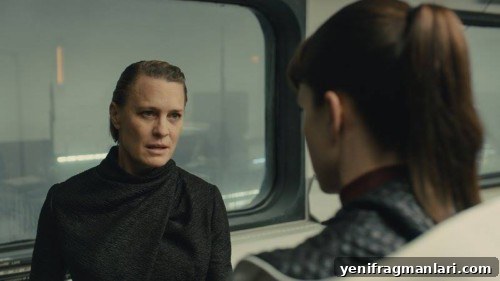
Other prominent women in the film also suffer the same narrative fate: their bodies and deaths serve male advancement. Lt. Joshi (Robin Wright), the film’s most powerful authority figure, is subtly coded as emotionally invested in K; that affection contributes to her decision to cover up his reckless actions, a choice that leads directly to her brutal murder. Her authority and any independent agency she might possess are eliminated to create a plot consequence for K’s trajectory. Across the film, violence against women is staged in ways that foreground physical damage and spectacle over the women’s inner lives or moral complexity.
What makes this especially frustrating is that science fiction, by definition, should be a genre of possibility. Futuristic stories can challenge present inequalities and imagine new social arrangements—but many contemporary sci‑fi films squander that potential. They reproduce the same sexualized tropes and reductive narratives about women that we see every day offscreen. Even recent films with prominent female leads, such as Arrival and Gravity, sometimes retreat into portraying their heroines primarily through the lens of motherhood or emotional vulnerability rather than fully exploring their intelligence, strength and autonomy.
With mounting revelations about systemic sexism in the film industry, it’s urgent to call out predictable and damaging portrayals when they appear. Filmmakers have both the power and the responsibility to depict women as complete people rather than as props, prizes, or test subjects. Science fiction should use its speculative canvas to expand how we imagine gender, not to reinforce the same old hierarchies.
To filmmakers across genres: the female body is not a prop.
Written by Alex Morden Osborne
Show your support for this article by following Alex on Twitter at: @mosborne93