
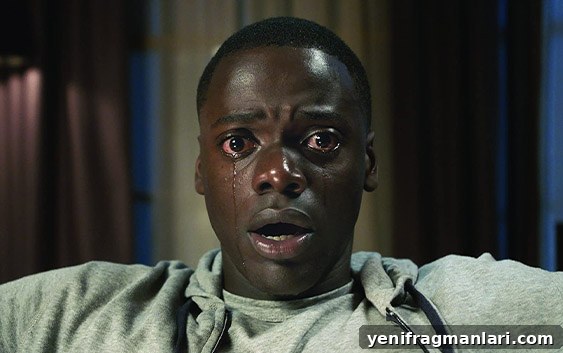

Get Out (2017)
Director: Jordan Peele
Screenwriter: Jordan Peele
Starring: Daniel Kaluuya, Allison Williams, Bradley Whitford, Catherine Keener, Lakeith Stanfield, Caleb Landry Jones, Lil Rel Howery, Betty Gabriel, Marcus Henderson
Jordan Peele’s feature debut, Get Out, arrived in 2017 as a landmark blend of psychological thriller and social commentary. The film follows photographer Chris Washington as he accompanies his white girlfriend, Rose Armitage, to meet her family at their isolated estate. What begins as an awkward weekend visit quickly unravels into growing unease: odd behavior from the household staff, uncomfortable questions from Rose’s parents, and a series of events that point to something sinister beneath the surface. The central revelation—that members of the Armitage family participate in a scheme transplanting the minds of older white people into healthy black bodies, while using hypnosis to trap those black consciousnesses in what the film calls the “sunken place”—is chilling and original.
Get Out works on multiple levels. As a horror film it builds suspense through atmosphere, careful pacing, and restraint, favoring suggestion over gore. As a social critique it interrogates race, exploitation, and white supremacy, delivering commentary that became even more resonant for many viewers in the years after its release. The movie’s economy of sound—Michael Abels’ sparse, eerie score—and its strategic use of silence amplify the mounting dread, letting small moments speak louder than shock or spectacle.
Daniel Kaluuya anchors the film with a performance that moves from wary politeness to exhausted terror and finally to combustible rage. His portrayal of Chris gives the audience an emotional center: someone constantly measuring the room, trying to keep peace while sensing danger. Allison Williams as Rose Armitage expertly balances warmth and menace; her performance is crafted so that her friendliness feels authentic until the moment it becomes threatening, revealing a predatory edge. Their relationship provides the film’s most unsettling emotional pivot.
The supporting cast strengthens every scene. Catherine Keener and Bradley Whitford play Rose’s parents—hypnotherapist Missy and neurosurgeon Dean—whose different forms of control and gentility conceal a clinical cruelty. Caleb Landry Jones makes a potent impression as Jeremy, Rose’s volatile brother, whose sudden, violent presence jolts the viewer. Lil Rel Howery, as Chris’ friend Rod, offers well-timed humor that never undercuts the film’s tension; his scenes provide crucial breathing room and a moral compass when events spiral. Meanwhile, Lakeith Stanfield, Betty Gabriel and Marcus Henderson portray victims of the Armitage procedure whose altered behavior unnerves in subtle, haunting ways.
Michael Abels’ score, particularly the piece commonly referred to by its Swahili title “Sikiliza” (meaning “listen”), is used sparingly but effectively. The choral motif appears at key moments as a warning, a mournful cry and a lament, with lyrics that translate roughly to “run far away,” “save yourself,” and “listen to the ancestors.” These musical cues underscore the film’s tension and heighten the sense that danger is already present even when it’s not yet visible.
On a technical level, Get Out is tight and deliberate. Peele stages violence in ways that feel both realistic and restrained—most of the film’s most harrowing moments are suggested or framed so the emotional impact is greater than any explicit gore. One especially intense sequence in an operating room relies on clinical precision rather than shock tactics, reinforcing the film’s tone of contained horror. The recurring visual motifs—reflections, the deer accident that opens thematic threads about vulnerability and predation, and the “sunken place” itself—work together to create a coherent, unnerving language.
The film’s ending returns the story to its opening concerns about race and policing, flipping an early scene into a final, heart-stopping image. Where the first act shows Chris shielding himself and being admonished to “stay out of trouble,” the climax places him in a position of extreme vulnerability as a police car arrives. The arrival that finally offers rescue comes from an unexpected, human source, which gives the ending both relief and a pointed comment about how safety is negotiated for Black people in America. It’s a conclusion that feels earned and cyclic, bringing the film’s thematic concerns full circle.

Rewatching Get Out reveals how meticulously it is constructed: details that seemed odd the first time around—the peculiar mannerisms of certain characters, repeated visual cues, and small lines of dialogue—slot into place once the film’s larger twist is known. This layered structure rewards multiple viewings, as the film reads differently when you know where it’s headed. That craftsmanship, combined with bold thematic ambitions and strong performances across the board, explains why Peele’s debut resonated with critics and audiences alike.
There is much to analyze in Get Out—from its approach to satire to its exploration of cultural appropriation and bodily autonomy—but at its core it remains an effective, emotionally charged film. It demonstrates confident directing, tight writing, and memorable acting, creating a horror movie that lingers after the credits roll.
24/24
Recommended for you: 10 Best Horror Movies of the 2010s
You can support Darcy Rae in the following places:
Twitter – @dxrcyer
Instagram – @dxrcyer
Etsy Store – DEWildeArt