
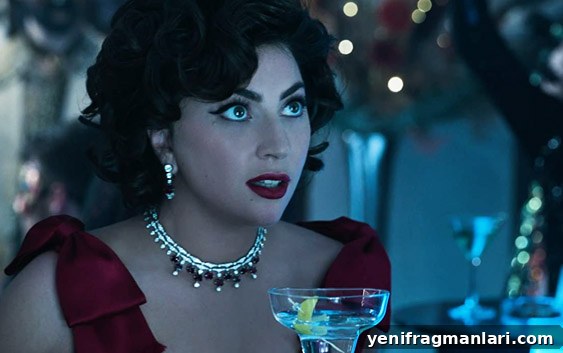

House of Gucci (2021)
Director: Ridley Scott
Screenwriters: Becky Johnston, Roberto Bentivegna
Starring: Lady Gaga, Adam Driver, Jared Leto, Al Pacino, Jeremy Irons, Salma Hayek, Jack Huston, Reeve Carney, Camille Cottin, Vincent Riotta, Youssef Kerkour
Ridley Scott’s House of Gucci adapts Sara Gay Forden’s book The House of Gucci: A Sensational Story of Murder, Madness, Glamour, and Greed into a glossy, sometimes erratic portrait of ambition, family and betrayal. The film charts more than two decades of the Gucci dynasty, tracing how love, status and greed combined to bring a sprawling fashion empire to a dramatic and violent crossroads.
The story centers on Patrizia Reggiani (Lady Gaga), an aspirational woman who falls for Maurizio Gucci (Adam Driver), a reserved heir to the Gucci name. After marrying into the Gucci family, Patrizia moves quickly to secure status and wealth, maneuvering within a complex web of relatives and power dynamics. What begins as a passionate romance turns into sustained conflict as Patrizia and Maurizio attempt to reshape the business and their roles within it. Family rivalries, legal battles and personal betrayals escalate until tragedy becomes inevitable.
Visually, the film is typically Ridley Scott: meticulous, stylish and rich in period detail. Cinematographer Dariusz Wolski frames scenes with an eye for texture and luxury that suits a story set among high fashion and excess. Janty Yates’s costume design further amplifies the era and personalities on screen, using wardrobes as an extension of character and status. Those elements make the film a feast for the senses and help ground some of its more theatrical moments.
The first act stands out as the film’s most satisfying section. Patrizia and Maurizio’s early encounters are written and performed with energy and warmth. Their meet-cute—set in a nightclub where she mistakes him for a bartender—is lively and believable, and the chemistry between Lady Gaga and Adam Driver feels immediate. They balance one another: she brings outspoken ambition and glamour, he offers a quieter, more conflicted presence. When the film captures that dynamic, it is both funny and compelling.
As the narrative expands to include the broader Gucci family, the film becomes less focused. Introducing multiple relatives and factions diffuses the central story, and several important characters are given limited arcs that feel underdeveloped. Jeremy Irons, as the elderly family patriarch, and Al Pacino, as the showman Aldo Gucci, deliver performances that hint at depth but often feel muted or uneven in a film that sometimes leans toward melodrama.

Jared Leto’s portrayal of Paolo, Aldo’s son, is one of the most divisive elements. His choices—an exaggerated physicality and affectations—draw attention but frequently pull viewers out of the story. The performance is striking and memorable, but not always in a way that serves the film’s tone. At times it undercuts the drama, turning tense scenes into odd counterpoints that distract from the main narrative.
Running roughly two and a half hours, the film sometimes overstays its welcome. The episodic structure can make the pacing feel irregular, and transitions between time periods and plot beats are sometimes handled unevenly. Much of the story’s progression is communicated through changing hairstyles and fashion, which underscores the film’s focus on appearance but also highlights a lack of deeper connective tissue between scenes. This episodic quality gives portions of the film a soap-opera rhythm, while other moments strive for cinematic gravitas.
Despite its flaws, the film reaches a clear conclusion about the cost of internal family strife on a commercial enterprise. As family feuds and power plays consume the Gucci name, the business falters, and the moral the film implies is that Gucci became commercially healthier once professionals—designers and managers steeped in modern business practices—moved the brand forward. The narrative thus becomes as much a cautionary tale about legacy and stewardship as it is a true-crime drama.
House of Gucci is not the taut, character-driven family drama of a series like Succession, nor is it a fully realized crime epic. It is, however, an entertaining if inconsistent dramatization populated by strong moments: Lady Gaga and Adam Driver’s pairing provides the emotional core, and the film’s production design and costumes consistently impress. For viewers intrigued by celebrity, fashion and high-stakes family conflict, the film offers spectacle, memorable performances and occasional insight into how glamour and greed can intertwine.
13/24