
This article was written exclusively for The Film Magazine by Scott Z. Walkinshaw.
King Kong vs. Godzilla (1962)
Director: Ishirō Honda
Screenwriter: Shinichi Sekizawa
Starring: Haruo Nakajima, Shoichi Hirose, Ichirō Arishima
Note: This is a review of the original Japanese cut.
The Godzilla series depends as much on the viewer’s imagination as on what appears onscreen; watching one is like being a seven-year-old again, lining up action figures and demolishing cardboard cities. The third film in the franchise, King Kong vs. Godzilla, captures that youthful, chaotic energy. It doesn’t merely expect audience buy-in for its absurd premise — it thrives on it and asks you to surrender your disbelief with enthusiasm.
The story opens with an American submarine colliding with an iceberg, inadvertently releasing Godzilla from confinement. At the same time, Mr. Tako (Ichirō Arishima), the head of a pharmaceutical firm, grows increasingly frustrated with the television content his company sponsors. In a rash bid to boost ratings, he sends two men (Tadao Takashima and Yū Fujiki) to Faro Island to capture King Kong and bring him to Japan as a publicity spectacle. Predictably, things go awry, and soon Japan becomes the stage for a cataclysmic clash between the two most famous monsters on Earth.
Director Ishirō Honda returns to the franchise he launched in 1954, reintroducing the satirical edge that defined the original film — an element missing from the second entry, Godzilla Raids Again. While the film dials back Kong’s meditation on humankind’s destructiveness and Godzilla’s origins as a nuclear allegory, Honda shifts his critical gaze toward television and advertising. Mr. Tako is a sort of Japanese J. Jonah Jameson: obsessive, reckless, and determined to secure footage of Kong at any cost, even if it endangers the public. Like cinematic figures such as Carl Denham in earlier King Kong tales or Preston Packard in more recent remakes, the most compelling human characters here are those driven to near-madness by their obsession with these titanic creatures. Yet this is, above all, a monster movie — the human drama exists to serve the spectacle.
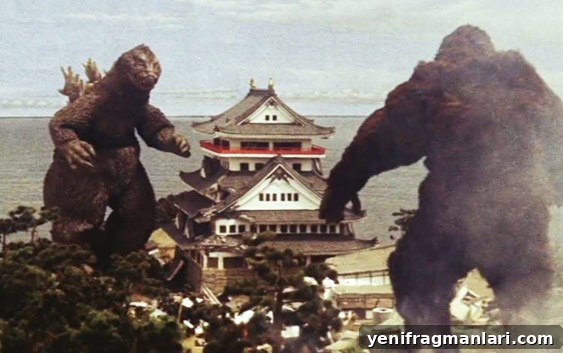
Seen through a modern lens, Kong’s practical effects are disappointing compared with the digital creations from studios like Weta or ILM, and they don’t age well even against Willis O’Brien’s stop-motion Kong from 1933. The ape’s suit often looks ragged and implausible; at a distance he borders on ridiculous, and close-ups expose the limitations of the construction. Godzilla fares a bit better: his design leans more toward a lizard-like creature than in some earlier incarnations, and the suit’s imperfections read as part of the film’s charm rather than a fatal flaw.
The film has troubling racial elements that are hard to overlook today. Kong’s native island scenes resort to caricature, with every tribesperson played by Japanese actors in dark makeup, and the portrayal of certain crew members, like the cowardly Konno, relies on dated and offensive stereotypes. Even the idea that cigarettes might smooth relations between the islanders and Kong is an uncomfortable relic of period filmmaking. These moments remain a stain on an otherwise spirited production.
Despite these issues, Honda manages a strangely earnest tone that anchors the film. The visual gags and occasional slapstick do not entirely undercut an underlying sense of awe: the notion that our world may harbor forces beyond human comprehension persists from the original 1954 film. There’s more comedy here than in the earliest entries, but beneath the laughs is the same unsettling awareness that humankind may not be as secure as it believes.
For viewers who criticized Gareth Edwards’ 2014 American Godzilla for skimping on monster action, King Kong vs. Godzilla is a reminder of a very different kind of pacing. The two titans don’t share the screen until roughly an hour in, and their first encounter is brief — a teasing prelude to the climactic showdown. If you enjoy the theatricality of suitmation, the film delivers: Kong gets drunk on fermented berries, injures himself in a scuffle, and even attempts to force a tree down Godzilla’s throat. These absurd, physical moments are part of the film’s lasting appeal; whether you laugh with it or at it, there’s a pure, unapologetic joy to watching two men-in-suits perform grandiose fights.
Ultimately, while King Kong vs. Godzilla shows its age in both technical craft and cultural sensibilities, it also possesses an endearing, earnest quality. The movie is a cultural milestone — the first cinematic meeting of two monstrous icons — and it remains enjoyable for those willing to accept its flaws and savor the spectacle.
13/24
Written by Scott Z. Walkinshaw
You can support Scott Walkinshaw in the following places:
Twitter – @scottfuzz
Letterboxd – /scottfuzz