
Last Night in Soho (2021)
Director: Edgar Wright
Screenwriters: Edgar Wright, Krysty Wilson-Cairns
Starring: Thomasin McKenzie, Anya Taylor-Joy, Matt Smith, Terrence Stamp, Diana Rigg, Rita Tushingham
Edgar Wright’s fascination with genre cinema has long been evident—from the affectionate horror-comedy of his early work to the kinetic style of his more recent films. With 2021’s Last Night in Soho he takes a deliberate step deeper into psychological horror, crafting a film that blends present-day London with vivid, dreamlike excursions into Swinging Sixties Soho.
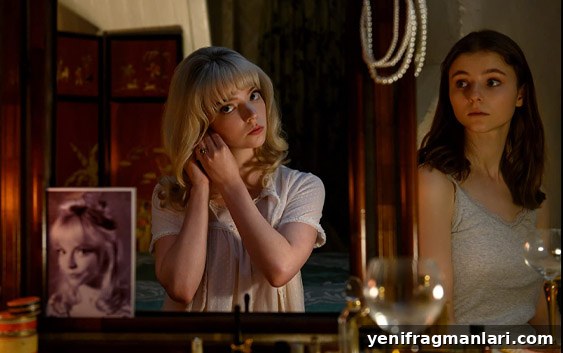
The story follows Eloise (Thomasin McKenzie), a shy fashion student who leaves her small hometown for London with a suitcase of her grandmother’s records and a passion for 1960s style. After moving into a boarding house on Goodge Street, Eloise begins to experience vivid visions of the 1960s and the life of Sandie (Anya Taylor-Joy), a glamorous young singer who once lived in her room. As Eloise slips further into these visions, what starts as nostalgic fascination becomes a darker, more dangerous obsession: the boundary between dream and reality frays, and secrets emerge that unsettle everyone around her.
Wright’s screenplay and direction draw clear inspiration from psychological thrillers and European art-horror traditions. Echoes of Roman Polanski’s unsettling domestic dread, Nicholas Roeg’s disorienting mood pieces, and the stylish violence of Giallo cinema inform the film’s tone and visual language. Yet Wright filters these influences through his own energetic visual sense, producing a movie that feels both referential and distinctly his.
Performance is a major strength. Thomasin McKenzie brings a quiet, melancholy intelligence to Eloise, making her vulnerability sympathetic and engaging. Opposite her, Anya Taylor-Joy’s Sandie is luminous—charismatic, ambitious and haunting. Matt Smith plays a slippery, showbiz figure whose charm masks deeper manipulation, while Terrence Stamp delivers a brooding, memorable turn as a mysterious regular at Soho’s Toucan bar. Diana Rigg, in one of her final roles, contributes a poignant and crucial presence that ties together several emotional threads.
Visually, the film is striking. Cinematographer Chung-hoon Chung, known for his work with Park Chan-wook, helps Wright achieve some of his most visually arresting sequences. Soho’s neon nights, smoky clubs and claustrophobic interiors are rendered with meticulous period detail and an expressive color palette that heightens both glamour and menace. The film’s editing and camera movement continually shift between dream and waking life, keeping the viewer off balance in a productive way.
Music plays an essential role in the film’s atmosphere. Wright’s careful selection of 1960s tracks—by artists such as The Kinks, Cilla Black, The Who and Dusty Springfield—creates an evocative soundscape that feels rooted in the era while serving the story’s emotional beats. Petula Clark’s “Downtown” is used prominently, both in its original form and in an intimate, acapella performance by Taylor-Joy, underscoring the film’s collision of public glamour and private longing.
Some viewers have found the film’s final act controversial. The tonal and narrative shifts in the closing sequences divide opinion, particularly around the depiction of violence and the way certain plot threads resolve. While these choices may unsettle or frustrate some, they are also consistent with Wright’s risk-taking approach and his willingness to push genre boundaries. For many, the film’s strengths—its mood, performances and technical craft—outweigh its divisive elements.
Overall, Last Night in Soho is a bold, stylish entry in Edgar Wright’s filmography. It showcases his flair for visual storytelling, his ear for music-driven atmosphere, and his evolving interest in darker material. Though not without flaws, the film succeeds as an immersive, uneasy ode to a vanished era—glamorous on the surface, with unsettling currents beneath. Fans of psychological horror and period-inflected thrillers will find much to admire here: a film that balances homage with fresh, modern tension.
18/24