
The debate between remakes and originals is as persistent as the film industry itself. When original ideas seem scarce, Hollywood often reaches into international cinema for inspiration, creating English-language versions of acclaimed foreign films. Recent years have seen adaptations of titles like Train to Busan, Toni Erdmann and Another Round in development. While many American remakes fail to match their source material, a few rare examples manage to stand on their own or even complement the originals.
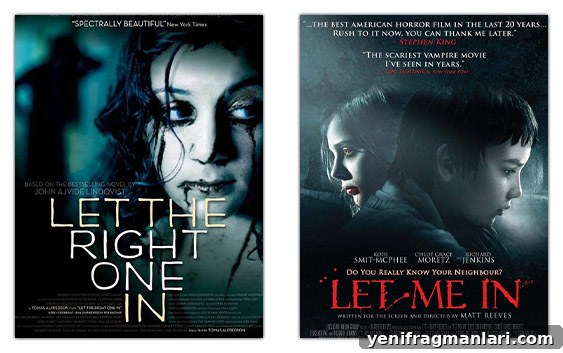
One of the most notable pairs in this conversation is Tomas Alfredson’s Swedish coming-of-age horror Let the Right One In and Matt Reeves’ American remake Let Me In. Both films are exceptional in their own right, offering two distinct cinematic approaches to the same core story: an isolated, bullied boy forming a complex bond with a mysterious vampire child who moves in next door.

Alfredson’s 2008 adaptation of John Ajvide Lindqvist’s novel (originally published as Låt den rätte komma in) made a powerful international impression. His film preserves much of classic vampire lore while reshaping it through a bleak, wintry lens and an intense focus on pre-teen emotion and social isolation. The Swedish original relies on mood, ambiguity and a subtle narrative that leaves room for interpretation: the nature of Eli’s past, the depth of Håkan’s relationship with her, and Eli’s true feelings for Oskar are all filtered through suggestion rather than explicit explanation.
Two years later Matt Reeves reimagined the story for an American audience with Let Me In, keeping the story’s early-1980s setting but relocating events from Stockholm to a snowbound New Mexico. While Reeves has said his film draws from the novel as well as the screenplay, the remake follows many of the same beats and recreates key moments and images from Alfredson’s version. Rather than a bare reinterpretation, Reeves offers a different tone—sharper character work, a clearer emotional through-line and some new political subtext that reflects its U.S. setting.
Both films center on a lonely boy—Oskar in the Swedish film, Owen in the American version—whose life is defined by bullying and family neglect. Both boys meet a childlike but ancient vampire who calls herself Eli (and Abby in the remake). Their relationship evolves into a fragile, unusual companionship that forces both characters to confront violence, loyalty and the limits of love. The moral and emotional ambiguities of their bond are what elevate both films beyond genre fare into resonant human drama.

Alfredson’s Let the Right One In excels as a slow-burning horror and a piercing social drama. Its patient pacing and atmospheric dread create a sense of relentless unease, while the film also charts Oskar’s emergence from passive victimhood to someone capable of defiance. Lina Leandersson’s performance as Eli is haunting—enhanced by the production choice to alter her voice to an androgynous, otherworldly tone—which intensifies the character’s unsettling presence and highlights the film’s humanist core.
Let Me In finds strength in deeper characterization and small shifts in perspective. Richard Jenkins’ portrayal of the character analogous to Håkan brings pronounced empathy and sorrow, rendering the guardian figure more emotionally accessible and tragic. Reeves’ film also intentionally distances Owen from his mother through framing and focus, emphasizing his isolation. The American remake makes different storytelling choices: it embraces slightly more conventional character arcs, foregrounds a moody score, and layers in cultural references—such as nods toward 1980s American politics—that subtly alter the film’s context without betraying its source.
Visually and thematically, the two films share many similarities, yet each creates a distinct experience. Alfredson’s original leans into raw, spiritual horror grounded in human relationships; Reeves’ remake is cleaner in its narrative flow, more explicit in character sympathy, and polished in production values. Importantly, Reeves resists the temptation to add gratuitous spectacle: the film’s effects and action sequences, including its more violent moments, serve the story rather than overwhelm it.
Deciding which film is superior ultimately comes down to personal taste. If you prefer an austere, haunting atmosphere and a film that preserves mystery and ambiguity, Let the Right One In will likely resonate more. If you prefer a slightly more conventional, character-driven drama with clearer emotional beats and polished filmmaking, then Let Me In may be your choice. Seen together, the two films complement one another—two cinematic lenses on the same central myth of boy meets not-quite-girl amid blood and snow, each offering its own strengths without diminishing the other.