
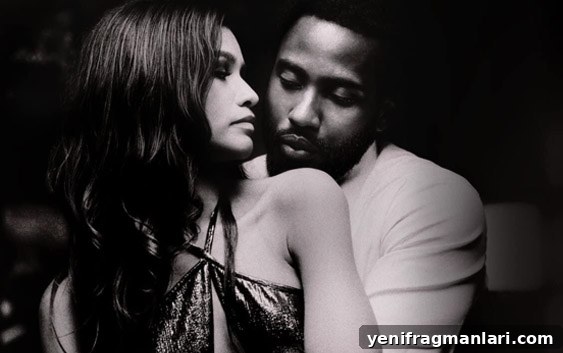
Malcolm & Marie (2021)
Director: Sam Levinson
Screenwriter: Sam Levinson
Starring: John David Washington, Zendaya
The Covid-19 pandemic closed theatres and production floors, forcing filmmakers to rethink how to create movies under strict limits. Malcolm & Marie is one of those lockdown productions: a contained, black-and-white chamber piece shot in a single house with a small crew. Its ambition is clear — stripped-back storytelling, intense performances and striking cinematography by Marcell Rév — but the result is a mixed one. The film’s visual precision and deliberate staging contrast sharply with a screenplay that often feels repetitive and emotionally narrow.
The story follows a couple returning from a film premiere. Malcolm, a director played by John David Washington, gives a triumphant speech and then, offstage, forgets to publicly thank his girlfriend Marie, played by Zendaya. That omission sparks a late-night argument that unfolds for the rest of the film. The setup is minimal by design: a single location, two characters, and a long stretch of dialogue that aims to probe love, art, fame and race.
Visually, Malcolm & Marie is impressive. The decision to shoot in high-contrast black and white gives the film a formal, theatrical quality and allows Rév’s camera to emphasize faces, gestures and the textures of the house. There are shots that linger and compositions that feel carefully composed, and the film often looks striking enough to warrant a close visual examination. These elements make it easy to appreciate the technical achievement of shooting a feature during lockdown with a tiny crew.
But the screenplay undermines much of the promise. Sam Levinson’s writing leans on long monologues, repeated rhetorical beats and a pattern of exchanges that begins to feel engineered rather than spontaneous. Arguments repeat similar points, falling into a predictable rhythm: Malcolm escalates, Marie responds, Malcolm retreats into music, Marie smokes outside — rinse and repeat. The repetition robs many scenes of momentum and reduces conflict to a series of staged confrontations rather than a developing emotional arc.
The film explicitly raises topical issues about race and recognition. Malcolm boasts about critics and the praise his film has received, and the script tries to wrestle with how Black artists are read and valued in contemporary culture. Those are important themes, but they are complicated by the fact that the writer-director is a white man exploring the subjective experiences of Black creators. Even when spoken by Washington and Zendaya, the lines sometimes feel like arguments written from a distance rather than from lived experience. That dissonance weakens the film’s credibility when addressing questions of authorship and artistic labor.
As characters, Malcolm and Marie are intense but not always fully realized. Malcolm is drawn as a charismatic, arrogant artist whose ego and insensitivity propel many of the film’s conflicts. He alternates between performative vulnerability and self-justification, and the character’s singularity makes it hard to empathize with him. Marie, meanwhile, is positioned as a wounded, talented woman whose history and creative contribution are often invoked but not explored in depth. Zendaya brings nuance and emotional clarity to Marie’s moments of pain, but the script frequently confines her to reactive lines rather than allowing her a more complex interior life.
There are brief, potent moments: a laugh at a paywall blocking the first published review, a quiet exchange that reveals real hurt, a gesture that lands with honesty. Washington and Zendaya demonstrate remarkable chemistry and a commitment to the material; their performances contain flashes of the intensity the film aspires to sustain. But those high points are undercut by the film’s tendency toward lecturing, particularly when it returns to didactic riffs about critics and artistic integrity. The film states its premise — that critics can wound and that artists can be fragile — early on, and then frequently circles back to the same assertions rather than developing them in surprising or deeper ways.
Malcolm & Marie invites comparisons to other successful two-character, single-location films such as My Dinner with André, Persona and Before Sunset. Those films sustain their focus by layering ideas, building organic shifts in perspective and revealing new facets of character. By contrast, Malcolm & Marie often substitutes volume and performance for complexity. It is a technically accomplished piece with two committed leads and memorable visual design, but its emotional and intellectual payoff feels limited.
Ultimately, the film is a study in contrasts: beautiful to look at yet repetitive in argument, powerful in isolated moments yet uneven across its runtime. It’s a lockdown-era curiosity that showcases what can be achieved with a tiny production, a strong cinematographer and two energetic lead performances. But as a dramatic statement about art, race and relationships, it too often settles for confrontation over insight. For viewers drawn to intense, actor-driven duologues and stark cinematography, Malcolm & Marie will offer satisfying scenes. For those seeking a layered exploration of its themes, the film may feel frustratingly thin.
7/24