
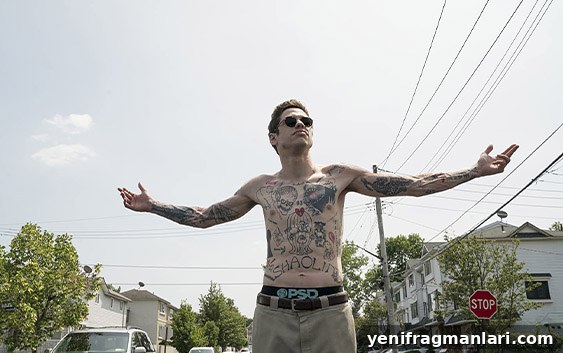

The King of Staten Island (2020)
Director: Judd Apatow
Screenwriters: Pete Davidson, Judd Apatow, Dave Sirus
Starring: Pete Davidson, Bel Powley, Marisa Tomei, Maude Apatow, Bill Burr
Pete Davidson’s performance in The King of Staten Island positions him as a modern-day Peter Pan who resists growing up, preferring the aimless safety of his mother’s home over adult responsibility. Best known to many from his time as a young cast member on Saturday Night Live, Davidson developed a public persona that blends self-deprecating humor, candid vulnerability, and an everyman stoner charm. That persona is central to this semi-autobiographical film, which Davidson co-wrote with Judd Apatow and Dave Sirus and has described as roughly seventy-five percent based on his own life.
The film follows Scott, played by Davidson, a twenty-four-year-old living in his mother’s Staten Island house with no steady job, vague ambitions, and a habit of spending his days tattooing friends, watching cartoons, and getting high. Scott’s inertia is rooted in unresolved grief: his father, a firefighter, died in the 9/11 attacks, and the loss hardened into a long shadow that shaped Scott’s emotional development. Where his younger sister Claire (Maude Apatow) takes steps toward college and independence, and his girlfriend Kelsey (Bel Powley) pursues plans with purpose, Scott remains stuck, using his father’s memory as a justification for a life he hasn’t tried to build.
That dynamic produces some of the film’s most affecting moments. In a raw exchange with his sister, Scott explains how knowing their father might have ruined her by setting an impossible standard. It’s a line that exposes both his reverence and his resentment, and it helps the audience understand how grief can be weaponized to excuse stagnation. The screenplay allows these honest, painful reveals to surface among broader comedic beats, and Davidson’s frank vulnerability anchors many of the film’s emotional high points.
The plot accelerates when Scott tattoos a young boy, setting off a confrontation with the boy’s father, Ray (Bill Burr), who is also a firefighter. Ray’s brusque arrival upends the household, and when Scott’s mother (Marisa Tomei) falls for him, Scott faces the unnerving prospect of someone who both challenges his sloth and represents a living link to the man he idealizes. Ray pushes Scott toward growth, not out of malice but out of insistence that Scott take responsibility for his life. That tension—between loyalty to memory and the need to live in the present—drives the film’s emotional core.
Judd Apatow’s direction leans into the familiar territory he’s cultivated across comedies about reluctant adults—characters who are often funny, messy, and emotionally stunted. Apatow balances slapstick and crude humor with moments of sincere pathos, and his collaboration with Davidson brings an unusually personal edge to this material. The King of Staten Island is more overtly serious than many of Apatow’s earlier comedies, and it often succeeds at mining laughs while confronting depression, trauma, and the liminal space between adolescence and adulthood.
However, the film is not without flaws. Clocking in at over two hours, it occasionally wanders into indulgent set pieces—ill-conceived robbery scenes and extended party sequences that add little to character development. Those detours dilute the film’s emotional momentum, scattering powerful scenes among throwaway gags. Still, tucked between the looser bits are moments of genuine tenderness: an intimate conversation about antidepressants and sexual side effects between Scott and Kelsey, for example, reveals his insecurities with clarity and restraint. Bel Powley’s performance as Kelsey is a standout; she brings warmth, wit, and grounded chemistry that elevate many scenes.
Ultimately, the film’s greatest strength is its beating heart. Davidson’s Scott is an oddly compelling protagonist because his flaws feel lived-in rather than contrived. When the story leans into grief—such as an uneasy outburst at a firefighter gathering—the performance cuts deep, offering an unvarnished portrait of pain that coexists with comedic awkwardness. These moments are why the film resonates: they remind viewers that comedy can hold sorrow and that laughter and grief often sit side by side.
As with many semi-autobiographical comedies, The King of Staten Island resists a tidy, conventional ending. Scott’s arc closes not with neat resolution but with guarded forward movement—an honest choice that reflects how real people often leave adolescence without all questions answered. That ambiguity may frustrate viewers seeking a classic Apatow wrap-up, but it also honors the film’s subject matter by acknowledging that recovery and maturity are ongoing processes.
Despite its occasional narrative looseness, the film marks a clear step forward for Pete Davidson as an actor and creative voice. Translating personal trauma into a performance that blends comedy and catharsis is a difficult balance, and Davidson largely succeeds. The King of Staten Island is funny, candid, and affecting: a messy but heartfelt tribute that pays respect to loss while insisting life can continue—imperfectly, and sometimes with a laugh.
Bel Powley (left) and Pete Davidson (right) in The King of Staten Island (2020).
18/24