
Peninsula (2020)
Director: Yeon Sang-ho
Screenwriters: Yeon Sang-ho, Park Joo-Suk
Starring: Gang Dong-won, Lee Jung-hyun, Kim Min-jae, Koo Kyo-hwan, Kim Do-yoon, Kwon Hae-hyo, Lee Re, Lee Yi-won
Peninsula, the standalone follow-up to the breakout hit Train to Busan, feels shamelessly derivative at times, especially compared with the film’s more inventive predecessor. Yet while it leans heavily on familiar genre beats, Yeon Sang-ho’s zombie-action picture still delivers crowd-pleasing spectacle and enough character moments to keep it diverting for fans of post-apocalyptic cinema.
The premise is simple and grim: four years after an outbreak decimates Seoul and Busan, the Korean Peninsula has been effectively quarantined from the outside world. Cities are overrun, most of the population is either infected or displaced, and isolated gangs of marauders and hardy survivor groups pick through the ruins. Guilt-ridden ex-soldier Jung-seok (Gang Dong-won) and his widowed brother-in-law Chul-min (Kim Do-yoon) accept a high-risk contract from gangsters based outside the peninsula to retrieve a truck full of cash abandoned in Busan. What begins as a raid quickly turns into a desperate fight to escape a ruined city that is both hostile and eerily familiar.
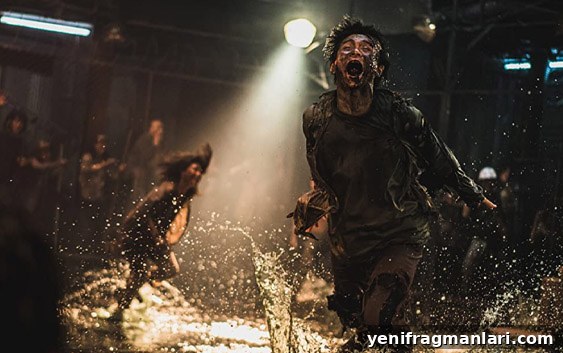
The film’s central appeal remains its depiction of the undead. Yeon leans into a fast, jerky, rictus-like movement for his infected that calls to mind other contemporary visions of the living dead while retaining its own physical signature through committed performances from the extras. These zombies are tireless and physically unsettling, yet not infallible: they respond to light and noise, and many sequences play off how they can be distracted or corralled. The movie oscillates between brutal set-pieces—zombie bloodsport arenas, tidal surges of bodies spilling from overpasses—and moments where the horde is almost cartoonishly outwitted by a toy-like remote-control car or stalled by open vehicle doors.
Where Peninsula falters is in its wholesale borrowing from other action franchises. The film frequently slides into “Mad Max”-style road-warrior territory, calls back to jungle-and-island thrillers, and even flirts with game-show brutality reminiscent of dystopian entertainments. These tonal shifts broaden the canvas but also dilute narrative focus: set pieces replace a tightly contained plot, and the film’s identity blurs under the weight of homage and pastiche.
Performances are mixed. Gang Dong-won anchors the film with a weathered, emotionally taut turn as Jung-seok, and Lee Jung-hyun provides a stable counterpart. The young actresses playing resourceful sisters—Lee Re and Lee Yi-won—bring energy and levity when the script needs it most. By contrast, several antagonists are exaggerated to the point of caricature. Kim Min-jae and Koo Kyo-hwan play marauder leaders whose relish for cruelty and theatrical villainy undercuts any plausibility; their glee at staging prisoner-versus-zombie spectacles often feels like over-acting rather than menace.
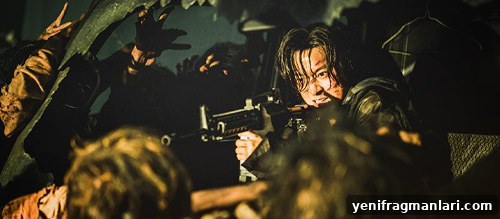
Yeon Sang-ho shows clear skill with action staging and kinetic choreography, but the film’s biggest set pieces sometimes suffer from an artificial sheen. Budgetary and practical limits are visible in certain CG-heavy moments, where large-scale sequences feel unevenly realized. The movie’s strongest action occurs early, when a small, ragtag group sneaks into Busan at night, threading through a maze of abandoned cars and trying not to trigger alarms that would draw the infected. One memorable rescue arrives in the form of an armored vehicle driven by a teenager, a spectacle that briefly returns the film to grounded, visceral thrills. By contrast, the film’s long final car chase overstays its welcome: it feels dated and overextended, with stunts and edits that at times look rushed or digitally softened.
Part of what made Train to Busan so effective was its tight, confined setting, which amplified tension and character drama. In doubling down on scale, Peninsula loses some of that concentrated suspense. The villains’ motivations are often vague, and the survivors drift between sequences with survival as their only unifying objective. As a result, emotional stakes can feel sporadic rather than sustained.
Watching a film about an escalating viral outbreak in 2020 inevitably adds an unintended resonance for contemporary audiences. That context can make some of the imagery and scenarios feel sharper, but it doesn’t fundamentally change the movie’s strengths and weaknesses: it remains an entertaining, if uneven, entry in the zombie-action subgenre. For viewers who want big set-pieces, fast-moving undead, and muscular action from Yeon Sang-ho, Peninsula will satisfy. For those hoping for the emotional clarity and inventive economy of its predecessor, it may feel overambitious and unfocused.
11/24
Peninsula review, Yeon Sang-ho, Gang Dong-won, Train to Busan sequel, zombie action film — an entertaining but flawed expansion of a familiar post-apocalyptic world that favors spectacle over the tight, character-driven tension of the original.