
Star Wars: Episode VIII – The Last Jedi (2017)
Director: Rian Johnson
Screenwriter: Rian Johnson
Starring: Mark Hamill, Carrie Fisher, Adam Driver, Daisy Ridley, John Boyega, Oscar Isaac
At about 1 hour and 11 minutes into The Last Jedi, Rey and Kylo Ren experience a Force connection that stands out for its subtlety and visual clarity. Rather than presenting the exchange as a single, fantastical vision, the scene intercuts between the two characters’ perspectives, showing each of them in their distinct locations. Rey is framed against jagged, shadowed rock—an external reflection of her inner uncertainty—while Kylo appears bare-chested and stark in his own quarters, a simpler, more honest presentation that underscores his current mindset. The contrasting shapes—Rey’s harsh angles and Kylo’s softer curves—reinforce their differing relationships to the past and their places in the story.
Their opening lines establish that the connection is involuntary and personal. Rey cannot understand how Kylo could kill his father, and Kylo responds with a cold logic: family is weakness. He allows Rey to see Luke’s moment of hesitation when he briefly contemplated killing his nephew, and the abrupt editing makes it clear she has witnessed it too. Kylo then delivers one of the film’s most crucial lines: “Let the past die. Kill it if you have to.” That phrase becomes a thematic throughline for the movie.
The Star Wars franchise finds itself at a transition point: younger viewers who grew up with the Prequels are now adults, the modern cinematic landscape has shifted toward shared universes, and new leadership at Lucasfilm and Disney has different ideas about how to move the saga forward. Much of Disney’s output has leaned on familiar eras and nostalgic beats, often postponing a true leap into uncharted territory. The Last Jedi reads like an effort to push forward while still operating within those constraints—trying to honor what came before while embracing change.
I don’t love every choice the film makes, but most of it fits within the spirit of Star Wars. A sequence about saving creatures on a casino world might feel frivolous to some, but it aligns thematically with the franchise’s long-standing opposition to oppression. Moments of levity, such as Poe’s quips, are in keeping with the series’ tradition of mixing humor into high-stakes drama. Personal taste will always shape responses to such choices, but the film contains enough thoughtful work to outweigh its missteps.
Rey’s training with Luke echoes the arc of a young apprentice learning from an older master, and the film leans into the mystical, introspective aspects of Jedi lore. Her sequences of feeling the island and its life through the Force—accompanied by a carefully chosen musical backdrop—effectively immerse the viewer in her sensations: warmth, cold, light and darkness. One of the film’s most striking images is a root-filled pit that seems to pull her in with dark energy. The movie also quietly showcases the power of an unsuspecting Force-sensitive character in the emotional sequence involving Leia, reminding us the Force can manifest in surprising ways.
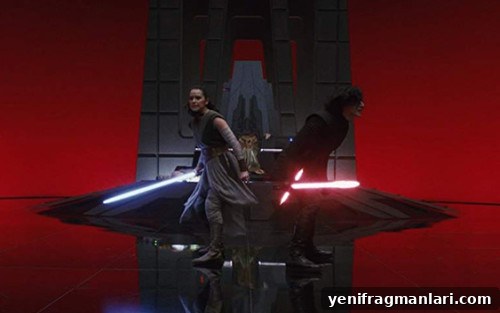
Rian Johnson’s production design and art direction deserve praise for creating environments that sit comfortably within the franchise while bringing fresh touches. Costuming references the Imperial era without imitation, and the casino’s fashions are an inventive riff on high-society aesthetics. Snoke’s throne room is visually arresting, and the mineral surface of Crait plays directly into the power of the film’s final confrontation and Luke’s decisive moment.
Two of the story’s most debated elements—the handling of Rey’s origins and the abrupt fate of Snoke—reflect the film’s core argument about legacy. Snoke primarily functions as an immediate, menacing presence, but he also operates as a cipher: a Palpatine-like shadow whose mystery serves more as a mirror for Kylo than as a standalone figure. Revealing Rey as a person from humble beginnings, disconnected from galactic dynasties, sidesteps soap-opera genealogy and turns her into a stand-in for the audience: someone who came to these events by hearing stories. That choice allows her to develop independently and contrasts her arc with Kylo’s more entangled past.
Johnson wisely trims peripheral material to focus on character-driven episodes and thematic throughlines—wonder, change, and possibility. This economy enables smaller moments to resonate, such as a sidelined stable boy using the Force to retrieve a broom, implying that heroism can rise from unexpected places and that the Force isn’t reserved for a lineage of elites.
It’s fair to observe that the movie’s overall structure still riffs on the classic Rebels-versus-Empire framework and draws parallels with The Empire Strikes Back. Those structural echoes are partly a symptom of the franchise’s recent direction and the choices made by previous filmmakers. Acknowledging that resemblance is important, and the film speaks candidly to the franchise’s struggle between honoring its past and breaking toward new eras.
Looking forward, key questions remain: will future films continue to circle the Skywalker era, or will the franchise embrace a bold shift in time, tone, and character dynamics? Can Star Wars thrive as a cinematic universe similar to other franchises, or does it succeed best as a series of distinct, event-driven entries? The Last Jedi argues for making room to let the past go and for creators to explore fresh ground. Rian Johnson demonstrates a clear cinematic voice, and it would be exciting to see that energy applied to a new chapter unburdened by legacy constraints.
19/24