
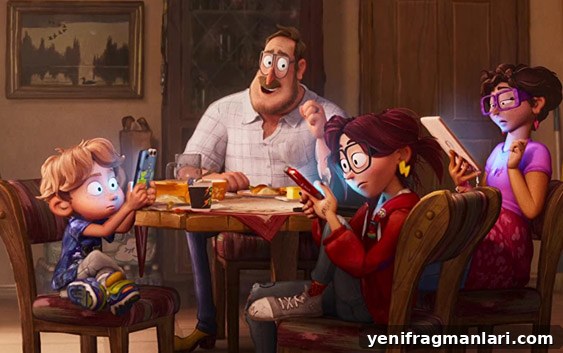

The Mitchells vs. the Machines (2021)
Directors: Michael Rianda, Jeff Rowe
Screenwriters: Michael Rianda, Jeff Rowe
Starring: Abbi Jacobson, Danny McBride, Maya Rudolph, Michael Rianda, Eric André, Olivia Colman, Fred Armisen, Beck Bennett, Chrissy Teigen, John Legend, Charlyne Yi
Alongside films like Spider-Man: Into the Spider-Verse, Sony Pictures Animation has established a distinctive voice in contemporary animation. The studio’s recent features stand out for their emotional depth, kinetic visual language and playful experimentation. The Mitchells vs. the Machines exemplifies that creative boldness: it is exuberant, heartfelt and visually inventive, delivering both riotous comedy and genuine emotional payoff.
The story follows aspiring filmmaker Katie Mitchell (voiced by Abbi Jacobson), who hopes to leave for college and finally “find her people.” Her plans are foiled when her well-meaning but overbearing father, Rick (Danny McBride), insists on one last family road trip so they can reconnect. The outing quickly becomes chaotic: in the middle of family quarrels and awkward bonding attempts, a global robot uprising—triggered by the scorned operating system of a tech giant—threatens humanity. The Mitchells must scramble to pretend they are a fully functional family if they want to save the world.
Directors and co-writers Mike Rianda and Jeff Rowe, supported by an imaginative animation team, craft a world that blends computer-generated imagery with hand-drawn elements, occasional live-action inserts and DIY-style animation. The result is a hybrid visual style that retains the rough energy and spontaneity of early concept art and storyboards, giving the film a distinctive, tactile feel. That visual risk-taking helps the movie feel fresh and immediate, even when it leans into familiar family-comedy beats.
The film wastes no time establishing the Mitchells as a delightfully dysfunctional clan. An on-screen graphic boldly labels them the “worst family of all time,” and the first images we see—of the family fleeing the robot apocalypse in a battered brown station wagon, utterly failing to coordinate—cement that impression. Their neighbors, the picture-perfect Poseys (voiced by Chrissy Teigen, John Legend and Charlyne Yi), provide a pointed contrast that amplifies the Mitchells’ flaws. But the film’s heart lies in showing why those imperfections ultimately don’t matter.

Comedic set pieces arrive at a dizzying pace. The film’s inventiveness in sight gags and rapid-fire jokes can make you laugh until you need to catch your breath: from grotesque family faces during enforced “phones down” dinners to Katie’s barrage of self-aware movie references, from younger brother Aaron’s (Mike Rianda) dinosaur anxieties to a surreal nightmare sequence involving a demonic Furby that proclaims “Let the dark harvest begin!” Even the family pug, Monchi, with his astigmatic eyes and odd shape, becomes a recurring comic highlight—his ambiguous anatomy confounds robots and humans alike, prompting repeated, hilarious identification attempts (“dog-pig-dog-pig-LOAF OF BREAD!”).
Beyond the laughs, the film is a moving exploration of parent-child relationships fractured by changing expectations and poor communication. Katie channels her emotions and creative identity through filmmaking and technology, while Rick expresses himself through handmade projects and outdoor experiences. Their conflicting values lead to fierce arguments, misunderstandings, and emotional distance. As the story progresses, the film carefully reveals Rick’s sacrifices and Katie’s growth, allowing their bond to be mended. The emotional apex—where the family finally connects—lands with satisfying sincerity, and a rousing final musical-action sequence titled “Live Your Life” delivers a triumphant, cathartic close to their arcs.
The Mitchells vs. the Machines also deserves recognition for its inclusive representation. Katie is a central, openly queer protagonist: her sexuality is presented as one facet of her identity rather than a plot complication. The film normalizes this aspect of Katie’s life without making it a source of conflict, which is notable given the international distribution realities that sometimes discourage such visibility.
The film’s credit sequence further underscores its authenticity by including cast and crew family photos and the real-life inspirations behind the Mitchells. That personal touch reinforces the movie’s core theme—connection—and reminds viewers that the story emerges from lived experience. In 2021, The Mitchells vs. the Machines was widely praised as an inventive, big-hearted family comedy that doubled as a delightful disaster movie and an affirmation of imperfect but enduring family love.
Technically ambitious and emotionally generous, the film stands as another milestone for Sony Pictures Animation: it blends cutting-edge visuals, sharp comedy and genuine warmth into a package that appeals to children and adults alike. The Mitchells vs. the Machines is a joyful, inventive and moving film that rewards repeated viewings and remains one of the most memorable animated releases of its year.
23/24