
The Flash (2023)
Director: Andy Muschietti
Screenwriters: John Francis Daley, Jonathan Goldstein, Christina Hodson
Starring: Ezra Miller, Sasha Calle, Michael Shannon, Michael Keaton, Ben Affleck, Jeremy Irons, Maribel Verdú
When the DC Extended Universe (DCEU) launched with Man of Steel in 2013, it entered a marketplace already energized by the Marvel Cinematic Universe (MCU) and the promise of large-scale superhero crossovers. The early DCEU strategy often prioritized spectacle and bold choices over careful world-building, leading to moments like Batman v Superman: Dawn of Justice arriving before audiences had fully met the new Batman. Nearly a decade later, the DCEU has reached a turning point as new leadership prepares to reshape the franchise. Against that backdrop, The Flash arrives with ambitions both commercial and sentimental: a multiverse story that leans on nostalgia, surprise appearances, and the emotional gravity of its protagonist’s personal history.
At first glance The Flash feels like it could be a calculated attempt to replicate the crowd-pleasing beats of recent franchise cinema. The film embraces familiar tricks—cameos, crossovers, and a multiverse premise—to draw audience interest. Yet rather than feeling entirely cynical, it manages to balance those elements with surprisingly sincere character work. The movie’s central strength is its willingness to ground big set pieces in a human story about grief, responsibility, and the consequences of trying to change the past.
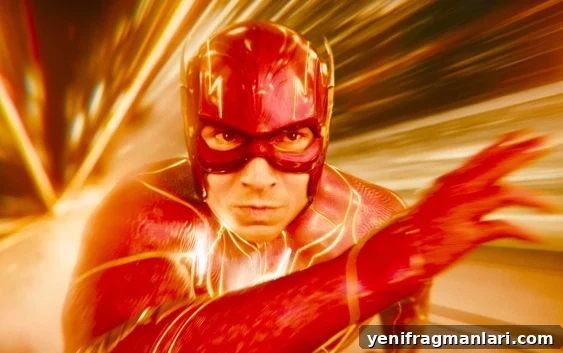
Ezra Miller’s Barry Allen is introduced as the more modest member of the Justice League, the one who’s usually sent out when others are tied up. That positioning immediately makes Barry relatable: he’s eager, awkward, and often the underdog, which opens the film to moments of genuine warmth and humor. Early sequences mix action with comedy as Barry handles a localized disaster while trying to prove himself. Some jokes land better than others, and a rescue scene staged in a multi-story hospital occasionally overreaches for laughs, but the film generally shows restraint when it comes to emotional stakes.
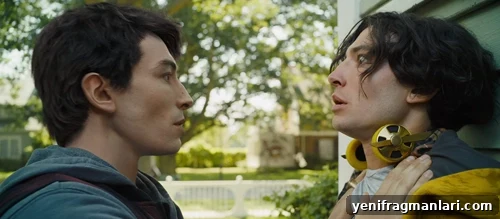
The emotional engine of the story is Barry’s attempt to fix a personal tragedy. As a child his mother was murdered and his father was imprisoned for the crime. Once Barry discovers he can run fast enough to traverse time, he sets his sights on rewriting that painful past. The setup is both emotionally credible and motivating: his desire to undo a life-shaping loss feels honest and immediate, even if the mechanics of time travel are presented in broad, fantastical strokes.
A major selling point of the film is the return of Michael Keaton as an older, weathered Batman. Keaton’s appearance is treated with reverence, drawing visual and tonal callbacks to the Tim Burton-era films without turning the sequence into pure fan service. The film uses these crossover moments as tributes—short, affectionate homages that acknowledge earlier eras of superhero cinema rather than simply exploiting them for reaction shots. That awareness helps The Flash avoid the mawkishness that can come from repeatedly engineering theatrical gasps.
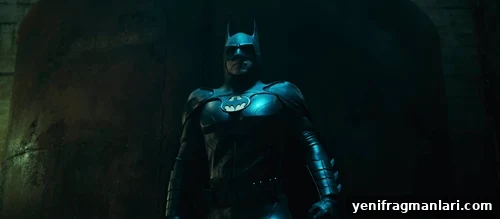
The film’s treatment of the multiverse largely works because it keeps tribute and storytelling in balance. Instead of collapsing into a string of cameo-driven moments designed only to provoke recognition, The Flash uses those encounters to deepen Barry’s arc and explore the emotional consequences of tampering with timelines. The collisions between different worlds are staged as respectful nods, allowing the narrative to honor previous iterations of these characters while still moving Barry’s personal journey forward.
Beyond its emotional core, The Flash delivers on genre expectations: there are kinetic chase sequences, inventive uses of Barry’s speed, and moments of genuine visual spectacle. That said, some aesthetic choices are uneven. Scenes where Barry travels through time are rendered with stylized CGI that deliberately resembles plasticine or animated reconstructions of reality. The approach likely aimed to create a unified look across disparate eras, but it often reads more like dated video-game cut-scenes than immersive cinematography, and the effect can be distracting.
Nevertheless, the film’s thematic focus—loss, unresolved grief, and the temptation to correct past mistakes—gives it an emotional weight that anchors the action. The Flash juxtaposes high-energy thrills with quieter, heartbreaking beats, allowing the audience to care about the consequences of Barry’s choices. While not every joke lands and some visual effects feel inconsistent, these flaws are forgivable because the movie succeeds at what matters most: making the viewer feel invested in its hero.
Performances are a mix of solid and memorable. Ezra Miller portrays Barry’s vulnerability and awkward heroism effectively, while supporting players add depth to the broader world he inhabits. Michael Keaton’s return is handled with dignity and nostalgia rather than pure spectacle, and the film wisely uses familiar faces to underscore the story rather than overpower it.
In sum, The Flash is a heartfelt, entertaining superhero film that often transcends the pitfalls of modern franchise filmmaking. It leans on multiversal spectacle and nostalgia but grounds those elements in a sincere character study about the cost of trying to undo grief. Despite occasional missteps in humor and effects, the movie balances action and emotion well enough to be worth watching for fans of the genre and for viewers drawn to more character-driven blockbuster fare.
Score: 16/24
Recommended for you: DCEU Movies Ranked
Written by Rob Jones