The Pope’s Exorcist (2023)
Director: Julius Avery
Screenwriters: Michael Petroni, Evan Spiliotopoulos, R. Dean McCreary
Starring: Russell Crowe, Daniel Zovatto, Alex Essoe
The tradition of using Catholic imagery and themes to evoke fear is long and storied in cinema. From landmark possession films to contemporary psychological horrors, filmmakers have consistently mined guilt, faith, and the institutional Church for unsettling narratives. In this landscape, Julius Avery’s The Pope’s Exorcist arrives as a modern entry in a well-worn subgenre, offering familiar tropes—an authoritative yet unorthodox priest, a fractured family, and eerie, claustrophobic settings—but ultimately it struggles to renew these elements into something consistently compelling.
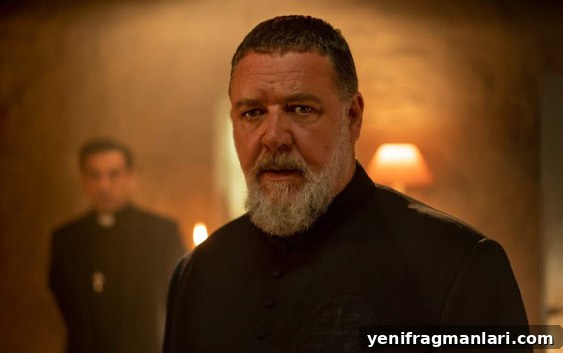
The film centers on Chief Exorcist Gabriele Amorth, portrayed by Russell Crowe, who presides over demon extraction for decades beginning in the early 1980s and extending into the twenty-first century. Amorth is presented as a defiant figure within the Church: blunt, irreverent, and convinced that confronting evil directly is necessary. The main storyline follows an American family who inherits and moves into an old Spanish abbey after the death of the father. Their mute, grief-stricken son Henry is soon targeted by a powerful demonic force that tears at the family’s stability. Amorth is summoned to confront this evil, setting up a familiar conflict between priest and possession.
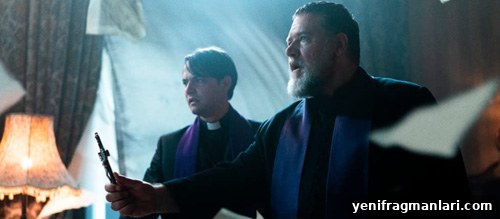
The film’s strongest sequence is its opening. In that early scene, Amorth arrives at a home where a young man appears possessed. Crowe gets to display a larger-than-life, occasionally humorous take on the exorcist figure—one who taunts a demon with sharp barbs and theatrical gestures. The scene blends bravado and cunning: when the “possessed” man speaks English and various inconsistencies appear, Amorth resorts to psychological theater, using performance and misdirection to break through what turns out to be a case of psychosis rather than a literal demonic takeover. This initial sequence hints at a movie that might interrogate faith, modernity, and the role of ritual, offering a meta-commentary on the Church’s place in a skeptical age.
Unfortunately, that promising opening is not fully realized. After briefly nodding to themes of modernization and the Church’s need to adapt—ideas that could have lent the film a contemporary edge—The Pope’s Exorcist retreats into conventional exorcism beat-for-beat. The script opts for familiar scares and set pieces instead of deepening the film’s earlier ambiguities about belief and performance. As a result, the movie often feels more like an action-adventure or a buddy picture built around the priest’s persona than a nuanced horror that plumbs modern spiritual anxieties.
Part of the broader problem is contextual: audiences in 2023 are not the same as audiences in 1973. Classic films that redefined the genre did so by shocking viewers with direct, unprecedented depictions of blasphemy and bodily violation tied to religious faith. Over the past fifty years, however, filmmakers and viewers have explored far more complex and varied spiritual crises. Contemporary works that succeed—films that interrogate grief, family trauma, and the erosion of institutional belief—tend to blur the lines between psychological and supernatural terror. They situate horror in the lived experience of characters rather than relying solely on ritualized exorcism tropes.
A clear modern reference point is Hereditary, which translates family trauma and grief into an escalating, intimate nightmare. The Pope’s Exorcist, by contrast, returns to the classic formula too readily. It leans heavily on established imagery: the isolated abbey, dramatic confrontations, and a linear priest-versus-demon structure that leaves little room for surprise. While Crowe’s performance is charismatic and textured—he brings menace, wit, and a weathered moral certainty to Father Amorth—his presence cannot fully compensate for a screenplay that rarely surprises or probes deeper psychological or theological questions.
Visually and tonally, the film delivers some tense moments and effective set pieces: shadows, sudden noises, and ritualized confrontations are staged cleanly and professionally. Yet when the film shifts back to textbook exorcism solutions and predictable scares, the tension dissipates. What could have been an exploration of institutional doubt, performance, and the evolving nature of faith instead becomes a serviceable but forgettable entry in the possession genre.
For viewers seeking a straightforward exorcism movie with a commanding lead, The Pope’s Exorcist offers moments of entertainment and a memorable central performance. For those looking for a fresh, psychologically layered take on spiritual horror that reflects contemporary anxieties about faith and family, the film is likely to feel safe and conventional.
Score: 10/24