
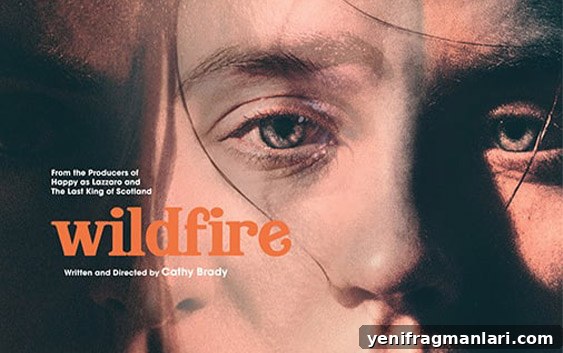
Wildfire (2020) — Film Review
This article was written exclusively for The Film Magazine by Jack Cameron.
Wildfire (2020)
Director: Cathy Brady
Screenwriter: Cathy Brady
Starring: Nika McGuigan, Nora-Jane Noone, Kate Dickie, Martin McCann
Opening with a montage of archival-style footage—soldiers on Belfast streets, bombs, arrests, incarceration and family tragedy—Wildfire quickly situates itself in the long shadow of Northern Ireland’s Troubles. The film compresses decades of political upheaval into a taut, unsettling prologue that highlights the Good Friday Agreement and the controversial early release of political prisoners before fast-forwarding to contemporary anxieties centred on Brexit. The threat of a hard border and the fragile nature of peace become the atmospheric backdrop for the drama that follows.
The story begins when Kelly (Nika McGuigan) returns home unexpectedly, hitchhiking back into a life she left under unclear circumstances. Her arrival is met with a guarded, almost chilly reception from her sister Lauren (Nora-Jane Noone). The tension between them is immediate and layered: Kelly’s return feels both necessary and disruptive. As Cathy Brady’s feature debut unfolds, the sisters are forced to confront old wounds and re-open suppressed memories. The film prioritizes tone and mood over explicit exposition, asking viewers to fill the silences and sense the weight of what remains unspoken.
Brady crafts a persistent sense of unease, a feeling that something in the air could unsettle everything at any moment. This nervous energy is reflected in Lauren’s job at a fulfilment warehouse—an environment of relentless productivity and timed tasks where a single failure triggers alarm. That professional pressure mirrors the wider political and societal strain surrounding Brexit and the enduring fragility of peace in Northern Ireland. In this way, Brady draws a parallel between the dehumanising mechanisms of modern labour and the larger political forces that continue to shape ordinary lives.
The film’s strongest moments are those where mood and metaphor align: quiet domestic scenes inflected by historical trauma, the relentless hum of industry as a metronome for anxiety, and the sisters’ tentative attempts at connection. Yet while the atmosphere is consistently compelling, the narrative itself often feels dispersed. Wildfire touches on many themes—family violence, suicide, generational trauma, political instability—without always committing enough screen time to fully develop each thread. The violent death of the sisters’ father and the mystery surrounding their mother’s suicide are revelations that should carry great emotional weight, but the film sometimes holds back the kind of resolution or exposition that would make these plot points land with the force they deserve.
Performance-wise, Nika McGuigan and Nora-Jane Noone are the film’s anchors. Both actresses bring depth and a raw vulnerability to their roles, making the sisters feel lived-in and authentically fraternal. Their interactions convey a shared history and mutual dependence: one sister can chip away at the other’s armour, and in quieter moments their grief and tenderness find a believable, heartbreaking rhythm. The decision to keep much of their backstory ambiguous allows their relationship to remain the emotional core, even when the screenplay falters in other areas.
Where the film struggles is in differentiation and dramatic friction. Despite clear cues that Kelly is the more volatile sibling, both characters often echo one another in tone and behaviour. The lack of true confrontational arcs between them reduces opportunities for dramatic transformation; instead of clashing and transforming, the sisters frequently loop back into each other’s pain. This creative choice preserves the film’s meditative texture, but it also contributes to a sense that the plot stalls rather than evolves.
Wildfire should be commended for ambition, atmosphere and some genuinely striking moments of filmmaking. Cathy Brady demonstrates a confident visual style and an ability to weave political context into intimate storytelling. Still, the film ends feeling a touch unfinished: more an evocative mood piece than a satisfying narrative journey. It leaves viewers with a hazy, melancholic impression—an accurate reflection of lives fractured by history, but not always a fully coherent cinematic resolution.
12/24
Written by Jack Cameron
You can support Jack Cameron in the following places:
Twitter – @JackCam86118967
Contently – Jack Cameron