
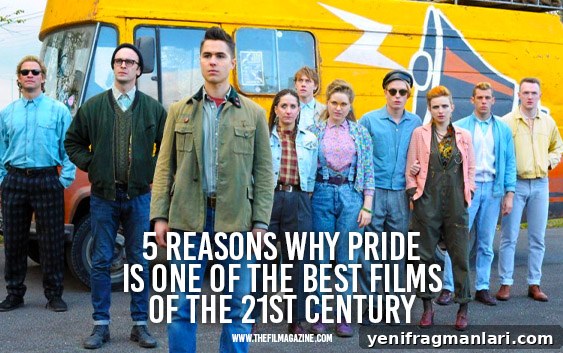
Pride (2014) stands out as one of the most affecting British films of the 21st century. In just 122 minutes, director Matthew Warchus and screenwriters manage to weave together the 1984–85 miners’ strike, the emerging gay liberation movement, and the early days of the AIDS crisis into a single uplifting and political story.
Pride is inspired by the true story of LGSM (Lesbians and Gays Support the Miners) and the unexpected friendship that developed between activists in London and a small mining community in Wales. LGSM was founded in 1984 by Mark Ashton (portrayed in the film by Ben Schnetzer) and Mike Jackson (Joseph Gilgun), and famously raised thousands of pounds to support striking miners. The film celebrates solidarity, humour, and a courageous coming together of different communities during a turbulent era.
Make sure to follow us on Twitter to make sure you never miss another list like this one.
1. The Blending of Political Agendas
“I support you whoever you are, hand to hand, shoulder to shoulder, as it should be.”
Pride is unabashedly political while remaining accessible and human. The film brings together two groups who, at first glance, seem to have little in common: striking miners fighting industrial decline and gay and lesbian activists campaigning for equality. Rather than dwelling solely on conflict, the movie shows the real hardships each group faces—Gethin (Andrew Scott) removing homophobic graffiti and miners like Dai (Paddy Considine) coping with disconnections to basic utilities—so the audience understands what motivates both sides to act.
While some historical details are softened for dramatic balance—such as Mark’s explicit political affiliations—the film keeps politics at its emotional centre. It invites viewers to empathize with people pushed to the margins by government policy, social prejudice, and economic hardship, and it celebrates the solidarity that can grow from shared struggle.
2. A Quiet, Powerful Coming-Out Scene
One of the film’s most tender moments comes when Cliff (Bill Nighy) quietly tells Hefina (Imelda Staunton) that he is gay while they make sandwiches for the miners. There is no dramatic reveal—Cliff’s confession is simple and understated, and Hefina’s calm reply, “I know,” offers immediate acceptance.
That exchange captures the relief of being seen and understood. Cliff has been reserved and cautious, and the scene marks a real emotional shift for him. It’s a model of how coming-out scenes can be honest and moving without spectacle: recognition, love, and everyday kindness provide the emotional payoff.
3. ‘God I Miss Disco’ — The Soundtrack
The soundtrack of Pride is carefully curated and brilliantly deployed. Combining disco classics, pop hits of the era, and folk songs with political resonance (including a memorable rendition of the strike ballad “Bread and Roses”), the music reflects the film’s joyful and defiant spirit.
One standout sequence shows Jonathan breaking into dance in a Welsh pub, performing to Shirley & Company’s “Shame, Shame, Shame.” The scene shifts the mood from awkward distance to contagious fun: Dominic West’s energetic dancing wins over local men and women, bridges cultural gaps, and ushers the two groups toward mutual understanding.
4. A Charming Ensemble, Especially Mena Trussler as Gwen
The cast of Pride mixes seasoned actors and rising talent to great effect, creating a warm ensemble full of distinct voices. Mena Trussler’s Gwen is a scene-stealer: blunt, curious, and funny, she connects the miners and LGSM by inviting them to her town and then charging head-first into new experiences.
Gwen’s unfiltered questions—like wondering whether all lesbians are vegetarians—provide comic relief while also challenging assumptions. She forms genuine friendships with the LGSM women and brings a joyful energy to scenes both small and large. Her loud, affectionate call of “Where are my lesbians?” late in the film is one of the movie’s most uplifting moments.
5. A Hopeful, Political Finale
The film closes on a powerful image of solidarity. One year after the initial meetings, LGSM prepares to march in London for Pride. A mini bus arrives from Wales, followed by an entire fleet of buses from other mining communities ready to support the march. The sight of miners and their families marching alongside LGBT groups to the tune of Billy Bragg’s “There Is Power In A Union” is a genuine cinematic high point.
The epilogue ties up several character arcs: Sian’s later political achievements, Mark Ashton’s tragic early death from AIDS-related complications, and Jonathan’s long-term survival after an HIV diagnosis are all noted onscreen. The ending balances political urgency with emotional uplift—an appropriate and moving close to the story of LGSM’s unlikely alliance.
What makes Pride memorable is how it combines politics, humour, music, and human connection into a story that still resonates. Its portrayal of solidarity across social divides, its warm performances, and its carefully chosen soundtrack make it a film that continues to inspire conversations about activism, identity, and community.
Share your thoughts in the comments: which scenes or songs from Pride stay with you, and how does the film influence the way you think about solidarity today?