
Directors: Michael Powell, Emeric Pressburger
Screenwriters: Michael Powell, Emeric Pressburger
Starring: David Niven, Kim Hunter, Roger Livesey, Marius Goring, Raymond Massey, Abraham Sofaer, Robert Coote, Kathleen Byron
Michael Powell and Emeric Pressburger’s A Matter of Life and Death opens in a way that immediately signals the film’s blend of whimsy and seriousness. It begins with two light jokes—a tongue-in-cheek disclaimer and a wry, omniscient observation about the universe—before unfolding into a story that mixes romantic drama, fantasy, and a philosophically organised afterlife. That tonal confidence is one of the reasons the film remains memorable and influential decades after its release.
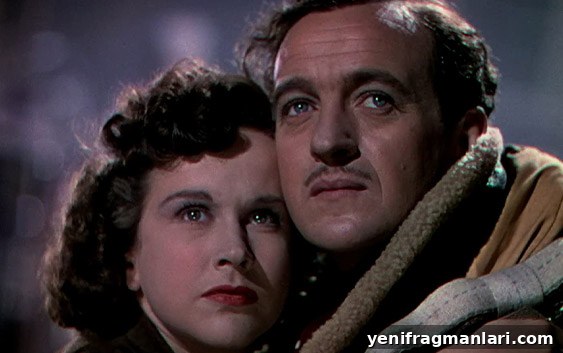
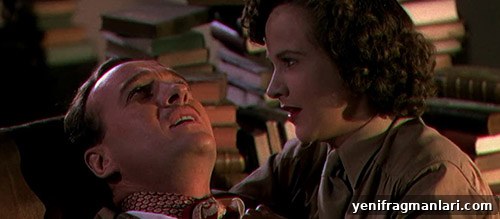
The narrative follows RAF pilot Peter Carter (David Niven), whose bomber is shot down over the English Channel. By all rules of this universe he should die, yet an office error in the great beyond leaves him stranded between life and death. As a result, Peter must argue his case for continuing to live, aided by June (Kim Hunter), the woman he fell in love with while facing death, and the quietly determined village doctor Dr Reeves (Roger Livesey).
The opening sequence is a masterclass in cinematic craft and emotional clarity. Through contrasting soundscapes and precise staging, the film conveys both urgency and intimacy: June’s background is punctuated by the steady tick of a clock; Peter is surrounded by wind, groaning metal, and failing engines. They meet over a radio with a calm, human exchange—professional at first, then confiding, even playful—turning what might have been a conventional rescue scene into an intimate meditation on love and mortality. That small-talk-as-salvation moment captures the film’s unique heart: it treats ordinary conversation as a lifeline.
Beyond its romance, the film builds a strikingly logical vision of the afterlife. Powell and Pressburger imagine heaven as a bureaucratic, administratively managed realm where “Conductors” process souls and paperwork—an idea that reads as both comic and oddly sensible. This organised, rule-bound otherworld gives the film a grounding that makes its fantasy elements feel coherent. Dr Reeves’s observation that Peter’s visions are “logical invention” underlines the film’s insistence that even the extraordinary follows rules.
Humour here is distinctively British: dry, colloquial, and understated. It appears in small, character-defining details—Peter’s gruff exchanges with his green-cane-wielding heavenly messenger, a reference to wartime thrift, or a courtier’s civilized disdain for the oddities of modern life. These jokes never undermine the film’s emotional stakes; instead they humanise lofty ideas, making questions of justice, prejudice, and national pride feel lived-in rather than doctrinal.
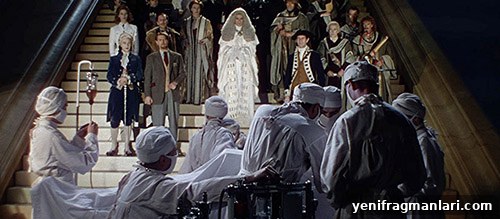
Visually the film remains unforgettable. It moves between vibrant colour for the living world and stark black-and-white for the afterlife, using that contrast to shape mood and meaning. The heavenly stairway, the massed ranks of famous figures, and the massive, glacier-like courtroom are striking inventions of design and scale. Several techniques feel ahead of their time: colour that seems to ebb into monochrome, point-of-view moments that place the audience in a near-death experience, and playful instances where characters break the fourth wall to remark on the nature of cinema itself.
At its centre, the courtroom sequence is noteworthy not only for inventiveness but for its political edge. The trial that determines Peter’s fate turns into a debate about empire, cultural influence, and national character. Powell and Pressburger use that moment to interrogate assumptions about power and prejudice—the trial becomes as much a contest of worldviews as it is a legal hearing. In doing so, the film addresses post-war anxieties and the shifting balance between nations with subtlety and wit.
The performances strengthen these themes. David Niven’s Peter blends charm and vulnerability; Kim Hunter’s June conveys warmth and moral clarity; and the supporting cast, including Marius Goring as the flamboyant Conductor 71, add humour and texture to the cosmic bureaucrats who run the afterlife. Together they keep the film lively even while it explores weighty ideas about love, justice, and fate.
A Matter of Life and Death stands as a rare combination of romance, philosophical reflection, and visual invention. It feels both intimate—rooted in conversation and personal connection—and grand, imagining an ordered hereafter with theatrical boldness. If you have not yet seen it, the film rewards attention: its blend of humour, imagination, and emotional conviction explains why it continues to captivate audiences and influence storytellers intrigued by the intersection of the human and the metaphysical.
24/24