
Wolfwalkers (2020)
Director: Tomm Moore, Ross Stewart
Screenwriter: Will Collins
Starring: Honor Kneafsey, Eva Whittaker, Sean Bean, Simon McBurney
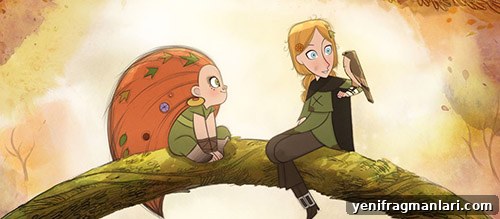
Cartoon Saloon returns with Wolfwalkers, a 2020 animated folk fantasy that deepens the studio’s reputation for blending mythic storytelling with arresting hand-drawn visuals. Set in Kilkenny, Ireland, during the English conquest under Oliver Cromwell, the film follows a young English girl, Robyn, and her evolving relationship with the mysterious wolfwalkers — a mystical group who live within the forest and command a pack of wolves charged with protecting their land and its creatures.
Robyn, voiced with earnestness by Honor Kneafsey, moves from Northern England to Ireland with her father Goodfellowe, played by Sean Bean, who serves as a guard in the effort to eradicate the remaining wolves. Through Robyn’s point of view, Wolfwalkers explores themes of belonging, courage, and resistance. The film quietly addresses gender expectations of the period, showing Robyn’s constrained opportunities and her father’s anxieties about her future, while threading these details into a larger story about freedom, empathy, and the human relationship to nature.
The storytelling balances simplicity and depth. On the surface, it is an adventurous tale of friendship between two girls from opposing worlds; below that surface the film meditates on cultural conflict, loss, and the violence that accompanies conquest. These elements are never heavy-handed; instead, they are woven into character choices and the atmosphere of the film so that contemporary relevance emerges organically without ever feeling preachy.
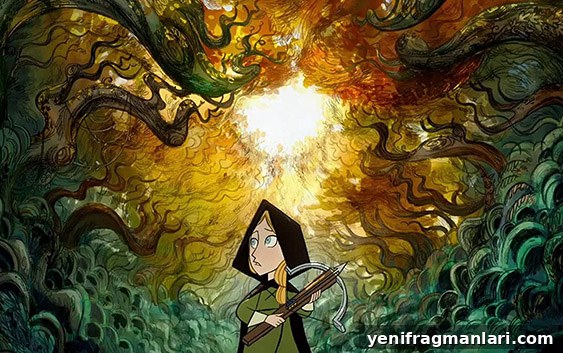
Visually, directors Tomm Moore and Ross Stewart commit to a distinctive woodblock-inspired aesthetic. The 2D animation is rich with intricate line work, layered textures, and geometric design choices that both enchant and unsettle. The forest sequences glow with a luminous, almost magical palette, while the town and garrison are rendered in muted greys and earth tones. That contrast reinforces the film’s central tensions — civilization versus wilderness, control versus freedom — and allows the animation itself to act as a storytelling device.
The film’s design is careful and deliberate: delicate hand-drawn details give life to characters and environments, and the movement is expressive without relying on heavy CGI or visual shortcuts. Color and composition are used to guide emotion and focus; at times the art feels like a living illustration, at others a kinetic tapestry of ink and brushstrokes. This visual approach places Wolfwalkers alongside the most memorable examples of traditional animation while also staking out its own modern identity.
Voice performances anchor the film’s emotional core. Honor Kneafsey’s Robyn conveys curiosity and vulnerability, while Eva Whittaker’s portrayal of the wolfwalker she befriends brings a feral, intuitive strength to the role. Sean Bean lends a measured gravitas to Goodfellowe, capturing the conflict of a man torn between duty and paternal care. Supporting performances add texture and humanity to the social world Robyn navigates.
The film’s pacing allows moments of wonder and quiet reflection alongside sequences of real peril, giving audiences time to appreciate both the visual craft and the emotional stakes. Scenes of the wolves moving through the forest are drawn with a sense of speed and grace, contrasting with scenes in the town that feel boxed and constraining. These choices deepen the narrative impact without resorting to melodrama.
Wolfwalkers also situates itself in an animation tradition that ranges from early Disney features to the work of Don Bluth, taking inspiration from classic storytelling while confidently asserting its own voice. Rather than merely echoing those precedents, the film uses their lessons—strong character arcs, mythic resonance, clear emotional through-lines—to build something that feels both timeless and timely.
Beyond its aesthetic achievements, the film is notable for how it treats its subject matter with nuance and compassion. It resists simplistic binaries and instead offers a story where empathy and curiosity become acts of resistance. The relationship between humans and animals, between conqueror and the conquered, is handled with moral seriousness that never undercuts the film’s sense of wonder.
Approachable for viewers of many ages, Wolfwalkers rewards repeat viewings: details in the artwork, thematic echoes, and character moments continue to reveal themselves on subsequent watches. It is an example of animation that respects its audience, offering both visual delight and sustained emotional resonance.
23/24