
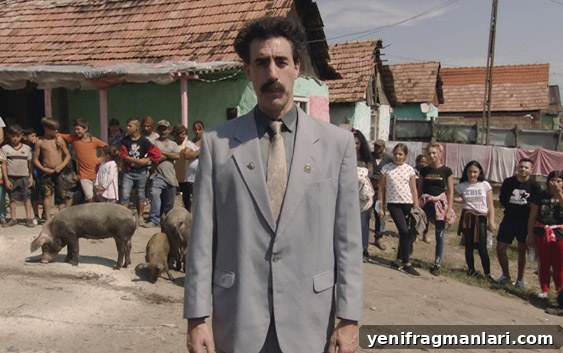
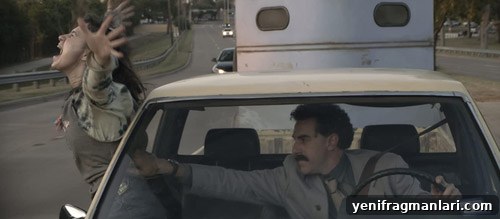
Borat Subsequent Moviefilm (2020)
Director: Jason Woliner
Screenwriters: Peter Baynham, Sacha Baron Cohen, Jena Friedman, Anthony Hines, Lee Kern, Dan Mazer, Erica Rivinoja, Dan Swimer
Starring: Sacha Baron Cohen, Maria Bakalova
Review: Satire, Shock and Sharp Political Commentary
Fourteen years after Sacha Baron Cohen’s original Borat introduced the world to a deliberately outrageous fictional journalist from Kazakhstan, Borat returns in Borat Subsequent Moviefilm (2020). The film sends its now-famous protagonist back to the United States with a new mission and a new companion: his adult daughter Tutar, played by Maria Bakalova. Directed by Jason Woliner and written by a collaborative team including Cohen himself, the sequel leans into a blend of scripted narrative and hidden-camera encounters designed to expose prejudice, hypocrisy and the fault lines of contemporary American politics.
This sequel opens by acknowledging an obvious obstacle: Borat is no longer an anonymous provocateur. Cohen’s character is recognized in public, stopped for autographs and pointed out to passersby. Rather than pretend that anonymity still applies, the film uses Cohen’s fame as a structural constraint that changes the way the comedy functions. With that barrier in place, the movie shifts emphasis from purely ambush-style pranks toward a more focused fictional through-line: the evolving relationship between Borat and Tutar. That narrative allows the filmmakers to stage encounters that are both personal and politically charged, crafting a film that feels more cinematic and concentrated than the wide-ranging original.
At its core, Borat Subsequent Moviefilm operates as a sharp satire of American life and, more specifically, the politics and cultural forces surrounding the Republican party in the late 2010s and early 2020s. The film’s scripted elements anchor the story—Borat’s goal, his awkward parenting decisions, and Tutar’s transformation—while the unscripted moments reveal real reactions from everyday people and public figures. These reactions are often unsettling: scenes that involve treatment of women, casual sexism, and exploitative attitudes are presented in a way that exposes how normalized such behaviors can be.
Several sequences stand out for their discomfort and clarity. In one episode a store clerk casually approves the purchase of a large animal cage for Tutar’s use; in another, a cosmetic surgeon bluntly describes the procedures he could perform on her, repeatedly referring to breast augmentation in crude terms. These moments are designed to be hard to watch because they reveal how casually degrading language and attitudes can pass as normal conversation. The film doesn’t shy away from such ugliness; instead it frames these interactions to highlight systemic sexism and the ways that public discourse enables it.
The movie culminates in a final sequence involving a well-known public figure that has been widely discussed since the film’s release. That scene crystallizes the film’s intent: to present real-world behavior as a mirror reflecting cultural and political problems. The result is a mix of dark comedy and documentary-style exposure that can be both laugh-out-loud funny and deeply disturbing.
One notable quality of Borat Subsequent Moviefilm is its timeliness. Released during a politically turbulent period in the United States, the film reads as an urgent, satirical commentary aimed at a moment of national consequence. It is unlikely to convert staunch political opponents, but it is crafted to motivate and energize viewers who are already skeptical of the targets it critiques. In its closing moments the film pushes directly at civic responsibility, urging participation in ways that align with the film’s broader ethical stance.
Despite the weight of its subject matter, the movie remains consistently funny. Cohen’s comedic instincts—his ability to craft situations that reveal contradictions and hypocrisies—are on full display, and Maria Bakalova provides a breakout performance that anchors the emotional arc of the story. The balance between scripted narrative and unscripted exposure makes the film feel immediate and raw, allowing humor and horror to coexist in a way that amplifies the impact of each.
Ultimately, Borat Subsequent Moviefilm succeeds as both comedy and social critique. It is sharpened by contemporary relevance, often uncomfortable to watch, and frequently very funny. The film builds on the original’s approach while tightening its focus, producing a sequel that is more targeted in its satire and more deliberate in its storytelling. Whether viewed primarily as entertainment or political commentary, it remains a memorable and provocative piece of filmmaking.
19/24