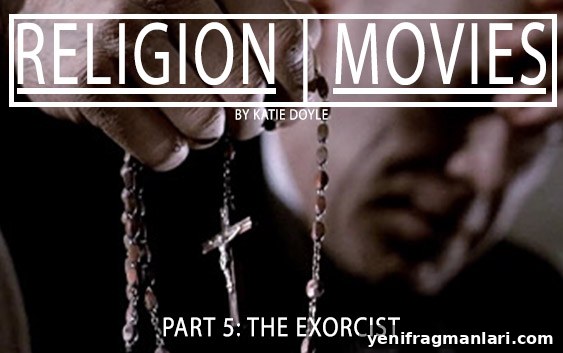
For readers familiar with The Film Magazine and this “Movies I Had a Religious/Spiritual Experience With” series, you will know the routine — Spoiler Alert! — and a brief disclaimer: this essay reflects my personal views formed by my life as a Roman Catholic. I do not claim these experiences are exclusive to Catholicism; I write only from my own perspective and do not speak for other faiths.
“Hocus Pocus!? Hocus Pocus, indeed! Don’t you know those words are a deliberate perversion of the Latin Mass, in fact a mockery of the very moment of blessing: Hoc est corpus meum — This is my body!”
“Oh. I didn’t.”
“Bet you also didn’t know that Jack in the Boxes were made to poke fun at tabernacles, did you?”
“No, you’re right.”
Religion can be strange, even for the faithful. Many of us did not choose our first encounter with faith — those drops of Holy Water on our foreheads when we were weeks old leave a mark that often shapes how others perceive us for life. As a Catholic, I sometimes wonder how much that early “branding” affects the way others see me.
The lines above point to how the English Reformation sought to belittle Catholic culture, an effort that successfully changed public attitudes for a long time. Over generations, however, people and culture evolved; once-sharp insults faded into curiosities of the English-speaking world. I cannot honestly claim the Reformation’s legacy has directly harmed me as an individual the way violent persecution has affected Catholics elsewhere. My ancestors may have fled religious strife in places like Belfast, but after settling in England the family slowly Anglicised and the old wounds became distant memories.
What I find particularly curious is how Catholicism is perceived in some parts of the United States, where evangelical and charismatic circles sometimes treat Catholic practices as if they were near heresy. Popular culture often reinforces this — for example, the inverted cross is widely seen as demonic when historically it is associated with St. Peter and the papacy. That caricature doesn’t trouble me much here in the North-East of England, but it does make for interesting intersections between my faith and Hollywood. Still, external stereotypes are not the primary struggle — crises of faith are usually internal.
These are dark times. People of faith often turn to religion in hardship, but with the reduction of public worship in 2020 — including the cancellation of formal Easter services across much of Christendom — it sometimes felt as if Christ himself remained in a cold, closed tomb. In a year when I was cut off from the tangible presence of God, I suspected I would have no profound spiritual experiences. Yet I found surprising inspiration in an unlikely place: William Friedkin’s 1973 horror classic The Exorcist. God works in mysterious ways.
My recent viewing began as a simple, seasonal rewatch. I hadn’t seen the full film since my first year at university, when we only watched the most famous possession scenes and one housemate hid under my bed, grabbing my leg in the dark — a traumatic ending that kept me away from the movie for years. The Exorcist’s reputation for shocking imagery — projectile vomiting, head-spinning, spider-walking — and accusations of sacrilege had long been enough for me to dismiss it. I suspected it reinforced a stereotype of Catholicism as archaic and complicit with the supernatural. I was wrong.
The Exorcist presents Catholicism in a surprisingly nuanced and authentic way, which reflects William Peter Blatty’s devout upbringing. The representation I needed came through the character of Father Damien Karras.
One persistent frustration I face is the assumption that religious people are anti-intellectual. I usually counter that with my Master’s degree in Chemistry, but the stereotype persists because a vocal minority of faith leaders reject scientific consensus. In reality, the Catholic Church has played a significant role in the development of scientific methods and evidence-based inquiry, and many clergy contributed to scientific advances. Father Karras embodies that bridge: he is a priest who trained as a psychiatrist with Church support, combining pastoral duty and medical knowledge. He does not indulge in faith-healing fantasies; instead, he approaches supposed cases of possession with clinical skepticism, acknowledging that many conditions once attributed to demons—epilepsy, schizophrenia—have medical explanations.
Karras’s first meeting with the possessed Regan McNeil symbolizes the intersection of faith and science. The modern Church accepts scientific discoveries — Pope Francis’s encyclical “Laudato Si” makes clear the moral imperative of environmental stewardship — yet it also embraces mysteries that science cannot fully explain: the dual nature of Christ, the doctrine of transubstantiation, and reported miracles. Many Catholics, including clergy, view supernatural claims with healthy skepticism; Karras initially laughs at the suggestion of an exorcism because he believes psychiatric explanations are more likely.
But when he encounters phenomena that defy diagnosis and physics alike, his scientific framework begins to strain. He is willing to revise his assumptions in light of new evidence. The film shows his reluctance and rational attempts to understand the impossible, and through that process he rediscovers the value of faith.
Why try to serve both the natural and supernatural when they seem at odds? For me and for Karras, science is a duty to truth: pursuing knowledge and relieving suffering is part of Christian servitude. The Church’s moral teachings urge care for the vulnerable, and supporting scientific discovery often serves that end. The supernatural side of faith requires another kind of acceptance: trusting in mysteries and a divine plan despite suffering and injustice. That is the essence of faith — believing there is meaning beyond what we can immediately prove.
Karras is a priest who feels abandoned by God. Trained as a psychiatrist, he has reached the limits of what clinical care can do. He faces vocational doubts, guilt over abandoning his infirm mother to an underfunded institution, and a pervasive sense of worthlessness. These failures haunt him: he feels he has let people down, and that his efforts as a priest and doctor have not mattered. His conflicted interior life is a central reason his character resonates so deeply.
“I think I’ve lost my faith, Tom.”
Damien’s story is not merely a portrait of burnout; it’s one of a man formed by Catholic duty who finds his moral code tested by real-world suffering. His struggle to reconcile compassion and impotence — to keep serving when service seems fruitless — mirrors a common human experience. Many of us have felt our best efforts were wasted and have suffered deep despair because of it. That persistent moral responsibility — the so-called “Catholic guilt” — can be crushing when we cannot meet our own standards of care.
After reflecting on why Karras’s portrayal moved me, I must admit something unexpected: despite its fearsome reputation, I found The Exorcist profoundly life-affirming. I am not alone in finding hope in Jason Miller’s performance. For many viewers who have experienced doubt or felt their belief systems fail them, the film shows that faith can reappear in moments of crisis and that even imperfect people can act courageously. Karras, despite his doubts and moral confusion, chooses to do what is right. His final act — a sacrificial gesture to save Regan — is portrayed as a Christ-like offering, turning despair into a redemptive act.
For everyone, regardless of religious affiliation, The Exorcist is ultimately a story about the resilience of the human spirit. When faith feels absent, staying true to what is right can be a profound moral victory. The film suggests that even in emptiness we can offer kindness and justice, and that such acts may be more meaningful for their difficulty than for their ease.
Part 1: The Prince of Egypt, 2001: A Space Odyssey & A Matter of Life and Death
Part 2: Blade Runner, Cloud Atlas & It’s a Wonderful Life
Part 3: Brazil & In Bruges
Part 4: Beckett & A Man for All Seasons
For the full catalogue of Katie Doyle’s “Movies I Had a Religious/Spiritual Experience With” series, please visit this page.