
Edward Scissorhands (1990)
Director: Tim Burton
Screenwriter: Caroline Thompson
Starring: Johnny Depp, Winona Ryder, Dianne Wiest, Anthony Michael Hall, Kathy Baker, Alan Arkin, Vincent Price
It’s almost astonishing that more than thirty years have passed since Edward Scissorhands first arrived in cinemas. When Tim Burton was the defining voice of gothic-tinged cinema, this 1990 film became essential viewing for many teenagers—especially those who identified as outsiders. Over the years, cultural tastes have shifted: music evolved, superhero cinema expanded, and new forms of escapism emerged. Yet Edward Scissorhands still stands as a singular piece of filmmaking—part fairy tale, part social satire, and wholly Tim Burton.
Common comparisons tie the film to classic tales—Grimm-like fables, Beauty and the Beast, or even a modern Frankenstein. While those parallels are valid, Burton’s film retains a distinct identity: a simple, curious story that blends melancholy and whimsy, one that even asks, in its own poetic way, where snow comes from.
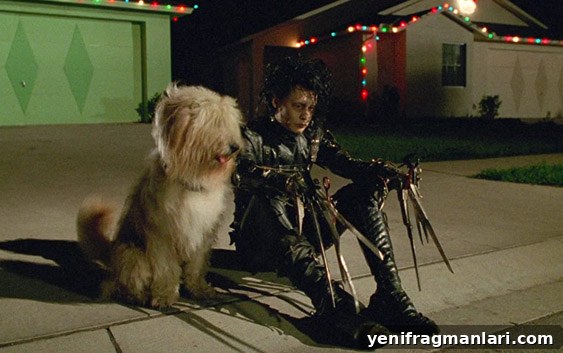
Johnny Depp’s Edward is one of the actor’s most memorable roles. Created by an eccentric Inventor (played by Vincent Price), Edward lives alone in a gloomy mansion above a bright, pastel suburb. He was left unfinished when the Inventor died, and as a result Edward’s hands are made of large, razor-sharp scissors. When Peg Boggs (Dianne Wiest), a kindly Avon saleswoman, discovers him, she brings Edward down to her neighborhood in the hope that he might find a place among ordinary people.
In that suburban world, Edward’s gentle nature and unusual talents—expressed through his scissor-hands—turn him into a local curiosity and, for a time, a beloved figure. He creates exquisite topiary, sculptures, and haircuts, transforming the bland into something lyrical. But the same hands that craft beauty also pose a constant danger, and admiration quickly curdles into fear, prejudice, and ultimately, rejection.
This movie helped define several recurring elements of Burton’s cinematic identity. It cemented the creative partnership between Burton and composer Danny Elfman, whose haunting, elegiac score is inseparable from the film’s mood. It continued Burton’s collaboration with actors like Winona Ryder and began his long-running rapport with Johnny Depp. Yet beyond these signatures, Edward Scissorhands stands out because it balances stylized visuals with a clear emotional core: a plea for empathy.
Visually, Edward Scissorhands contrasts extremes—the gothic, shadowed mansion versus the bright, manicured suburb. Burton’s background in animation and visual storytelling is clear in every frame. The exaggerated suburban sets could have turned the film into a cartoonish exercise, but Burton tempers the whimsy with careful, observant character work. The result is a heightened reality that remains emotionally truthful.
The film also taps into adolescent longing and the desire to be adored. Through Kim (Winona Ryder), Burton explores the intoxicating idea of being chosen—of escaping mediocrity because someone extraordinary notices you. Their romance reads as youthful and intense; while the narrative doesn’t deeply justify every emotional beat, the emotional truth of first love and longing carries the story forward.
At its heart, Edward Scissorhands is a film about difference and about how society treats those who do not fit its narrow norms. Burton offers a sharp satire of late-20th-century suburban life—consumerist, shallow, and quick to judge. The supporting characters are drawn in broad strokes: the distracted father figure, the bored housewife, the petty neighbor, the charismatic bully. These caricatures reveal how easily kindness can be replaced by gossip and fear.
Viewed through a contemporary lens, the film also speaks to disability and exclusion. Edward is admired like a spectacle but not accommodated in meaningful ways. He performs unpaid work, is denied the tools and support to build an independent life, and faces microaggressions that range from awkward condescension to outright hostility. The film quietly exposes how superficial inclusion can fail those who are genuinely vulnerable, and how society often conflates physical difference with moral deficiency. Burton’s depiction of Edward—vulnerable, creative, and essentially humane—challenges those harmful assumptions.
“Edward tries to succeed and fit in, but he finds himself trapped by numerous barriers and challenges.”
There are many painful moments: Edward’s inability to sleep on a water bed because of his hands, the awkward attempts to adapt everyday objects for him, the town’s gradual turn from fascination to fear. These scenes resonate because they echo real struggles faced by people who live with visible differences or disabilities. The film’s quieter triumph is its insistence on dignity—on the idea that every person has worth that transcends appearances.
Ultimately, Edward Scissorhands succeeds as both a work of visual imagination and a humane parable. It is one of Tim Burton’s most emotionally resonant films, a story that uses fantasy to ask serious questions about compassion, otherness, and belonging. The film’s emotional finale—its bittersweet mix of loss and wonder—reminds us that beauty can arise from the most unlikely places. If Edward is responsible for the film’s magical snow, it is a fitting metaphor: a reminder that what seems fragile or broken can still create something unexpectedly beautiful.
Score: 20/24
Recommended: Tim Burton films ranked and other notable works by the director