
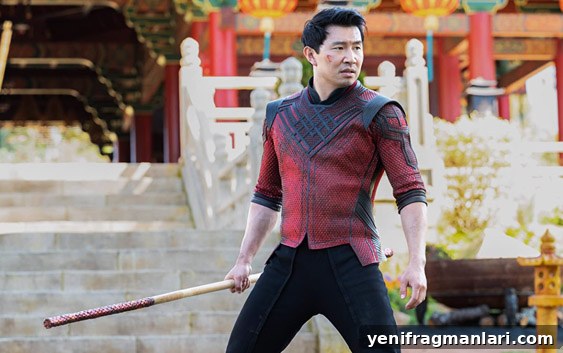
Shang-Chi and the Legend of the Ten Rings (2021)
Director: Destin Daniel Cretton
Screenwriters: Dave Callaham, Destin Daniel Cretton, Andrew Lanham
Starring: Simu Liu, Awkwafina, Tony Leung, Meng’er Zhang, Fala Chen, Michelle Yeoh, Florian Muneanu, Andy Le, Benedict Wong
Shang-Chi’s journey from a supporting character in 1970s comic books to a leading figure on the Marvel Cinematic Universe (MCU) screen is a milestone for superhero cinema. Originally introduced during the martial arts craze in American pop culture, Shang-Chi has evolved across decades of comic storytelling. The MCU’s cinematic take, Shang-Chi and the Legend of the Ten Rings, arrives as the franchise’s twenty-fifth film and marks an important cultural moment by featuring Marvel’s first Asian-American lead superhero in a major blockbuster.
Trained from childhood to become a lethal weapon, Shang-Chi (Simu Liu) abandons the violent criminal legacy of his family and disappears into an ordinary life in San Francisco. A decade later, he is pulled back into conflict when his father, Wenwu (Tony Leung), resurfaces. Wenwu is a powerful warlord empowered by the mystical Ten Rings; he intends to reclaim his children and continue a centuries-long path of conquest while pursuing a deeply personal quest that draws his family toward the legendary realm of Ta Lo. Forced to confront his past, Shang-Chi must wrestle with family ties, reckon with buried trauma, and decide what kind of person—and hero—he will become.
Simu Liu brings warmth, vulnerability, and physical credibility to the role, giving Shang-Chi an immediate, human appeal. His chemistry with Awkwafina, who plays his loyal and hilarious friend Katy, injects much of the film’s heart and humor. Katy serves as the film’s emotional anchor for everyday relatability—she is fiercely devoted, impulsively fun, and often the comic counterpoint to the movie’s more intense moments. Throughout the story, Shang-Chi and Katy travel from gritty, underground fighting rings to mythic landscapes, encountering Shang-Chi’s younger sister Xialing (Meng’er Zhang), who emerges as a striking and formidable presence in her own right. As the Ten Rings organization closes in, the film balances family drama with escalating action and supernatural spectacle.
One of the film’s standout elements is Tony Leung’s performance as Wenwu. A luminary of Hong Kong cinema, Leung brings gravitas and nuance to a character that could have been a one-dimensional villain. From his commanding early scenes—riding into battle protected by a mystical field and wielding the Ten Rings with devastating precision—Leung commits fully to the character’s mythic qualities while grounding Wenwu’s motivations in emotion and history. The relationship between Wenwu and Shang-Chi carries much of the movie’s thematic weight: questions of legacy, identity, and the meaning of family are tested through their fraught and complicated bond.
The film is visually opulent, often delivering images that linger long after the credits roll. Intimate, dreamlike moments—such as Wenwu’s first encounter with Shang-Chi’s mother, Ying Li (Fala Chen), in a bamboo grove—blend martial arts choreography with romantic lyricism, recalling the best moments of classic wuxia cinema while establishing a distinctly modern MCU aesthetic. In its most ambitious sequences, the movie layers elaborate creature design, sweeping landscapes, and kinetic combat into a dense visual tapestry. At times the climactic spectacles can feel visually overloaded, with so much detail competing for attention on a first viewing, but the ambition and scale are unmistakable: this is a Marvel film that leans into myth and fantasy more overtly than many of its predecessors.
The movie benefits enormously from its stunts and fight choreography. The late Brad Allan, a celebrated stunt coordinator whose work spans international action films, contributed to the fluid and readable action that anchors the film’s set pieces. Unlike many contemporary action films that rely on rapid cuts, These sequences maintain clarity, allowing the performers’ athleticism and the choreography’s rhythm to read on screen. Under Destin Daniel Cretton’s direction and with cinematographer Bill Pope’s dynamic camera work, action scenes range from intimate hand-to-hand exchanges to large-scale wuxia battles. Notable highlights include a precisely staged fight on a flexible bus, an acrobatic scaffolding confrontation that channels classic slapstick martial arts humor, and sweeping aerial fights that summon the grandeur of traditional Chinese fantasy cinema.
What sets Shang-Chi apart from many superhero origin stories is its cultural specificity. The film combines the familiar beats of the superhero formula with themes rooted in heritage, naming, and familial duty. Shang-Chi’s arc does not hinge on becoming less arrogant or more selfish; instead, it focuses on self-acceptance, reconciling cultural identity, and embracing responsibility in a way that aligns more closely with recent MCU entries that examine identity and community. The film’s heart lies in its relationships—the father-son conflict, the bond between siblings, and the friendship that grounds the hero in everyday humanity—and these relationships are what give the spectacle emotional depth.
As Marvel’s first full-throttle martial arts movie, Shang-Chi and the Legend of the Ten Rings delivers an entertaining blend of humor, emotional stakes, and exhilarating combat. It introduces a major new hero for the MCU while honoring martial arts traditions and contemporary storytelling. The movie builds a rich mythic world, showcases committed performances—particularly from Simu Liu and Tony Leung—and raises the bar for action choreography within the franchise. For viewers seeking a superhero film that combines cultural resonance with blockbuster scale, Shang-Chi offers a satisfying and memorable experience.
Score: 20/24