
The Xenomorph, the iconic intergalactic creature from the Alien franchise, has been a powerful image in popular culture since the original Alien premiered in 1979. While many filmgoers associate the monster with director Ridley Scott, the terrifying design came from Swiss artist Hans Rudolf (H.R.) Giger. Giger’s haunting paintings, sculptures and biomechanical visions shaped the film’s unsettling aesthetic, earning him and the effects team an Academy Award and establishing his reputation as a leading figure in contemporary surrealist art.
Born in Switzerland in February 1940, Giger was the son of a pharmacist and spent part of his childhood in a strict Catholic environment. He later reflected that early religious imagery—from bleeding saints to crucifixes—left a lasting impression on his imagination. In his memoir ARh+, Giger connects this upbringing to recurring themes in his work, including the unsettling blend of the sacred and the macabre.
As a young man he created a homemade ghost train populated with suspended figures and coffins—an early sign of the dark interests that would define his career. Influenced by surrealists such as Salvador Dalí, Giger began publishing drawings in pen and ink before developing the monochromatic airbrush technique that would become his hallmark. His imagery often fused human anatomy with machinery in erotic and disturbing ways, a style he called “biomechanical.” He also explored sacrilegious and subversive religious motifs as well as complex, often unsettling treatments of sexuality.
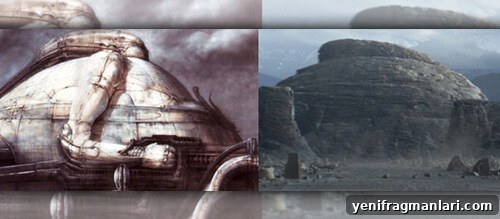
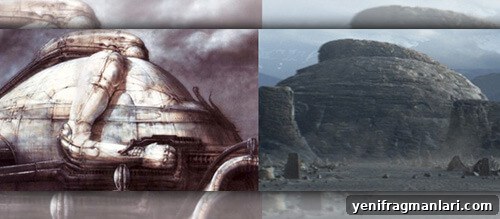
Giger refined these themes throughout the 1960s and 1970s, attracting international attention and eventually drawing the interest of filmmakers. One early Hollywood opportunity came when Alejandro Jodorowsky invited him to contribute designs for a proposed film adaptation of Frank Herbert’s Dune. Giger was asked to imagine an entire planet—within the constraint of no explicit sexual content—and the collaboration gave him the chance to meet Salvador Dalí, who admired some of his work. Although the Jodorowsky Dune project collapsed, several of Giger’s designs persisted and later influenced other films. Elements of his Harkonnen temple concept resurfaced, reworked, in Ridley Scott’s Prometheus (2012).
Giger’s 1977 book Necronomicon collected many of his images and became the direct bridge to Hollywood success. Ridley Scott, struck by the book’s nightmarish vision, brought Giger on to design the alien elements of Alien. Giger was responsible for the creature, the ship interiors, the Space Jockey and other non-human aspects, while artists like Ron Cobb and Chris Foss handled the human technology and the Nostromo’s utilitarian look. The juxtaposition of two distinct design philosophies gave Alien its unsettling duality—human and machine, familiar and utterly alien.
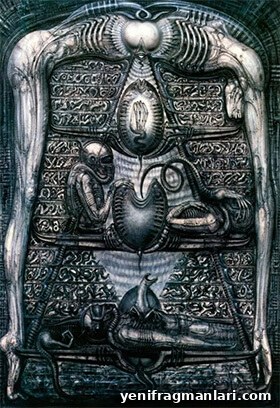
Ridley Scott was particularly drawn to Giger’s painting Necronom IV, choosing it as the basis for the film’s creature while exploring additional variations from Giger and other artists. Ultimately, the Xenomorph evolved directly from Giger’s vision, with modifications to suit the motion-picture medium and on-set requirements.
Giger’s visual language amplified the film’s recurrent sexual and reproductive themes. The facehugger’s enforced implantation of the alien into Kane and the subsequent chest-bursting birth are among the most discussed cinematic images of violated bodily autonomy and grotesque reproduction. Architectural motifs in the crashed ship on LV-426, inspired by depictions of mother goddesses such as the Egyptian Nut, contribute further to the film’s layered symbolism, combining the maternal with the monstrous.
Stories from production highlight Giger’s provocative sense of humor and his willingness to challenge audiences. One anecdote recounts how the original alien egg, featuring a single vertical slit, was altered at Giger’s suggestion: to diminish a plainly sexual reference, he transformed the opening into a shape resembling a Catholic cross—an intentional provocation toward religious sensibilities shaped by his own early experiences.
The extent to which Giger’s imagery translated into audience reaction is open to interpretation, but his influence on Alien is unmistakable. Many argue the movie’s lasting impact and the birth of a major franchise would not have been possible without his singular vision. The film’s Academy Award for Best Visual Effects—won over contenders including Star Trek: The Motion Picture—was, in large part, recognition of the distinctive world Giger helped create.
Giger continued to contribute concepts to later franchise entries, including designs for Aliens and Alien 3. Beyond film, his work appeared on album covers, inspired video games, and found expression in practical objects such as microphone stands commissioned by Jonathan Davis of Korn. He also opened a café in Switzerland that displayed his aesthetic and included furniture inspired by earlier designs for the ill-fated Dune project.
H.R. Giger passed away on May 12, 2015. His death prompted renewed discussion about how the Xenomorph should be used in subsequent films, and it influenced aspects of the creative decision-making for titles such as Alien: Covenant. Yet his artistic legacy endures: the image of the Xenomorph hanging among chains in the Nostromo remains one of cinema’s most indelible monsters. Giger’s work is disturbing, haunting and powerfully original, and the strange artist in black will always be closely identified with the alien queen he imagined.
Recommended for you: 10 Best Alien Moments
Images (order of presentation): “Necronomicon” (1993)
Pinnlandempire
Pinterest
Bibliography
Alien 3. 1992. [Film] Directed by David Fincher. USA: 20th Century Fox.
Alien: Covenant. 2017. [Film] Directed by Ridley Scott. UK/USA: 20th Century Fox.
Alien. 1979. [Film] Directed by Ridley Scott. United States of America: Brandywine Productions.
Aliens. 1986. [Film] Directed by James Cameron. USA: 20th Century Fox.
Dune. 1984. [Film] Directed by David Lynch. USA: Dino De Laurentiis Corporation.
Giger, H. R., 1991. ARh+. Germany: Taschen.
Giger, H. R., 1993. Necronomicon. New Edition ed. United States: Morpheus International.
Herbert, F., 1965. Dune. United States of America: Chilton Books.
Leroux, G., 1911. The Phantom of the Opera. France: Pierre Laie.
Prometheus. 2012. [Film] Directed by Ridley Scott. UK/USA: 20th Century Fox.
Shay, D. & Norton, B., 1997. Alien: The Special Effects. London: Titan Books.
Star Trek: The Motion Picture. 1979. [Film] Directed by Robert Wise. USA: Paramount.