
This article was written exclusively for The Film Magazine by Paul A J Lewis of paul-a-j-lewis.com.
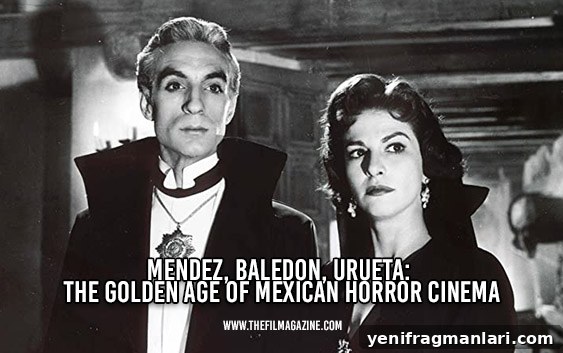
Open on a colonial hacienda shrouded in fog. In the central courtyard stands a tall, thin man with grey hair and a long black cape. Cut to a tight close-up of his intense eyes, the lower half of his face lost in shadow. Inside the adobe walls, a woman in traditional Mexican dress acts erratically, seemingly drawn by a psychic force. Outside, in a Méliès-style jump cut, the mysterious figure transforms into a giant bat and flies toward the window where the woman waits.
This striking sequence launches Fernando Méndez’s 1957 film El vampiro (The Vampire), a black-and-white Gothic horror picture released domestically around the same time as Hammer Studios’ vivid, gory revival of Gothic horror—Terence Fisher’s The Curse of Frankenstein (1957) and about six months before his colorful Dracula (1958). While Hammer’s films are better known internationally, Méndez’s El vampiro is equally significant: it is commonly cited as the first vampire film to show a bloodsucker with pronounced canine teeth—an iconographic shift that influenced later portrayals of Dracula and other cinematic vampires. Unlike many earlier vampire films set in a distant past, El vampiro and its concurrently shot sequel El ataúd del Vampiro (The Vampire’s Coffin) brought the vampire into a modern context, anticipating the trend of contemporary vampire stories seen in early 1970s American cinema.
El vampiro (1957)
El vampiro was produced by actor-producer Abel Salazar, who also stars in both films as Dr. Enrique Saldívar. Through his company Cinematográfica ABSA (founded in 1955), Salazar financed several of Mexico’s most influential horror pictures of the late 1950s and early 1960s, collaborating with directors such as Fernando Méndez, Rafael Baledón and Chano Urueta. Urueta, a prolific filmmaker who directed over a hundred films between 1928 and 1974, played a major role in shaping Mexican genre cinema. His 1953 picture El monstruo resuscitado (The Monstrous Doctor Crimen) is often credited with jumpstarting Mexico’s horror output, while his work in the wrestling-film genre helped shape a uniquely Mexican cinematic fusion that would continue into the 1960s and 1970s.
1957 was a turning point for Mexican horror. Alongside the Aztec Mummy trilogy and Méndez’s vampire pictures, filmmakers produced a wave of black-and-white Gothic and fantastical films that localized transnational horrors by fusing European motifs with Mexican folklore and settings. These films offered a darker, monochrome counterpoint to Hammer’s colorful revival, exploring themes of colonial legacy, cultural outsiders and the haunting persistence of the past.
Urueta’s own horror entries from this period are particularly memorable. El espejo de la bruja (The Witch’s Mirror, 1962) opens with woodcut montages and a male voiceover describing witchcraft’s alleged crimes, and follows Elena as she is drawn into a conspiracy with a sorceress who uses a prophetic mirror. The story evolves through betrayal, disfigurement and supernatural revenge before shifting into a macabre mad scientist narrative that echoes European Gothic trends. Urueta’s films often combine folkloric elements with mad-scientist motifs, producing strikingly photographed, sometimes surreal sequences.
El espejo de la bruja (1962)
El barón del terror (Brainiac, 1962) shares this inventive Gothic spirit. It begins in 1661 with the trial and execution of Baron Vitelius Destera (played by Abel Salazar) by the Mexican Inquisition. Destera vows revenge and returns three centuries later as a monstrous being after a passing comet. The film examines colonial-era injustice and the baron’s connection with indigenous communities, portraying his vengeance as a symbolic retribution against the descendants of his persecutors. Its black-and-white cinematography and weird, gruesome imagery—most notably the baron’s grotesque transformed form—make it a standout of Mexican Gothic cinema.
La maldición de la llorona (1961)
Rafael Baledón’s La maldición de la llorona (The Curse of the Crying Woman, 1961) blends local folklore with vampire imagery. Set in a decaying colonial hacienda owned by the widow Selma Jamarillo (Rita Macedo), the film centers on the ghostly legend of la llorona and a series of exsanguinated corpses found in the area. Selma plots to resurrect an ancestor whose petrified corpse lies in the cellar, hoping to harvest psychic power and restore influence—an explicit engagement with Mexico’s colonial past and its lingering violence.
In Méndez’s vampire films, the European vampire appears as a cultural outsider. Count Karol de Lavud (Germán Robles) arrives from Eastern Europe with crates of soil shipped from Hungary—an eccentricity treated as a rich man’s whim by local villagers. Marta González (Ariadne Welter) visits her uncle’s hacienda, where Dr. Enrique Saldívar (Abel Salazar) begins investigating strange occurrences that Marta’s aunt insists are the work of a vampire. Lavud’s claim to be asserting “the power and dominance of the House of Lavud” explicitly frames his presence as colonial and foreign.
The sequel, El ataúd del Vampiro, brings Lavud into an urban, contemporary environment by transporting his coffin to a modern hospital, where unscrupulous characters and scientific curiosity lead to his resurrection. Dr. Mendoza’s experiments and the accidental removal of the stake awaken Lavud, who then stalks hospital corridors and city streets. The hospital sequences—photographed in atmospheric low-key black and white—anticipate later “hospital horror” films and emphasize the unsettling contrast between modern institutions and ancient evil.
El ataúd del Vampiro (1958)
Scenes of Lavud stalking a late-night café patron or hiding in a theatre’s rafters use dramatic backlighting and shadow to convey menace, echoing techniques used in later urban thrillers. The films also foreground the isolation of their protagonists: Saldívar and Marta face disbelief from authorities, leaving them to confront the vampire alone. These interactions—often darkly comic—underscore how modern institutions dismiss or misunderstand folkloric threats even as those threats adapt to contemporary settings.
By placing a European vampire in Mexican landscapes and cityscapes, Méndez and his contemporaries explore anxieties about outsiders, colonial legacies and cultural exchange. The vampire’s visual codes (cloak, aristocratic dress) clash with Mexican architecture and folklore, yet European vampire stories themselves were shaped by encounters with the Americas—vampire bats and reports from travel narratives became woven into European myths. In this sense, Mexican vampire films reclaim elements of the myth that have roots in the Americas.
Mid-century Mexico also produced influential literary works that resonated with filmmakers. Juan Rulfo’s 1955 novella “Pedro Páramo,” with its ghostly town of Comala and blurred line between the living and the dead, anticipated the fusion of the ordinary and the supernatural that characterizes much of Mexican Gothic cinema. Filmmakers of the era—like Méndez, Urueta and Baledón—used folklore, colonial memory and modern anxieties to craft distinctive horror films that stood alongside European and British Gothic cinema while offering a uniquely Mexican perspective.
These films—black-and-white, often surreal and politically resonant—demonstrate how transnational myths can be adapted and localized. By combining European Gothic motifs with local legends and histories, Mexico’s late-1950s and early-1960s horror cinema interrogated the past and examined how its violences persisted into the present.
Recommended for you: Holy Water and Unholy Ghosts – The Resurrection of Hammer
Written by Paul A J Lewis
You can support Paul A J Lewis in the following places:
Website – paul-a-j-lewis.com
Twitter – @Krycek_Facility