
Mank (2020)
Director: David Fincher
Screenwriter: Jack Fincher
Starring: Gary Oldman, Amanda Seyfried, Lily Collins, Tom Pelphrey, Arliss Howard, Tuppence Middleton, Monika Grossmann, Joseph Cross, Sam Troughton, Toby Leonard Moore, Tom Burke, Charles Dance
David Fincher’s Mank is a lovingly crafted behind-the-scenes portrait of the making of Citizen Kane, shot with frequent visual and tonal references to Orson Welles’s 1941 classic. The film centers on Herman J. Mankiewicz, the screenwriter credited with much of the screenplay’s voice, and it examines Hollywood’s studio system, the politics of 1930s America, and the creative and personal battles that shaped one of cinema’s most famous scripts. With a screenplay written by Fincher’s father Jack Fincher, the finished film reads like a cinephile’s essay on authorship, power and compromise.
The story opens in 1940 when a young Orson Welles arrives in Los Angeles to make his first feature film. Welles hires Herman J. Mankiewicz, a veteran writer battling alcoholism and fraught relationships with powerful studio figures, to put the script together. When Welles shortens the already tight deadline while Mank is recovering from a broken leg, the pressure to finish mounts. The completed screenplay unmistakably echoes the life of newspaper magnate William Randolph Hearst, and Mank finds himself embroiled in a clash with Hearst’s circle and the era’s media power brokers.
Fincher’s decision to shoot Mank in black-and-white and to reproduce period sound and visual techniques—mono audio, deep focus, low angles, prominent shadows and rear-projection for driving scenes—creates an immersive period atmosphere and constantly invites comparison with Citizen Kane. These stylistic choices are not mere imitation; they function as commentary. By adopting the formal language of the era, the film explores how cinematic form shapes political and cultural narratives, and how a script can both reflect and provoke the society that produces it.
The screenplay itself is dense, layered with references to the studio system, 1930s politics and Hollywood personalities. Jack Fincher’s script moves briskly, with snappy exchanges and acidic barbs that reveal characters through sharp dialogue. Fincher also uses on-screen captions to mark scene headings—EXT. PARAMOUNT STUDIOS – DAY – 1930 (FLASHBACK)—drawing attention to the mechanics of screenwriting and the way stories are constructed across time and place.
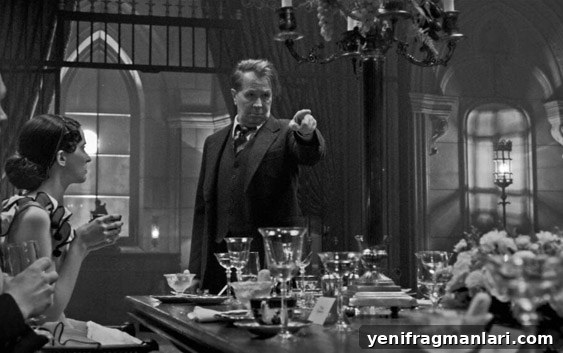
Gary Oldman anchors the film with a raw and volatile performance as Mankiewicz. He captures Mank’s wit, bitterness and self-destructive tendencies, delivering comic and devastating moments in equal measure. One of the film’s standout sequences is a furious, slurred monologue in which Mank lashes out at his detractors—an emotionally draining scene reportedly filmed with numerous takes and clearly pivotal for the character’s arc. Amanda Seyfried is memorable as Marion Davies, a faded star and Hearst’s companion, bringing nuance to a role that could easily have been reduced to stereotype. Tom Burke depicts Orson Welles with a mix of youthful charisma and strategic ambition, while Charles Dance conveys the imposing presence of William Randolph Hearst. Arliss Howard’s portrayal of Louis B. Mayer underscores the studio power dynamics that shaped writers’ careers during the period.
Beyond its performances, Mank is a technical accomplishment. Cinematographer Erik Messerschmidt recreates the textured look of early 20th-century film with purposeful grain and contrast. The score by Trent Reznor and Atticus Ross reinforces the period tone with propulsive, jazz-tinged cues that sit comfortably alongside the movie’s visual pastiche. Production design, costume work and makeup all support a believable 1930s world, reinforcing the film’s commitment to authenticity while also highlighting the artifice behind studio storytelling.
At its core, Mank is a film about creative authorship and the compromises demanded by industry and politics. It champions the often-overlooked labor of screenwriters who shaped Hollywood’s golden age, and it challenges the myth of single-author genius by foregrounding collaboration, conflict and the influence of wealth and media power. The film can feel self-indulgent at times—its many references and inside-baseball flourishes assume a degree of familiarity with film history—but for viewers who appreciate close readings of cinema and its history, Mank offers a richly rewarding experience.
David and Jack Fincher’s shared affection for classic cinema fuels this tribute to an unsung figure in film history. The result is a dense, witty and formally ambitious picture that pays respect to the era’s craft while interrogating the cultural forces behind one of the most debated screenplays of the 20th century. For film lovers and students of Hollywood history, Mank is a meticulously made, thought-provoking study of how stories are written, who gets credit for them, and the costs of artistic integrity in the studio era.
21/24
Recommended for you: David Fincher Movies Ranked