
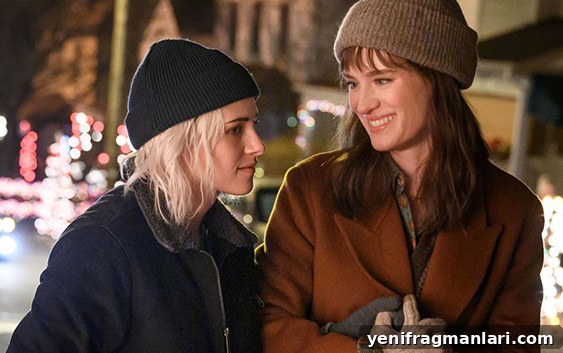
Happiest Season (2020)
Director: Clea DuVall
Screenwriters: Clea DuVall, Mary Holland
Starring: Kristen Stewart, Mackenzie Davis, Alison Brie, Aubrey Plaza, Dan Levy, Mary Holland, Victor Garber, Mary Steenburgen
Happiest Season arrives as one of the more prominent mainstream attempts to centre a same-sex couple within the familiar framework of a holiday romantic comedy. Directed and co-written by Clea DuVall, the film pairs Kristen Stewart and Mackenzie Davis in a story that combines seasonal cheer with the fraught emotional terrain of coming out to family. While the premise promises warmth and representation, the execution produces mixed results: the film offers genuine holiday charm in spots, but it also relies on problematic character choices and an uneven tone that undermine its best intentions.
The film introduces us to Harper (Mackenzie Davis) and Abby (Kristen Stewart) during an affectionate winter stroll. Harper is a devoted Christmas enthusiast; Abby, marked by the grief of losing both parents, is understandably less invested. Harper invites Abby to spend the holiday season with her family, setting up the classic “meet the family” holiday arc. The complication — Harper is not publicly out to her conservative family — is the film’s central conflict. That premise could have provided an insightful examination of identity, authenticity, and family dynamics, but in practice it sometimes lets its lead off the hook for choices that feel emotionally unfair to Abby.
One of the film’s biggest weaknesses is how it treats Harper’s secrecy. Rather than portraying a nuanced, private struggle, the plot too often frames Harper’s decision to hide her relationship as an excuse for hurtful behavior: omissions, evasions and scenes where Abby is asked to conceal her identity. That dynamic leads to repeated moments where Abby is sidelined or publicly embarrassed, and the screenplay does not always hold Harper accountable in a way that feels satisfying. As a result, the audience can end up sympathizing more with Abby’s frustration than with the strain Harper is experiencing, and the emotional balance of the film tips toward resentment rather than empathy.
Compounding the issue is a lack of sustained chemistry between the central couple. Stewart and Davis are both capable actors, but their relationship onscreen lacks the warmth and spark necessary to convince viewers that this is a partnership worth rooting for through difficult moments. By contrast, Aubrey Plaza — as Harper’s former girlfriend Riley — shares a natural rapport with Stewart that creates some of the film’s liveliest scenes. Alison Brie’s Sloane and Mary Steenburgen’s poised matriarch command screen presence as written, though Steenburgen’s character is positioned largely as an obstacle rather than as a complex figure. Dan Levy offers comic relief and a tender, grounded support for Abby, and Mary Holland’s Jane (also a co-writer) emerges as the film’s moral center: kind, earnest and invested in the happiness of others.
Comparisons to earlier LGBTQ+ holiday films are inevitable. The conceit of pretending a partner is a friend while visiting family appears in prior titles, and this film’s treatment differs in tone and consequence. Where some predecessors frame secrecy as a temporary protection that is handled with mutual respect, Happiest Season sometimes allows secrecy to become a weaponized avoidance that damages intimacy. This choice shapes the movie’s three main thematic problems: it risks suggesting that partners must endure poor treatment from closeted loved ones; it implies that coming out is a singular watershed that will automatically resolve personal turmoil; and it focuses too narrowly on the spectacle of coming out to parents, when coming out more often happens gradually and in many contexts.
That said, the film is not without virtues. Its seasonal set pieces and visual design capture holiday coziness effectively. Supporting performances — particularly Holland’s Jane and Levy’s comic warmth — provide human moments that land emotionally. The screenplay offers clever beats, small acts of kindness, and a few genuinely funny exchanges that recall classic holiday rom-com rhythms. These elements make the film intermittently enjoyable, even if the central relationship struggles prevent it from fully satisfying.
For viewers seeking a festive movie with LGBTQ+ lead characters, Happiest Season is a noteworthy mainstream attempt, but it is also a reminder that representation alone is not enough. Storytelling choices matter: how characters are treated, and how their flaws are addressed, shape the social messages a film sends. In this case, the film’s emphasis on secrecy and the emotional toll placed on Abby create a tension between intention and impact. While the movie offers moments of levity and warmth, it falls short of becoming a modern holiday classic or a definitive holiday statement about coming out.
12/24