
The Royal Tenenbaums (2001) — A Review
Director: Wes Anderson
Screenwriters: Wes Anderson, Owen Wilson
Starring: Gene Hackman, Anjelica Huston, Gwyneth Paltrow, Ben Stiller, Luke Wilson, Owen Wilson, Bill Murray, Danny Glover
After the breakout acclaim of Rushmore, Wes Anderson followed with The Royal Tenenbaums, a film that helped define his singular voice and cemented his reputation for meticulously composed visuals, offbeat characters, and bittersweet comedy. Released in 2001, the film brought Anderson’s signature aesthetic and narrative sensibility to a broader stage and earned him and co-writer Owen Wilson an Academy Award nomination for Best Original Screenplay. Over the years it has only grown in stature among critics and audiences alike.
The Royal Tenenbaums focuses on a dysfunctional, vividly drawn family. Royal Tenenbaum (Gene Hackman) is an impulsive patriarch who returns to the lives of his estranged family after many years away. His children — Richie (Luke Wilson), a former tennis prodigy; Chas (Ben Stiller), a protective entrepreneur; and Margot (Gwyneth Paltrow), a secretive playwright — are all living with the emotional fallout of their parents’ fractured household. Anderson assembles an ensemble cast that delivers the film’s idiosyncratic dialogue and strange tenderness with remarkable ease, supported by memorable turns from Bill Murray, Danny Glover, and Owen Wilson.
Gene Hackman is a standout, playing Royal with a weary charm that alternates between scoundrel and sentimentalist. His chemistry with the rest of the cast—particularly Ben Stiller and Danny Glover—anchors the film’s emotional currents. Rather than feeling overcrowded, the ensemble is balanced: Anderson gives each character enough room to reveal quirks and vulnerabilities, creating a tapestry of oddly sympathetic misfits.
One of the film’s strengths lies in its ability to blend whimsy and sorrow. Anderson’s dialogue, often deadpan and precise, finds humor in the characters’ pain while maintaining a sincere affection for them. The narrative slowly shifts from ridicule and distance to a softer recognition of the characters’ weaknesses and their need for one another. That emotional arc—Royal’s awkward attempts at reconciliation and the siblings’ gradual, believable thaw—remains the movie’s warm center.
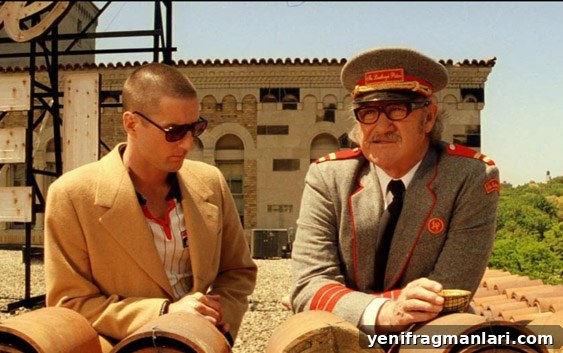
Visually, The Royal Tenenbaums is quintessential Wes Anderson. Cinematographer Robert Yeoman crafts a world that feels like a living pop-up book: symmetrical compositions, saturated palettes, and carefully chosen period details combine to form an immediately recognizable visual language. Costumes and production design reinforce the film’s stylized reality, where every frame feels intentionally arranged and every set piece contributes to mood and character.
Music is another essential element. Anderson’s use of needle drops—classic tracks from the 1960s and 1970s—adds emotional texture and helps to define character moments. Songs are chosen with a light but deliberate touch, often underscoring scenes with ironic counterpoint or nostalgic resonance, and contributing to the film’s distinctive tone.
Thematically, the film explores aging, regret, and the fragile need for connection. Where Rushmore examined adolescence and identity, The Royal Tenenbaums turns its attention to the failures and small redemptions of adulthood. Unconventional relationships—between fathers and sons, siblings, and unlikely friends—recur throughout Anderson’s work, and here they are treated with a mix of humor, melancholy, and tenderness that feels both stylized and deeply human.
Pacing is lively and brisk; the story moves with an energetic, almost literary momentum, folding in eccentric episodes without losing sight of the emotional through-line. Anderson’s screenplay balances eccentricity and pathos, allowing characters to be both comic and heartbreakingly real.
More than two decades after its debut, The Royal Tenenbaums still stands as one of Wes Anderson’s most beloved films. It showcases his growing command of visual storytelling, his gift for casting and directing an ensemble, and his ability to mix the whimsical with the poignant. For viewers who appreciate carefully crafted films that marry style with sincere emotion, The Royal Tenenbaums remains essential viewing.
Rating: 20/24