
My Octopus Teacher (2020)
Directors: Pippa Ehrlich, James Reed
Screenwriters: Pippa Ehrlich, James Reed
Starring: Craig Foster, Tom Foster
Wildlife documentaries remain one of the most enduringly popular genres in film and television. From high-profile nature series to unexpected viral sensations, audiences repeatedly return to stories that bring the natural world close to home. My Octopus Teacher, directed and written by Pippa Ehrlich and James Reed, taps into that same hunger. The film centers on Craig Foster, a South African filmmaker and freediver, and the unusual bond he forms with a wild common octopus in the kelp forests of False Bay.
The film opens by establishing Foster’s lifelong connection to the sea. Raised on the Cape of Storms, he spent his childhood exploring tidal pools and kelp forests—an upbringing that shaped his career as a wildlife filmmaker. That background informs the film’s visuals and emotional core: a man who knows the ocean intimately returns to it at a pivotal moment in his life.
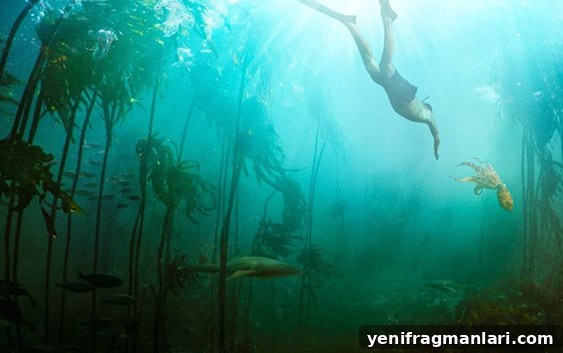
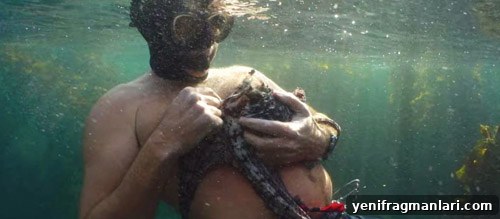
Struggling with a depressive episode that affected his family life and his relationship with his son Tom, Foster chose to return to freediving as a form of recovery. During repeated dives in the kelp, he discovers an octopus hiding beneath a pile of shells and rocks. Fascinated, he begins to visit the animal nearly every day, observing its behavior and gradually developing a close, nearly intimate rapport. The resulting footage and Foster’s reflective narration form the backbone of the film.
Unlike many nature documentaries that prioritize scientific exposition, My Octopus Teacher leans heavily into personal reflection and emotional resonance. Foster’s voiceover is intimate and often confessional, focusing less on technical biology and more on the psychological and spiritual impact of his encounters with the octopus. That narrative choice gives the film a dramatic intensity that sets it apart from more detached, observational wildlife films. Moments of predator-prey interaction and the octopus’s survival strategies become deeply affecting because they are filtered through Foster’s subjective experience.
However, the film’s emphasis on emotion over rigorous science has drawn criticism. Much of the biological information—such as the octopus’s intelligence and problem-solving abilities—is familiar to viewers who follow animal behavior. Some sequences presented as novel or revelatory, including the octopus’s use of shells and rocks for defense, are not entirely unprecedented; similar behaviors have appeared in prior nature programming, including coverage in established series. This raises questions about how the film balances fresh insight with familiar facts and how it frames the significance of what it documents.
There are also concerns about perspective and authorship. Foster is both the central subject of the story and a professional wildlife filmmaker, while Ehrlich and Reed direct and shape how his experience is presented. That arrangement invites discussion about documentary objectivity and editorial influence: how much of the narrative is an authentic record of events, and how much is crafted for emotional effect? The film does not pretend to be a purely scientific study; instead it positions itself as a personal odyssey, which will satisfy viewers looking for empathy-driven storytelling but may frustrate those seeking strict empirical depth.
Another ethical question the film raises is the nature of human-animal relationships. Foster’s sustained interactions with a wild octopus are presented as meaningful and transformative for him, and the project did contribute to positive outcomes such as the creation of the Sea Change Project. Still, the film can encourage the romantic idea that close bonds between humans and wild animals are easily replicable, an impression that may have unintended consequences when audiences try to emulate such interactions.
Despite these criticisms, the film delivers powerful audiovisual rewards. The underwater cinematography captures the alien beauty of kelp forests and the intricate movements of marine life, producing moments of genuine wonder. Foster’s emotional honesty, combined with striking footage of the octopus’s behavior, gives the film a hypnotic quality that resonates with many viewers. For those drawn to ocean-based stories and contemplative, character-driven documentaries, My Octopus Teacher offers a moving experience.
Ultimately, My Octopus Teacher is a hybrid: part nature documentary, part personal memoir. It excels at evoking intimacy with the natural world and portraying how an encounter with a wild animal can catalyze personal change. Yet its narrative choices—prioritizing emotion over exhaustive scientific context and centering the human protagonist—mean it will be more appreciated by audiences seeking heartfelt storytelling than by those expecting a purely scientific account. The film’s visual beauty and emotional candor are its greatest strengths, even as they prompt important conversations about documentary ethics and the portrayal of wildlife.
10/24