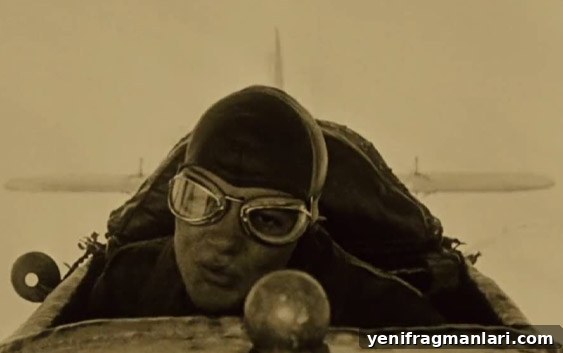
Wings (1927)
Director: William A. Wellman
Screenwriters: John Monk Saunders, Hope Loring, Louis D. Lighton
Starring: Clara Bow, Charles ‘Buddy’ Rogers, Richard Arlen, Jobyna Ralston, El Brendel, Richard Tucker, Gary Cooper
Wings stands as a landmark of early cinema: a silent-era spectacle that not only captured audiences with its daring aerial sequences but also earned the distinction of being the first film to receive the Academy Award for Best Picture in 1929. Set during the First World War, the film follows two young Americans—one from wealth (David, played by Richard Arlen) and one from a working-class background (Jack, played by Charles “Buddy” Rogers)—whose friendship, rivalry, and shared experience as pilots propel the story through both romance and combat.
At first, the film shows its age. The direction can feel stiff in places and the early pacing is tentative, with some conventional plotting that takes time to warm up. Title cards often state what the images already make clear, and a few tender moments are undercut by melodramatic exposition. Yet as the film progresses, the production finds its rhythm. The camera work loosens, scenes gain fluidity, and the narrative begins to ride the momentum of its best strengths: spectacle, sincerity, and visual storytelling that makes the most of silent cinema’s expressive potential.
The aerial photography is where Wings remains most impressive. The dogfights and aerial maneuvers were filmed with a level of realism rare for the era—actual aircraft in the sky, daring stunts, and inventive camera placements that convey velocity and peril. Close shots of spinning planes, trailing smoke, and aircraft descending in spirals immerse the viewer in the mechanics and danger of early aerial combat. Miniatures and staged explosions on the ground complement the real flying sequences, creating battle scenes that feel immediate and visceral rather than staged or artificial.
Harry Perry’s cinematography is a standout element throughout. His lens captures both the intimate human moments and the epic scale of war: the cramped cockpits, the camaraderie among pilots, and the wide tableaux of battlefields littered with extras and practical effects. These choices lend the film a textured realism—explosions sending earth into the air, crowds of soldiers in motion—that no modern green-screen shortcut can wholly replace.
Where the film falters is in its handling of romance and certain structural choices. The love triangle—with Jack and David both linked, at different times, to Sylvia (Jobyna Ralston) and Jack’s hometown sweetheart Mary (Clara Bow)—creates predictability and sometimes dilutes the emotional core. Sylvia functions mostly as a plot device, and a long sequence devoted to Mary’s efforts to reach an indifferent Jack slows the film’s momentum. The central emotional bond should ideally be the comradeship forged between the pilots, and in places that stronger, more concise writing would have served the drama better.
Despite these flaws, Wings offers memorable performances and moments of true cinematic bravery. Clara Bow and the supporting cast contribute solid character work, while the leading men convey the rivalry and loyalty that drive much of the film’s poignancy. The film’s mix of technical achievement and human drama explains why it has held a place in film history: even when it stumbles, it does so with ambition and a clear vision of spectacle rooted in human stakes.
For viewers interested in silent-era filmmaking, aviation cinema, or the evolution of cinematic craft, Wings rewards close attention. It demonstrates how filmmakers of the 1920s pushed practical effects, aerial photography, and large-scale staging to create immersive experiences. The movie is not flawless—its pacing and occasional reliance on title-card exposition date it—but the breathtaking aerial sequences and the emotional core of friendship and sacrifice keep it compelling.
In short, Wings is both an important historical milestone and an entertaining film in its own right: technically ambitious, at times thrilling, and ultimately human in its focus. It may not be uniformly polished, but when it soars, it does so spectacularly.
17/24