
The Hunchback of Notre Dame (1996)
Directors: Gary Trousdale, Kirk Wise
Screenwriters: Tab Murphy, Irene Mecchi, Bob Tzudiker, Noni White, Jonathan Roberts
Starring: Tom Hulce, Demi Moore, Tony Jay, Kevin Kline, Paul Kandel, Jason Alexander, Charles Kimbrough, Mary Wickes, David Ogden Stiers
The story of Victor Hugo’s Notre-Dame de Paris has inspired countless adaptations since the novel’s first publication. Disney’s animated musical adaptation, The Hunchback of Notre Dame (1996), remains one of the most memorable interpretations, notable for its ambition, dark themes, and formidable musical score. The film attempts to balance a sweeping, serious narrative with family-friendly animation, producing a unique and often polarizing entry in the Disney Renaissance.
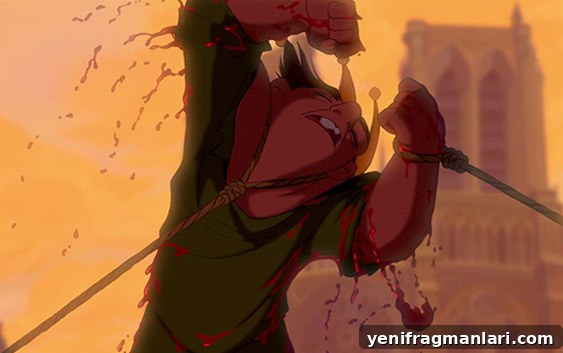
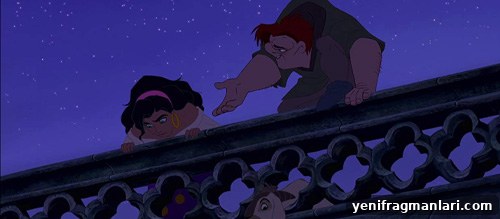
Set in 15th-century Paris, the film follows Quasimodo (voice of Tom Hulce), the deformed bell ringer who has lived his life hidden within the towers and vaults of Notre Dame Cathedral. Raised and confined by his guardian, the fanatical Judge Claude Frollo (Tony Jay), Quasimodo yearns to experience the outside world. During the city’s Feast of Fools, he ventures into the streets and meets Esmeralda (Demi Moore), a compassionate and spirited gypsy woman who treats him with kindness. That encounter sparks Quasimodo’s desires for freedom and belonging, while also drawing the obsessive attention of Frollo, whose brutal campaign against the Romani people and consuming lust for Esmeralda drive the film’s central conflict.
The film’s technical achievements are among its most impressive features. Disney developed a new crowd-simulation program, internally called “Crowd,” to populate Medieval Paris with bustling, individually animated citizens. This innovation gives large-scale sequences—most notably the Feast of Fools and the climactic siege of Notre Dame—an unprecedented depth and dynamism for animated features of the era. Camera moves, layering, and background detail combine to create a vivid sense of place and scale that supports the story’s emotional stakes.
Source material and character choices
Disney’s adaptation takes clear inspiration from earlier cinematic versions, particularly the 1939 Charles Laughton film, which influenced Quasimodo’s physical presence and the decision to cast Frollo as a secular judge rather than an archbishop. That characterization of Frollo as an amoral, self-righteous magistrate amplifies the film’s themes of hypocrisy, power, and moral corruption. Frollo’s menace comes less from supernatural evil than from the terrifying plausibility of a powerful man convinced he is carrying out divine justice while committing horrific acts in the name of righteousness.
Tonal tension and the gargoyles
One of the film’s most debated choices is the inclusion of three talking gargoyles who befriend Quasimodo and provide much of the comic relief. While the gargoyles give Quasimodo confidants and moments of levity, their broad, cartoonish humor contrasts sharply with scenes of attempted infanticide, torture, public humiliation, and ethnic persecution. That tonal oscillation—between grim melodrama and slapstick comedy—remains a defining and sometimes jarring element of the film.
Music and emotional core
Alan Menken’s score, with lyrics by Stephen Schwartz, gives the film its emotional weight. The soundtrack blends operatic grandeur and intimate humanity. Songs such as Quasimodo’s “Out There” and Esmeralda’s “God Help the Outcasts” articulate yearning and compassion, while Frollo’s “Hellfire” stands out as one of Disney’s darkest and most psychologically complex villain numbers. The music amplifies the movie’s thematic concerns—sin, desire, exclusion, and redemption—often elevating scenes beyond what animation alone might convey.
Criticism, legacy, and modern perspective
At release, the film divided critics and audiences. Its darker material challenged expectations for a family-oriented animated musical, while some elements—particularly the portrayal of Romani culture and the sexualization of Esmeralda—drew valid criticism then and continue to feel problematic today. Despite these shortcomings, many viewers and critics acknowledge the film’s artistic strengths: the striking visual design, the ambitious musical moments, and the willingness to confront weighty moral themes within an animated format.
Ultimately, The Hunchback of Notre Dame stands as one of the more daring entries of the Disney Renaissance. It is imperfect and uneven, but its technical innovation, memorable performances, and powerful score secure its place as a film that still provokes discussion and emotional response decades after its premiere. For those who appreciate animation that takes risks and tackles complex subject matter, this adaptation remains compelling and resonant.
20/24