
Nope (2022) Review
Director: Jordan Peele
Screenwriter: Jordan Peele
Starring: Daniel Kaluuya, Keke Palmer, Steven Yeun, Brandon Perea, Michael Wincott, Wren Schmidt, Kieth David, Terry Notary, Jacob Kim
Jordan Peele’s third feature, Nope, arrives after a long, tightly controlled marketing campaign that offered little more than a mysterious poster and brief teasers. That deliberate secrecy pays off: this film resists easy categorization and unfolds in unexpected ways. At once a science-fiction suspense movie, a character-driven drama, and an exploration of spectacle, Nope rewards viewers who approach it without preconceived notions.
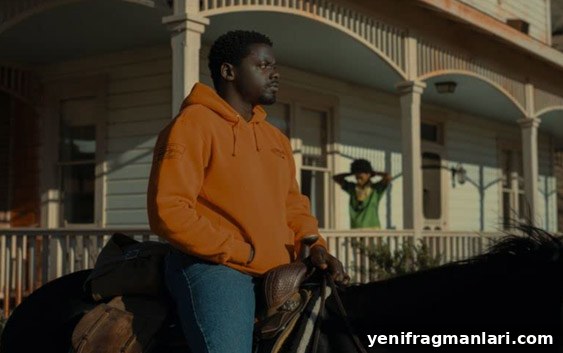
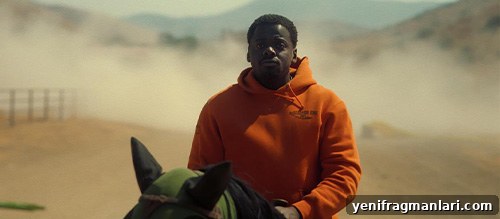
The story centers on siblings OJ and Emerald Haywood (Daniel Kaluuya and Keke Palmer), who run a horse-training ranch outside Hollywood following the sudden death of their father. Strange events begin to occur on their property, suggesting the presence of something not of this world. Determined to document conclusive proof, the Haywoods enlist the help of Angel (Brandon Perea), an eager tech specialist, and Antlers Holst (Michael Wincott), an idiosyncratic cinematographer with a taste for spectacle. Together they attempt to capture definitive evidence that we are not alone.
Peele frames the Haywoods’ story against a history of erased contributions to early cinema. The film opens by referencing the first moving image of a Black man on horseback—an omitted detail in film history—and positions Otis Haywood (Kieth David) and his family as inheritors of that legacy. Their connection to horses and to Hollywood’s behind-the-scenes labor is central to both the plot and the film’s themes.
At its core, Nope explores two interrelated obsessions: the human appetite for spectacle and the dangerous consequences of looking directly at certain beings. Peele examines how people are drawn to astonishing images, often at the expense of their own safety or dignity. He also taps into ancient myths about monsters whose power is tied to being seen, suggesting that observation can itself be a form of vulnerability.
A key subplot involves a traumatic event from the 1990s, when a chimpanzee on a popular sitcom violently attacked its co-stars. The lone child survivor, who as a child was known as Jupe (Jacob Kim), grows up to be a showman played by Steven Yeun. Jupe capitalizes on his past and runs a Western-themed amusement park near the Haywood ranch, transforming personal trauma into a live spectacle for an entertainment-hungry public. This proximity binds Jupe’s ambitions to the Haywoods’ attempt to confront the unknown.

The film’s first half builds tension slowly, lingering on character and mood in a way that recalls classic encounter films. Peele gives ample screen time to each protagonist so their motivations and relationships feel earned; this investment pays off as stakes rise. Kaluuya and Palmer deliver warm, convincing performances as siblings who argue and care like real family members, while Wincott’s eccentric Antlers provides memorable, oddly comic flourishes that break the tension at key moments.
In its second half, the film shifts into a more pulsing, creature-feature mode reminiscent of big-animal thrillers. Instead of the open ocean of Jaws, Peele uses the vast California landscape and a disturbingly still cloud to create menace. The film’s antagonist—a flying, shape-shifting organism—unfolds visually over time, transforming from a familiar retro UFO silhouette into something stranger and more convincingly organic. Hoyte van Hoytema’s IMAX cinematography amplifies the scale, lending grandeur and an old-school cinematic sweep that complements the Haywoods’ Western roots.
Peele weaves in biblical, mythological, and cultural references throughout the script. An early pre-title biblical quote hints at judgement and spectacle, while other moments draw on classical ideas about monsters and the dangers of looking. In a modern twist, Peele interrogates how cameras have become the instruments through which people satisfy their curiosity, often substituting mediated images for direct experience. That theme—our faith in captured images and the hunger for proof—turns the camera itself into a central symbol.
In the context of recent thoughtful science-fiction films that prioritize atmosphere and idea—works such as The Vast of Night, Resolution, and The Endless—Nope distinguishes itself through scale and technical ambition. With a reported $68 million budget, the film makes full use of its resources without ever feeling frivolous. It combines intimate character work with striking set pieces and effects, creating a film that is both thoughtful and thrilling.
While Nope may not deliver the visceral jolt of Peele’s debut Get Out or the shocking intensity of Us, it unfolds with quiet, accumulating power. The film grows stronger on repeat viewings, revealing layers in its thematic concerns and visual design. Peele demonstrates both his versatility and his commitment to character-driven storytelling. He balances original ideas about spectacle and observation with a cinematic bravura that often evokes classic filmmakers while remaining distinctly his own voice.
Score: 22/24