
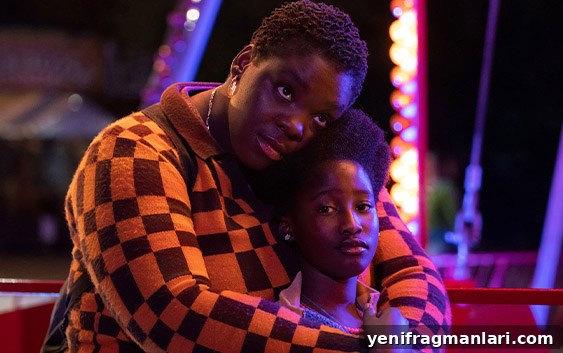

Girl (2023)
Director: Adura Onashile
Screenwriter: Adura Onashile
Starring: Déborah Lukumuena, Le’Shantey Bonsu, Liana Turner, Danny Sapani
Adura Onashile’s debut feature, Girl, premiered at the Sundance Film Festival and later opened the 2023 Glasgow Film Festival. Set in Glasgow, where the film had its UK premiere, Girl centers on Grace (Déborah Lukumuena), a migrant mother living with severe trauma, and her young daughter Ama (Le’Shantey Bonsu). Their intense, co-dependent relationship is tested when Ama begins returning to school and encounters life beyond her mother’s protective world.
Onashile arrived in film after a strong track record in theatre and after acclaim for her short film Expensive Shit, which won both audience and critics’ awards at Glasgow in 2020. That theatrical experience is apparent in some of the film’s strengths—particularly in moments of intimacy and character intimacy—but the transition to feature filmmaking exposes weaknesses in staging, framing and editing that undermine the story’s emotional potential.
Girl opens with striking, intimate imagery that establishes Grace and Ama’s closeness: they share a bed, bathe together, and inhabit a fairy-tale universe that Grace constructs for her daughter. Early scenes illustrate how Grace spins stories to keep Ama close, such as a fable about how Ama came to her after a wish at a well. These moments provide an intriguing glimpse into Grace’s attempts to protect and shape Ama’s perception of the world.
However, the screenplay relies on broad strokes rather than concrete detail, and important elements of backstory and cultural identity remain underdeveloped. By focusing almost exclusively on behaviour and surface actions, the film risks flattening its central character into a single archetype: mother-as-victim. This reduction weakens the film’s capacity to make Grace’s trauma feel fully human and complex, which blunts the intended emotional impact of her PTSD and protective instincts.
The film’s secondary characters are similarly underwritten. Care workers, teachers and neighbours often appear as narrative conveniences or caricatures rather than fully formed people, and their reactions frequently feel implausible. For example, a scene in which Grace asks a teacher about her missing daughter plays out with a troubling lack of empathy or practical response, a choice that could have been a deliberate commentary on institutional neglect but instead reads as a shortcoming in characterization.

Where Girl finds its clearest emotional footing is through Ama. Le’Shantey Bonsu gives a quietly engaging performance: her wide-eyed curiosity and yearning to explore the wider world anchor many of the film’s best moments. Scenes of friendship between Ama and her schoolmate Fiona (Liana Turner) feel honest and compelling once their chemistry settles, and they reveal what the film does when it allows a child’s perspective to lead. Those sequences offer warmth and a believable sense of discovery—qualities the rest of the film sometimes struggles to sustain.
Structurally, the film feels uneven. The screenplay unfolds in distinct thirds that often read like separate short films, each with its own beginning, middle and end. This segmented approach creates pacing problems and leaves some scenes feeling abrupt or disconnected from the film’s overall arc. When Girl reaches its climax, the payoff lacks the sense of inevitability that good structure provides; many plot points close without feeling fully earned, leaving the viewer unsettled rather than moved.
Technical choices occasionally undercut the narrative. Awkward staging and some jarring edits distract from performances and dilute emotional beats. These filmmaking issues would be easier to forgive were the characters more fully realized or if the script offered clearer motivations and texture. As it stands, the combination of uneven writing and tentative direction prevents the movie from consistently delivering the impact its premise promises.
Despite these flaws, Girl shows the promise of a filmmaker with a strong theatrical voice and a keen interest in intimate human stories. Onashile’s writing demonstrates empathy and an eye for detail in moments, and the central performance by Bonsu is a highlight. With more experience in film storytelling—refining structure, deepening character detail and tightening cinematic technique—Onashile could turn her theatrical strengths into equally powerful cinema.
In summary, Girl contains moments of tenderness and solid performances, especially from its young lead, but is held back by thin character development, uneven pacing and technical inconsistencies. It is a debut with worthwhile ideas that need more precise execution to reach their full emotional effect.
Score: 5/24