Priscilla (2023)
Director: Sofia Coppola
Screenwriter: Sofia Coppola
Starring: Cailee Spaeny, Jacob Elordi, Ari Cohen, Dagmara Dominczyk
Following in the wake of Baz Luhrmann’s lavish Elvis biopic, Sofia Coppola’s Priscilla might at first seem destined to play second fiddle. Luhrmann’s film was a grand, unrestrained spectacle that mapped Elvis Presley’s life in operatic strokes. Coppola takes a very different approach: instead of competing with scale and flash, she narrows the lens to tell Priscilla Presley’s side of the story. The result is not a retread but a complementary portrait that reframes the myth of Elvis through intimacy, restraint, and a focus on a woman who has often been defined by someone else’s legend.
The film opens with the improbable, almost storybook meeting of a fourteen-year-old Priscilla (Cailee Spaeny) and a young Elvis (Jacob Elordi) at a party in West Germany. Their connection is immediate: two lonely people craving a return to home and belonging. Elvis becomes the center of Priscilla’s world — he courts her, comforts her, and promises escape. When his military service ends and he returns to the United States to resume life as a superstar, Priscilla follows, finishing her education stateside and stepping into a new reality filled with privilege, visibility, and constraint.
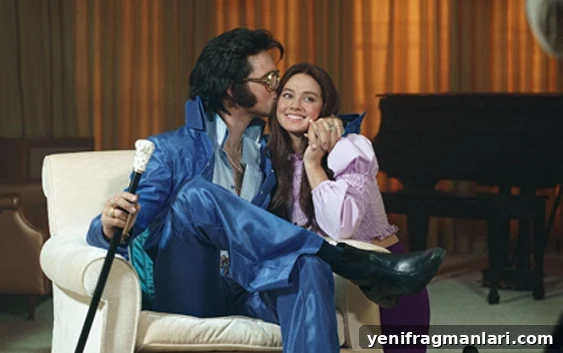
Coppola’s film traces the transition from infatuation to confinement. The early romance feels like a dream, full of whispered conversations, stolen moments, and the exhilaration of being chosen. But once Priscilla arrives at Graceland, the romance shifts. Elvis’s charisma remains, but Coppola peels back the performative layers to reveal a more complicated, sometimes controlling figure. Small decisions about Priscilla’s appearance and behavior, tantrums over perceived slights, and the looming threat of withdrawal of love reveal a relationship built on fragile power dynamics. Coppola does not sanitize Elvis’s faults; she presents them plainly, letting the consequences fall where they may.
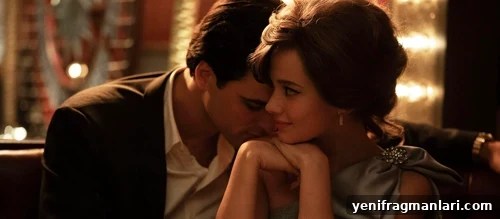
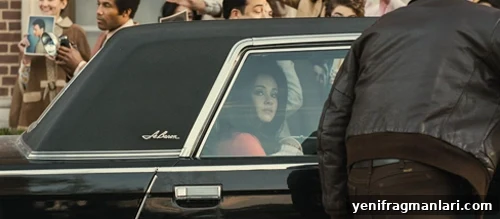
Stylistically, the film is unmistakably Coppola. Her precise visual sensibility permeates every frame: costumes, sets, and props cohere into a meticulously realized world. Graceland is sumptuous and tactile — an environment that both pampers and isolates. Cinematographer Philippe Le Sourd’s camera often stays close to Priscilla, emphasizing the modest, claustrophobic scale of her experience amid opulence. At moments when Elvis’s life pulls away — tour buses disappearing into the distance, crowds gathering at the edges of frames — the film underscores how absence can become as dominant as presence.
Jacob Elordi’s portrayal is deliberately muted. Rather than leaning into pastiches of a famous persona, he offers a quieter, more human depiction: charming but volatile, wounded and demanding. This restraint serves Coppola’s intent; by dialing down Elvis’s larger-than-life star quality, the film re-centers Priscilla and the ways she is shaped by and struggles within their relationship.
Cailee Spaeny’s performance anchors the film. Casting a relative newcomer allows the audience to meet Priscilla without preconceptions. Spaeny brings vulnerability and gradual strength to the role: at once naive, fiercely devoted, and ultimately confronted with the personal cost of love and assimilation into a celebrity world. The physical contrast between Spaeny and Elordi subtly highlights the age and power imbalance at the heart of their relationship, a tension Coppola lets simmer rather than sensationalize.
Beyond romance, Coppola’s film examines identity and the pressures placed on women to conform. Hair, clothing, and appearance in the film become symbolic of who Priscilla is allowed to be. Early scenes show a tightly controlled, restrained girl; later, as she negotiates her place in the world, her look relaxes and shifts, marking slow but meaningful changes in selfhood. Coppola’s ongoing exploration of female interiority — how women are defined by and resist the expectations placed on them — is central to the film’s emotional core.
In the end, Priscilla complements other cinematic takes on Elvis by offering a patient, interior counterpoint. It resists spectacle in favor of nuance, placing a woman’s perspective at the center and inviting viewers to reconsider the stories we inherit about fame, love, and agency. Sofia Coppola’s film is an intimate, thoughtful study that reclaims Priscilla’s voice while illuminating the complex human realities behind celebrity.
Score: 19/24
Rating: 4 out of 5.