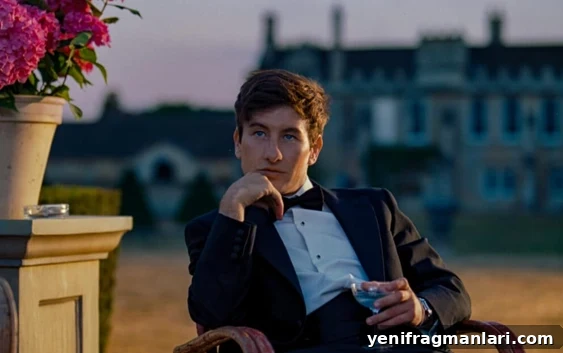

Saltburn (2023)
Director: Emerald Fennell
Screenwriter: Emerald Fennell
Starring: Barry Keoghan, Jacob Elordi, Rosamund Pike, Richard E. Grant, Alison Oliver, Archie Madekwe, Carey Mulligan
Emerald Fennell announced herself as a daring and original filmmaker with her debut feature, Promising Young Woman (2020). That film combined confectionary pop aesthetics with sharp social critique and a willingness to provoke difficult conversations. With Saltburn, her follow-up, Fennell returns with another bold tonal experiment: a seductive, slyly satirical study of privilege, desire and social performance. The result expands on her strengths—stylish direction, dark humor and moral ambiguity—while presenting a new, unsettling portrait of an insular elite.
Saltburn begins at the start of the 2006–2007 academic year, when Oliver Quick (Barry Keoghan) arrives at Oxford. An awkward, observant outsider, Ollie struggles initially to connect. He soon falls under the spell of the charismatic and aristocratic Felix Catton (Jacob Elordi). When Felix invites him to spend the summer at the Catton family estate, Saltburn, Ollie is drawn into a glittering, eccentric world that feels both intoxicating and toxic.
Fennell’s visual choices immediately set the tone. The film’s title appears scrawled across a 4:3 frame, a gesture that evokes adolescent scribbles on a schoolbook and subtly reminds viewers that many of the characters remain emotionally adolescent despite their wealth and status. This sense of arrested development is part of the film’s bite: these are people who wield real power yet behave like playground bullies, keeping scores, nursing slights and flouting rules they expect others to obey.
Saltburn’s central household is populated by a vividly drawn cast: the garrulous patriarch Sir James (Richard E. Grant), the decorous and aloof Elsbeth (Rosamund Pike), Felix’s alluring sister Venetia (Alison Oliver), and the mischievous cousin Farleigh (Archie Madekwe), who plays the jester to the family’s foibles. Carey Mulligan appears as Pamela, a melancholic and ostentatiously fragile figure whose presence adds a layer of tragicomic pathos. Each performer finds a precise tonal balance—many moments are uproariously funny, yet the humor often contains a darker edge that reveals the moral rot beneath the surface glamour.
The film quickly establishes the social dynamics of its world: pedigree and name outweigh effort and merit. Early scenes—such as Oliver’s awkward first meeting with his tutor—underline how status trumps diligence. Farleigh’s late arrival and unearned privileges contrast sharply with Oliver’s earnestness, and such contrasts drive much of the film’s tension. Felix himself embodies this contradiction: spoiled and entitled, yet capable of genuine kindness and vulnerability. Jacob Elordi gives Felix a layered portrait, mixing charm, volatility and a childlike entitlement that remains unpredictable.
Fennell’s camera treats the Saltburn estate almost as a character. Lavish interiors and long, lingering shots fetishize the house’s beauty while also making its allure comprehensible: this place seduces by design. Production design and cinematography work in concert to show why someone like Ollie might fall under the family’s spell and then find leaving nearly impossible. The film uses this seduction to interrogate desire—how it shapes choices and corrodes morals when people pursue what they want at any cost.
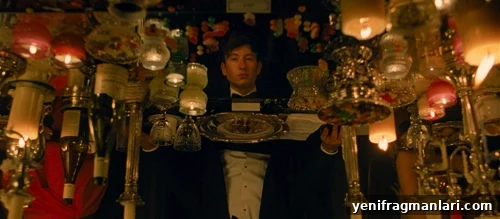
Saltburn does not reduce its characters to mere types; instead it animates them as complex, often contradictory humans. Felix is both obnoxious and thoughtful; the Cattons are monstrous and pitiable in equal measure. This refusal to simplify makes the film more unsettling: it’s easier to laugh at or loathe a caricature, but when a character is rendered in full, with glimpses of kindness and cruelty, the moral landscape becomes more ambiguous and therefore more compelling.
Above all, the film rests on Barry Keoghan’s performance. As Oliver, Keoghan navigates a transformation that moves from shy observer to a figure who understands how power and desire play out within this class. His portrayal captures small, physical shifts, subtle recalibrations of posture and expression that trace Oliver’s internal evolution. By the film’s end, the character’s arc feels fully realized: the final incarnation of Oliver lingers in the mind as a testament to Keoghan’s control and range.
Saltburn’s themes will land differently depending on the viewer. Some will respond more to its critique of privilege, others to its study of obsession and social mimicry. Structurally and tonally, it is more indulgent and baroque than Fennell’s debut, but that ambition yields rewards: a film that is both playful and menacing, full of sharp social observation and moments of dark comedic brilliance.
In short, Saltburn is a seductive odyssey of lust, rivalry and betrayal that reads like a modern, adolescent tragedy—equal parts dark comedy and social satire. Emerald Fennell confirms her status as one of contemporary cinema’s most intriguing voices, delivering another memorable, provocative work that will spark conversation and remain visually and thematically memorable.
Score: 23/24
★★★★★